
Corporate Uniform Programs: Tendering, Sizing and Reorders
How to run a corporate uniform program with a factory: tender documents, sizing a workforce, producing many sizes in small batches, reorders and delivery.
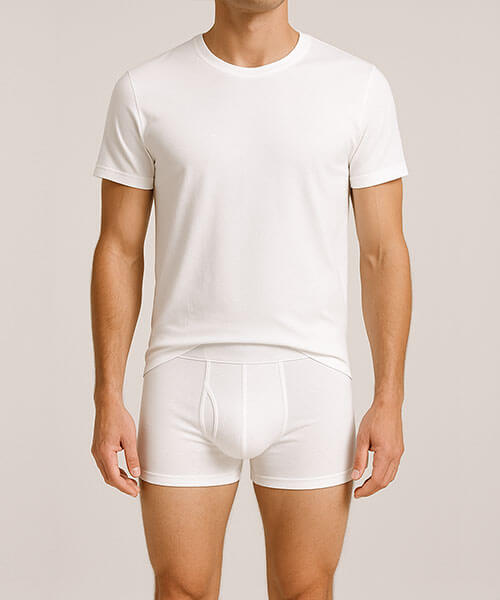
Answer first: A corporate uniform program is a supply contract, not a single order. It succeeds when four things are written down before production: a tender or request-for-quotation pack that specifies the garments, sizes, decoration, quality and delivery terms; a sizing method that turns a workforce into a size breakdown; a production plan that handles many sizes in small quantities without losing consistency; and a reorder mechanism that keeps the same specification for new starters and replacements over the life of the contract. Public-sector buyers also have to follow procurement law, which in the EU sets harmonised rules for tenders above value thresholds and in the UK is governed by the Procurement Act 2023. Garments that protect against workplace risks are personal protective equipment, which has its own EU regulation; plain knit basics such as T-shirts, polos and undershirts normally are not.
This article covers the knit layer of a uniform program: T-shirts, polos, undershirts and sweatshirts, which are the categories on Finetex’s published range. For the undershirt-specific view, see our B2B guide to undershirts for corporate uniforms.
The tender documents
Whether you are a public body running a formal tender or a company asking three suppliers to quote, the same documents make quotes comparable.
What the pack should contain
| Document | Content |
|---|---|
| Garment specification | Style, fabric composition and gsm, construction, colour standards, trims |
| Size chart and grading | Points of measure, tolerances, size range |
| Size breakdown | Forecast quantities per size and style for the first call-off |
| Decoration | Logo files, method (embroidery, print, woven label), placement per size |
| Quality and testing | Inspection level, test requirements (shrinkage, colour fastness, pilling) |
| Labelling and packing | Care and composition labels, individual packing, carton marks |
| Delivery | Locations, dates, split deliveries, Incoterm |
| Contract terms | Duration, price validity, reorder lead times, minimums per reorder |
| Supplier requirements | Audit reports, certificates, references |
A supplier who can only answer part of the pack is telling you something. Ask every bidder the same questions, in writing, and compare them line by line. Our method for comparing clothing factory quotes applies here.
Public-sector tenders
If the buyer is a public body, procurement law applies. The European Commission explains that the EU public procurement directives set minimum harmonised rules for tenders whose value exceeds certain thresholds, with core principles of transparency, equal treatment, open competition and sound procedural management; below the thresholds, national rules apply, still respecting general principles of EU law. In the UK, the Procurement Act 2023 governs public procurement, and the government publishes guidance documents for contracting authorities. Public buyers may also draw on the EU’s voluntary green public procurement criteria, which include a 2017 set for textile products and services.
As a supplier or a brand bidding with a factory, you do not run the procedure, but you must answer it. Read the award criteria and the mandatory requirements first; a well-priced bid that misses a mandatory document is excluded. Procurement rules are detailed and change; take advice from a procurement specialist where a public contract is involved.
Is it PPE?
Check whether any garment is intended to protect the wearer against a risk, such as high-visibility clothing or flame-resistant garments. The Commission’s personal protective equipment page explains that Regulation (EU) 2016/425 covers the design, manufacture and marketing of PPE, with CE marking as evidence of compliance, and warns that only notified bodies may issue certificates for harmonised products. Finetex’s published range does not include PPE; protective items in a uniform program need a supplier with the relevant certification.
Sizing a workforce
The size breakdown is the biggest risk in a uniform program, because the factory cuts to it.
Methods
- Self-reported sizes. Quick, but people often guess or choose by habit from other brands.
- Size-set try-on. Send a full size set to each site and have employees try on and record their size. Slower, but much more reliable. Finetex’s FAQ gives 10–12 working days for a graded size set.
- Body measurement. Measure employees at chest, waist and length and map them to the size chart. Most accurate, most effort; consider it for fitted styles.
Combine methods: try-on for most staff, measurement for people between sizes. Record results per site and role, because the size mix differs between, for example, a warehouse and an office. Our article on garment measurement points defines the points a size chart should use.
Size range
Uniform programs need a wider range than most retail lines, because everyone must be dressed. Finetex lists T-shirt sizes from XS to 4XL with custom grading, and undershirt sizes S–3XL with tall and extended sizes on request. Decide early whether you need a women’s or unisex block and tall or extended sizes; adding them later means a new pattern and a new size set.
Many sizes, small quantities
A uniform order often has hundreds of pieces spread over many sizes and several styles, with only a few pieces in the end sizes.
How it is produced
- Cut by size ratio. The cutting plan lays several sizes in one marker to use fabric efficiently. Very small end-size quantities may be cut together with other sizes or styles in the same fabric.
- Run on a line set up for the program. Finetex’s capabilities page states that lines are set up per programme rather than per style family, so several small programmes can run in the same week.
- Check every size. End sizes are where grading errors appear. Ask for first-output measurements on every size, not just the sample size; our article on the first-output check explains how.
- Respect minimums. Finetex’s FAQ gives 300 pieces per style on stock fabric with mixed sizes, and around 1,000 pieces per colour for a custom knit or dye lot. A uniform in a stock colour is easier to keep small than one in a custom brand colour.
Decoration across sizes
The logo is what makes a basic garment a uniform, and it is the part most often wrong on the end sizes.
- Placement per size. A chest logo positioned from the shoulder seam on a Medium can sit too low on a 3XL and too close to the armhole on an XS. Specify placement per size or per size group, measured from a fixed point such as the high point shoulder and centre front.
- Method per fabric. Embroidery on a lightweight jersey can pucker; a print on a stretch fabric needs an ink that stretches. Approve the method on the bulk fabric. Finetex’s T-shirt page states that print strike-offs are made on the production fabric and approved in writing before the run.
- Colour standards. Give Pantone or physical standards for thread and ink, and check them under the same light as the garment colour.
- Files and versions. Keep the approved logo files with the specification so reorders use the same artwork, not a newer marketing version.
- Wash test. Ask for decoration to be checked after washing to the care label, because a logo that cracks or fades fails the program even if the garment is fine.
Packing for distribution
Decide how garments arrive: bulk by size, kits per employee, or packs per site. Finetex’s private packaging page lists polybags, size stickers, barcode labelling, assortment and carton configuration to the buyer’s requirement. Write the packing rule in the tender, because repacking at your warehouse costs more than packing at the factory.
Reorders
Uniform programs live on reorders: new starters, replacements and size exchanges.
Keep the specification frozen
The second order must match the first. That needs an approved sample and specification under version control, the same fabric standard and shade, and the same decoration files. Finetex states on its quality control page that retained samples are kept for every approved specification, and its FAQ says repeat orders on an approved block usually run at the faster end of the 15–45 day bulk lead time.
Plan the reorder rhythm
- Hold a buffer for new starters and exchanges, sized on your own staff turnover. Decide who holds it: you, a distributor or the supplier.
- Agree a reorder minimum and lead time in the contract, per style and colour.
- Reorder core sizes on a schedule rather than on emergencies. Finetex’s capabilities page describes a rolling three-month plan with roughly 20% of line time kept for new programmes and reorders.
- Check colour continuity. A new dye lot can differ; see our Talk answer on reordering the same colour from a different dye lot.
Our article on selling wholesale to retailers covers vendor set-up if a distributor sits between you and the end customer.
Delivery
Uniforms have fixed start dates: a store opening, a new contract, a rebrand. Plan backwards.
| Stage | Published Finetex timing |
|---|---|
| Development sample | 5–7 working days after artwork and fabric are confirmed |
| Graded size set | 10–12 working days |
| Bulk production | 15–45 days from deposit and approved pre-production sample |
| Sea freight to Rotterdam / Hamburg | 26–34 days |
| Air freight to Rotterdam / Hamburg | 10–12 days |
Sampling, production and transit times are from Finetex’s FAQ and shipping page. Add your own approval time and customs clearance, and agree whether partial shipments are acceptable; the shipping page states that larger orders can be split across sailings with separate documentation for each shipment. Agree payment terms tied to milestones; our article on payment terms for small buyers compares the options, and our guide to factory audit types explains what supplier audit reports in a tender actually prove.
Fact, advice and uncertainty
Fact: EU procurement directives apply to public tenders above thresholds; the UK has the Procurement Act 2023; protective garments fall under Regulation (EU) 2016/425. Finetex’s published MOQs, lead times, size ranges, transit times and reorder practices are as quoted above, checked on 16 November 2026.
Advice: write a complete tender pack, size the workforce by try-on or measurement, check every size on the first output, freeze the specification for reorders, and plan delivery backwards from the start date.
Uncertain: your size breakdown and reorder volumes, which depend on your workforce and turnover; and the procurement rules for a specific public tender, which you should confirm with a procurement adviser.
Related reading
- Selling Wholesale to Retailers: Line Sheets and Vendor Setup
- TikTok Shop Apparel: Compliance, Packaging and Returns
- Shopify DTC Apparel Launch: The First 500 Units
- Subscription Underwear: Packaging, Replenishment and Unit Cost
Frequently asked questions
What should a uniform tender include?
Garment specifications, size chart and breakdown, decoration files and placement, quality and testing requirements, labelling and packing, delivery terms, contract terms for reorders, and supplier documentation requirements.
How do I get sizes right for a workforce?
Use a size-set try-on for most employees and body measurements for people between sizes, recorded by site and role.
Can a uniform order mix many sizes in small quantities?
Yes, if the style uses stock fabric and the factory sets up a line for the program. Finetex publishes a 300-piece minimum per style on stock fabric with mixed sizes.
Are uniform T-shirts and polos PPE?
Not normally. Garments designed to protect against workplace risks, such as high-visibility or flame-resistant clothing, are PPE under Regulation (EU) 2016/425 and need certified suppliers.
How do I keep reorders consistent?
Freeze an approved sample and specification, keep retained samples, use the same fabric standard and decoration files, and check shade on each new dye lot.
Sources
- European Commission: Public procurement legal rules and implementation
- legislation.gov.uk: Procurement Act 2023
- GOV.UK: Procurement Act 2023 guidance documents
- European Commission: Personal protective equipment
- European Commission Green Forum: GPP criteria and requirements
Quote your uniform program as a program
Send us the garments, the size range, a forecast size breakdown, logo files and the start date. We will quote the first call-off and the reorder terms, and plan sampling, size set and delivery backwards from your date.
Request a quote or see our undershirt and T-shirt programs.
More factory-floor notes for brand owners
Selling Underwear in Germany: Textilkennzeichnung, LUCID and Packaging Law
German textile labelling, LUCID registration and packaging law for underwear brands after the PPWR and VerpackDG took effect…
Read more →
GSM to Ounce Converter and Fabric Weight Chart
Convert fabric weight between gsm and oz/yd² with the exact factor (1 oz/yd² = 33.906 g/m²), a T-shirt…
Read more →
First-Output Check: The In-Line Inspection That Saves Bulk
What to check on the first garments off each line: measurements, seams, labels and print against the approved…
Read more →
A Fit Session Protocol for Knit Tops: 12 Wearers, 5 Measurements
A recommended fit session protocol for knit tops: recruit 12 wearers, take five measurements, run a movement checklist,…
Read more →
Muscle Fit and Athletic Fit T-Shirts: Pattern Changes That Matter
How muscle fit and athletic fit T-shirts differ from a classic block: chest-to-waist drop, sleeve cap and bicep,…
Read more →
Currency Exposure for Apparel Buyers: Pricing in USD vs CNY
How USD/CNY moves change apparel costs and margins, with official 2025–2026 rate data, plus hedging options, quote validity…
Read more →Request a sample & pricing information
Send us your tech pack, target price or a reference sample — we reply with a quotation, a realistic lead time and a fabric recommendation within one working day.
- Free sampling plan & cost breakdown
- MOQ from 300 pcs per style
- Reply within 1 working day