
Cut and Sew Manufacturing in China: What a CM/CMT Contract Does and Does Not Cover
Cut and sew (CM/CMT) covers marking, cutting, sewing and finishing - not development, fabric or design. See the boundaries, the pricing basis, and where risk moves…

.article h2{font:600 21px/1.35 system-ui,sans-serif;margin:34px 0 12px;color:#123a6b}
.article h3{font:600 17px/1.4 system-ui,sans-serif;margin:22px 0 8px}
.article .answer-lede{font-size:17px}
.article table.data{width:100%;border-collapse:collapse;margin:6px 0 20px;font-size:14px}
.article table.data th,.article table.data td{border:1px solid #dfe4ec;padding:9px 11px;text-align:left;vertical-align:top}
.article table.data th{background:#f5f7fb}
.article figure.image-block{margin:22px 0;border:1px solid #dfe4ec;border-radius:8px;padding:10px}
.article figure.image-block img{display:block;width:100%;height:auto;border-radius:5px}
.article figure.image-block figcaption{font-size:13px;color:#5b6675;padding:8px 2px 2px}
.article .faq{border-top:3px solid #123a6b;margin-top:34px;padding-top:6px}
.article .faq-q{font-weight:700;margin:18px 0 4px}
.article .cta{margin-top:30px;background:#f5f7fb;border:1px solid #dfe4ec;border-left:5px solid #123a6b;border-radius:8px;padding:18px 20px}
.article .source-note{font-size:13px;color:#5b6675}
Cut and sew is the narrowest of the three common manufacturing arrangements, and it is the one where the boundary between the factory’s responsibility and the buyer’s is most often left undefined. The scope, the consumption and the liability boundary are what a CM contract actually has to settle.
Cut and sew, CM and CMT: the same contract under three names
Three names for the making-up service.
Cut and sew, CM and CMT describe the same core service: the factory marks, cuts, sews, finishes and packs a garment from materials that the buyer or another party supplies.
Cut and sew is the general description, CM stands for cut and make, and CMT stands for cut, make and trim, with the last one implying that the factory also sources or attaches the trims. In practice, all three appear in the same conversation and mean different things to different suppliers, which is why the scope should always be written out rather than referenced by an acronym. The significant distinction is not between these three terms but between this family of arrangements and a full-package arrangement, where the factory also develops the product and sources the fabric. Getting that distinction clear at the start prevents a negotiation in which one party has priced development work and the other has not asked for it.
What the service includes: marking, cutting, sewing, finishing, packing
The making-up operations, and only those.
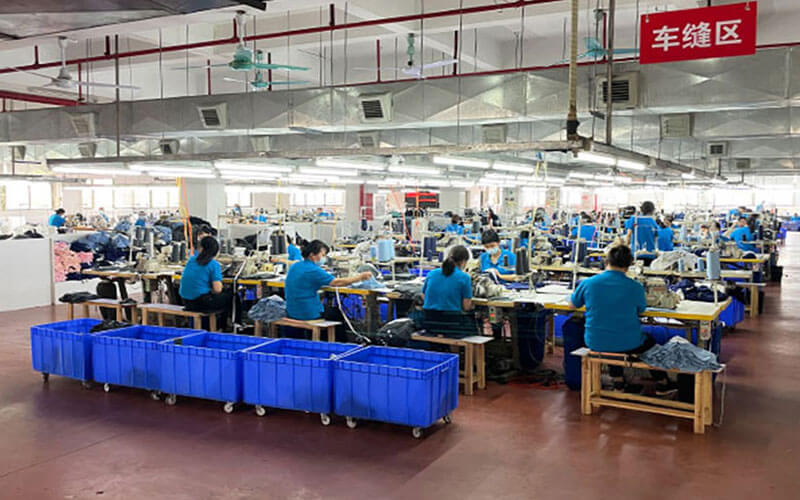
The inclusive scope is marker making to the buyer’s approved pattern, spreading and cutting, sewing and assembly, the finishing operations and packing to the agreed format.
Marker making is part of the service, and it determines how much of the buyer’s fabric the order consumes. Spreading and cutting include the layering decisions, the relaxation of the fabric before cutting and the numbering of the pieces. The sewing scope covers the assembly and finishing of the garment to the approved sample, including the seam types and the stitch specification. Finishing covers trimming, any washing or softening the contract includes, pressing and folding, and packing covers the bag or box and the carton. What the scope usually does not include is any of the development work that precedes making-up, and it is the exclusions rather than the inclusions that cause most of the disputes in a CM engagement.
What it excludes: design, pattern, fabric, trims and development
The exclusions are the point of the arrangement.
A CM contract excludes design, pattern development, fabric sourcing, trim sourcing and any development sampling, all of which the buyer provides or arranges separately.
Where the buyer supplies a pattern, the factory works to it and does not validate it, which means a pattern error discovered during sampling is the buyer’s to correct. Where the buyer supplies the fabric, the factory cuts it but does not guarantee the fabric’s properties, and a fabric that shrinks beyond the specified tolerance will produce garments that measure out of tolerance through no fault in the making-up. Where the buyer supplies the trims, the factory attaches them but does not control their availability, and a trim that arrives late stops the line. These exclusions are what makes a CM arrangement cheaper than full package, and they are also what concentrates the risk with the buyer.
Who owns fabric and trim risk in a CM contract
The buyer owns the material risk.
In a CM contract the buyer owns the fabric and the trims from the moment of purchase, which means a loss in cutting, a defect in the material and a quantity shortfall all fall to the buyer unless the contract says otherwise.
The distinction that matters is between normal cutting loss and abnormal loss. A defined allowance for cutting waste is normal and is built into the consumption figure. A loss that exceeds that allowance, because the fabric arrived with more defects than expected or because a cutting error destroyed more than the allowance, is abnormal and should be dealt with explicitly in the contract. The same applies to trims: a damaged batch of elastic is the buyer’s loss unless the damage occurred while the goods were in the factory’s care. The practical protections are a documented receipt of the materials with the quantity and condition recorded, a stated allowance for waste, and a clause allocating abnormal loss. Without those three, a shortfall at the end of the order becomes an argument about what was normal, and the factory is in possession of the evidence. The supply chain structure guide covers how this responsibility changes when more than one supplier is involved.
Marker efficiency and consumption: the clause that protects your margin
The consumption figure is the commercial centre of the contract.
Because the buyer owns the fabric, the marker efficiency determines how much of the buyer’s material the order consumes, which makes the consumption clause the most commercially significant part of the agreement.
A marker arrangement that uses the fabric more efficiently leaves more material for additional garments or reduces the quantity that has to be bought, and the saving accrues directly to the buyer rather than to the factory. That is why the agreed consumption per garment should be stated in the contract, along with the marker it is based on and the size ratio that the marker assumes. Where the size ratio changes, the consumption changes, and a contract that fixes the consumption without fixing the ratio is incomplete. The clause should also state what happens if the actual consumption is better or worse than the agreed figure, because a factory that finds a more efficient marker has produced a saving that the contract should recognise if the buyer is to benefit from the next improvement. The related question is who keeps the leftover fabric: where the buyer has paid for the material, the remainder should be returned, credited or held for a reorder.
How CM pricing works and why it is not comparable to FOB
The price is for making up, not for the product.
A CM price covers the labour, the machine time, the finishing and the packing, and it excludes the fabric, the trims, the development and usually the export packing materials, which is why it is not comparable with a full-package or FOB price.
The comparison that matters for a buyer is the total cost of the garment across both arrangements. A CM price plus the cost of the fabric, the trims, the freight of the materials and the buyer’s own overhead in managing the supply may be lower or higher than a full-package price, and which it is depends on the volumes, the buyer’s supply relationships and the amount of management time involved. A common error is to compare a CM price with an FOB price directly and conclude that the CM route is dramatically cheaper, when the difference is largely the materials the buyer has not yet bought. The other consideration is risk, because the CM route transfers the fabric risk, the development risk and the trim availability risk to the buyer, and those risks have a cost even when they are not invoiced. A CM price is also usually quoted per operation or per minute, and the rate depends on the construction complexity and on the line speed, so two styles with the same garment count can carry quite different CM prices.
Trim and component supply when the buyer sources directly
Direct sourcing shifts the coordination to the buyer.
Where the buyer sources the trims directly, the buyer takes on the supplier minimums, the lead times, the quality checks and the delivery coordination that a full-package factory would otherwise manage.
The trims on a garment include the elastic, the labels, the care labels, the hangtags, the threads where they are specified and the packaging, and each has its own supplier with its own minimum and lead time. The buyer also has to ensure that the trims arrive at the factory in time for the line, because a trim that arrives late stops production in the same way a late fabric does. The quality checks are also the buyer’s: a batch of elastic that is the wrong modulus will produce a garment that fails, and the failure will be attributed to the making-up unless the trims were checked on receipt. The practical arrangement is to have the trims delivered to the factory with the quantity and condition recorded, and to specify in the contract which party is responsible for checking them and what happens if they are found to be non-conforming. Where the buyer does not have the capacity to manage several trim suppliers, sourcing the trims through the factory while keeping the fabric direct is often the practical middle position.
Quality responsibility at the boundary: fabric defects versus make defects
Separate the material from the making.
The most common dispute in a CM contract is whether a defect is a fabric defect or a make defect, because the two have different owners and only one of them is the factory’s responsibility.
A defect that exists in the material before cutting, such as a hole, a slub, a needle line or a shade variation within a roll, belongs to the material and therefore to the buyer, subject to what the contract says about the factory’s obligation to detect it during cutting. A defect created by the making, such as a skipped stitch, an open seam, a measurement outside tolerance or an incorrectly attached trim, belongs to the factory. The boundary case is the defect that the factory could reasonably have detected and did not, such as a hole that was visible in the spread fabric and was cut into a panel anyway, and this is the case the contract should address explicitly rather than leave to negotiation. A practical clause requires the factory to report fabric defects found during cutting so that the buyer can be informed and the fabric supplier approached while the evidence is still available. The underwear production workflow applies the same inspection logic to a garment with more components than a simple cut and sew style.
Sampling and approval inside a CM-only engagement
The buyer supplies the pattern; the factory proves the line.
In a CM engagement the development sampling is the buyer’s, while the pre-production sample is the factory’s, and the two should not be confused.
Because the buyer supplies the pattern, the fit and the block are settled before the factory is involved, which means the sampling work the factory does is about proving that it can reproduce the approved garment rather than about developing the shape. The pre-production sample should therefore be made on the production line with the final fabric and the final trims, and approved against the specification rather than on appearance. Where the buyer’s pattern has not been proven in production before, a first CM order carries a risk that the pattern will need adjustment once it meets the line, and that risk is the buyer’s because the pattern is the buyer’s. The practical mitigation is to have the first pre-production sample made early enough that a pattern correction can still be made without disrupting the schedule. The scope of the samples and the number of rounds included should be stated in the contract rather than assumed, since a CM price is usually built on a single pre-production sample.
When cut and sew beats full package – and when it does not
It depends on what you already own.
Cut and sew works best when the buyer already has a pattern, a fabric supply and the capacity to coordinate the trims, and full package works best when the buyer has a product idea and wants one party responsible for the whole thing.
The clear cases for cut and sew are a brand with an in-house design and pattern function, a brand that already buys its own fabric at a better price or with better terms than a factory could obtain, and a brand whose fabric is proprietary or carries a certification that has to be controlled in the chain of custody. The clear cases for full package are a first product where no pattern exists, a brand without the capacity to manage several suppliers, and a product where the fabric and the construction interact closely enough that a single party should own the outcome. A middle position is common: the buyer owns the pattern and the fabric while the factory sources the trims, which reduces the coordination load without giving up control of the material. The decision should be made on total cost and on where the risk can best be managed rather than on the unit price of the making-up alone.
Contract checklist for a first CM order
Write the boundary down.
A first CM order should be placed against a written scope that states the operations included, the materials excluded, the consumption, the quality responsibility and the remedy.
The scope should name each operation the factory performs and each material and service the buyer provides, with the delivery point for the materials and the condition in which they are expected. The consumption should be stated per garment with the marker and the size ratio it assumes, along with the allowance for cutting waste and the treatment of abnormal loss. The quality section should define the inspection stages, the acceptance level, the defect classes and the remedy, and it should define who inspects the incoming materials and what happens when a non-conforming batch is found. The sampling section should state how many pre-production samples are included and what the buyer provides for each. The commercial section should state the price basis, the payment terms and the treatment of any excess or shortfall in consumption. Writing these six sections takes an afternoon and prevents the argument that otherwise arrives at the end of the first order, when the goods are cut and the leverage is gone.
FAQ
What is the difference between cut and sew and full package?
Cut and sew covers marking, cutting, sewing, finishing and packing from materials the buyer supplies. Full package adds design, pattern development, fabric and trim sourcing and development sampling, so one party owns the whole product rather than only the making-up.
Who owns fabric risk in a CM contract?
The buyer, because the buyer purchases and owns the material. Normal cutting waste is built into the consumption figure; abnormal loss, a shortfall or a material defect that exceeds the allowance should be allocated explicitly in the contract.
Is CM cheaper than FOB?
The CM price is lower because it excludes the materials, but the comparison is not meaningful on its own. Compare the total cost including fabric, trims, inward freight and your own management overhead, and weigh that against the risk the CM route transfers to you.
Who is responsible for a defect in a CM order?
A defect present in the material before cutting belongs to the buyer, and a defect created by the making belongs to the factory. The boundary case is a material defect the factory could have detected during cutting, which should be addressed explicitly in the contract.
Next step for your team: send the Finetex Global team your pattern, material plan and target quantity, and ask for a written scope covering the operations included, the consumption basis and the quality responsibility at the fabric and making boundary.
Sources: ISO 9001 quality management; OEKO-TEX STANDARD 100; Textile Exchange standards; Better Work (ILO/IFC); 16 CFR Part 303 textile labelling.
{“@context”:”https://schema.org”,”@type”:”FAQPage”,”mainEntity”:[{“@type”:”Question”,”name”:”What is the difference between cut and sew and full package?”,”acceptedAnswer”:{“@type”:”Answer”,”text”:”Cut and sew covers marking, cutting, sewing, finishing and packing from materials the buyer supplies. Full package adds design, pattern development, fabric and trim sourcing and development sampling, so one party owns the whole product rather than only the making-up.”}},{“@type”:”Question”,”name”:”Who owns fabric risk in a CM contract?”,”acceptedAnswer”:{“@type”:”Answer”,”text”:”The buyer, because the buyer purchases and owns the material. Normal cutting waste is built into the consumption figure; abnormal loss, a shortfall or a material defect that exceeds the allowance should be allocated explicitly in the contract.”}},{“@type”:”Question”,”name”:”Is CM cheaper than FOB?”,”acceptedAnswer”:{“@type”:”Answer”,”text”:”The CM price is lower because it excludes the materials, but the comparison is not meaningful on its own. Compare the total cost including fabric, trims, inward freight and your own management overhead, and weigh that against the risk the CM route transfers to you.”}},{“@type”:”Question”,”name”:”Who is responsible for a defect in a CM order?”,”acceptedAnswer”:{“@type”:”Answer”,”text”:”A defect present in the material before cutting belongs to the buyer, and a defect created by the making belongs to the factory. The boundary case is a material defect the factory could have detected during cutting, which should be addressed explicitly in the contract.”}}]}
More factory-floor notes for brand owners

Sample Revision Limits: How to Control Underwear Development Cost and Calendar
A sample revision limit should control scope, not block necessary correction. The buyer and factory need to distinguish…
Read more →
Lab Dips and Strike-Offs for Underwear: Approval Steps That Prevent Delays
A lab dip approves a dyed textile shade; a strike-off approves printed artwork on the intended substrate. They…
Read more →
Color MOQ Planning: How to Share Fabric Across Multiple Underwear Styles
Color MOQ planning works best when a brand treats dyed fabric as a shared material platform rather than…
Read more →
Underwear Fabric Utilization: How Marker Efficiency Changes Unit Cost
Fabric utilization converts a fabric quotation into a garment cost. The calculation must account for pattern area, fabric…
Read more →
Open Costing for Men’s Underwear: Reading Fabric, Trim, Labor and Overhead Lines
An open-cost sheet is useful only when every line is tied to a measurable specification, a purchasing unit…
Read more →Global Apparel Sourcing Outlook 2026: Cotton, Freight and Supply-Chain Risk
A data-led 2026 apparel sourcing outlook on cotton balances, freight volatility, supplier diversification, lead time, compliance and practical…
Read more →Request a sample & pricing information
Send us your tech pack, target price or a reference sample — we reply with a quotation, a realistic lead time and a fabric recommendation within one working day.
- Free sampling plan & cost breakdown
- MOQ from 300 pcs per style
- Reply within 1 working day