
Importing Men’s Underwear into the US: Duty, Labels and Customs Entry
How to import men's underwear into the US: HTS codes, duty and Section 301 layers, FTC label fields, origin marking and customs entry, checked 11 Nov…
Answer first: To import men’s underwear into the US you need a correct HTS classification, the right entry type, a licensed customs broker or your own ACE filing, and garments labelled with fibre content, country of origin, a manufacturer identity (name or RN) and care instructions. For China-origin knit underwear, expect the normal duty plus two Section 301 layers as of 11 November 2026.
This guide follows one shipment of men’s knit boxer briefs from a factory in Shenzhen to a US warehouse. It is written for brand owners and importers placing a first or second order, and it is organised around one printable checklist at the end. The rules quoted here were checked on official US government pages on 11 November 2026. Tariff layers have changed several times since 2025, so treat the numbers as a dated snapshot and have a licensed customs broker confirm your classification and duty before you price the order.
Who this applies to and what “importing” actually involves
When a shipment of underwear arrives in the United States, someone has to act as the importer of record. That party files the entry with U.S. Customs and Border Protection (CBP), pays duties and fees, and is legally responsible for the declared classification, value and origin. For most small brands the importer of record is the brand itself, with a customs broker filing on its behalf. Under a DDP arrangement the seller or its forwarder may act as importer of record instead, which moves the paperwork but not the need for correct data.
Three government bodies matter for a men’s underwear shipment:
- CBP decides classification, collects duty and fees, enforces country-of-origin marking and applies the Uyghur Forced Labor Prevention Act (UFLPA).
- The Federal Trade Commission (FTC) sets the textile label content under the Textile Fiber Products Identification Act and the Care Labeling Rule.
- The Consumer Product Safety Commission (CPSC) administers the flammability standard for clothing textiles, 16 CFR Part 1610.
A factory can prepare most of the documents and all of the labels, but it cannot file your US entry or accept your legal responsibility as importer. Knowing where that line sits avoids most first-order surprises.
Step 1: Classify the garment under the HTS
Every line on a US entry needs a 10-digit Harmonized Tariff Schedule (HTSUS) number. The classification drives the duty rate and whether extra tariff layers apply. For men’s knit underwear the usual starting point is heading 6107 (men’s or boys’ underpants, briefs, nightshirts, pyjamas and similar, knitted or crocheted). The fibre that predominates by weight decides the subheading.
| Garment (men’s, knitted) | HTSUS subheading | General (MFN) duty, checked 11 Nov 2026 |
|---|---|---|
| Cotton briefs, boxer briefs, trunks | 6107.11.00 | 7.4% |
| Man-made fibre briefs and boxer briefs (polyester, nylon, modal blends where MMF predominates) | 6107.12.00 | 14.9% |
| Cotton undershirts and singlets | 6109.10.00 | 16.5% |
These rates come from the USITC HTS search for the current 2026 revision. Two cautions apply. First, a cotton–modal or cotton–spandex blend is classified by the fibre that predominates by weight, so the fibre content on your tech pack must match the lab or mill certificate. Second, woven boxer shorts are not heading 6107; woven garments sit in Chapter 62 with different rates. If a style is borderline, ask your broker about a binding ruling, and search existing decisions in CBP’s CROSS rulings database before you ask.
Step 2: Work out the duty stack for China-origin goods
The general rate is only the first layer. For products of China, two additional Section 301 duties applied on the date this guide was checked:
- Section 301 List 4A (2019 action), +7.5%. The USITC “China Tariffs” reference list maps 6107.11.00, 6107.12.00 and 6109.10.00 to Chapter 99 heading 9903.88.15.
- Section 301 forced-labour action (2026), +12.5%. USTR imposed a 12.5% tariff on products of China under heading 9903.05.31, effective for goods entered on or after 24 July 2026, with listed exemptions.
On a cotton boxer brief that reads as 7.4% + 7.5% + 12.5% of the customs value, before fees. That arithmetic is illustrative, not a quote: exemptions, later Federal Register notices and the precise classification can change it. The IEEPA tariffs that applied in 2025 were ended after the Supreme Court’s February 2026 decision in *Learning Resources, Inc. v. Trump*, and the temporary Section 122 surcharge that followed expired in July 2026, according to the Congressional Research Service. If you see older landed-cost models that still include IEEPA layers, rebuild them.
Duty is charged on the customs value, which for most purchases is the transaction value, typically the price paid for the goods excluding international freight and insurance. Ocean freight and insurance therefore do not attract duty, but they do belong in your landed cost. Apart from duty, formal entries also carry the Merchandise Processing Fee and, for ocean shipments, the Harbor Maintenance Fee. Your broker will add these from CBP’s current fee schedule.
Step 3: Choose the entry type
Low-value parcels no longer avoid entry. CBP’s e-commerce FAQ states that the de minimis exemption for goods valued at $800 or less is suspended for all countries and all modes. Shipments must use informal or formal entry: informal entry is generally available up to $2,500, and formal entry is required above $2,500 and for certain goods. Formal entry also requires a customs bond.
For a typical first order of 500 to 3,000 pieces of underwear, the value will usually exceed $2,500, so plan on a formal entry with a single-entry or continuous bond. Ocean shipments also need an Importer Security Filing (ISF) submitted before the goods are loaded at the origin port. The ISF needs data that only the factory and forwarder have, such as the manufacturer’s name and address, the stuffing location and the container details, so agree who sends it and by when.
Step 4: Get the labels right before cutting, not after arrival
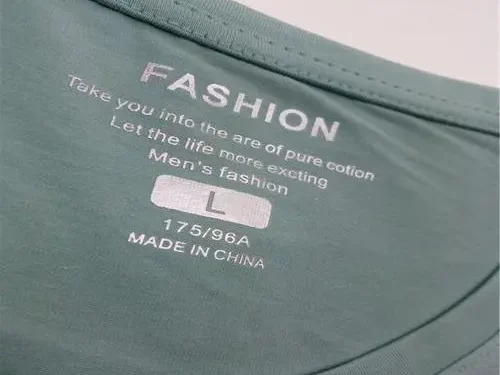
US textile labelling is the area where a factory can protect or ruin a shipment, because labels are sewn or printed during production. The FTC’s rules in 16 CFR Part 303 require each garment to show:
- Fibre content by generic name and percentage by weight, in order of predominance, for fibres present at 5% or more (smaller amounts may be listed as “other fiber”).
- Country of origin, the country where the product was processed or manufactured (16 CFR 303.33). For an imported garment this is typically “Made in China”.
- Identity of the manufacturer or dealer: either the company name or the FTC-issued Registered Identification Number (RN). Brands can check or apply for an RN in the FTC’s RN database.
The Care Labeling Rule (16 CFR Part 423) separately requires permanent care instructions that remain legible for the life of the garment. A printed heat-transfer label inside the waistband can satisfy both rules if it is durable and legible after washing.
Country-of-origin marking is also a customs requirement under 19 CFR Part 134, and for textiles the origin itself is decided by the textile rules in 19 CFR 102.21, not by where the goods were shipped from. Routing goods through another country does not change origin.
Our earlier article on care label requirements for the US and EU covers label materials and placement in more detail.
Step 5: Prepare for UFLPA questions on cotton
Under the UFLPA, CBP presumes that goods made wholly or in part in Xinjiang, or by entities on the UFLPA Entity List, are made with forced labour and are barred from entry unless the importer rebuts that presumption with clear and convincing evidence. Cotton garments from any origin can be examined. In practice a cotton underwear importer should be able to produce a supply-chain map from garment back to yarn and, where possible, to fibre, with purchase orders, invoices and shipping documents at each tier. CBP’s UFLPA page lists the guidance and the current entity list.
What a factory can realistically provide is the fabric purchase record, the mill’s invoices, and any chain-of-custody certificates it holds for certified fibres. What it usually cannot provide on its own is gin-level evidence for conventional cotton. Ask about this at quotation stage, not when goods are detained.
Step 6: Check flammability exposure
Men’s underwear is clothing, so the CPSC flammability standard in 16 CFR Part 1610 applies. Section 1610.1(d) exempts from testing certain fabrics that consistently pass, including plain-surface fabrics weighing 2.6 oz/yd² or more and fabrics made entirely of listed fibres such as nylon, polyester or acrylic. Many jersey underwear fabrics fall into these categories, but brushed or raised-surface cotton blends may not. Confirm with your test lab and broker what testing and certificate your importer of record needs.
Common mistakes that delay or penalise an underwear entry
These are common patterns behind holds, re-labelling or unexpected duty. They are practical advice, not legal findings:
- Fibre content that does not match the label. The commercial invoice says “95% cotton 5% spandex”, the label says “100% cotton”, and the mill test shows 92/8. Pick the lab figure and use it everywhere.
- Wrong chapter. A knit trunk entered under a woven heading, or a multipack entered as a set, changes the rate.
- Undervalued invoices. Declaring a lower price to reduce duty is a compliance risk for the importer, and the factory’s export documents must match the actual transaction.
- Missing RN or brand identity. A garment labelled only with a logo and size does not meet 16 CFR 303.16.
- ISF filed late. Late or inaccurate ISF data can lead to penalties for the importer.
- No traceability file for cotton. A UFLPA detention can last weeks while evidence is gathered.
How tariffs change the cost of a first order
Because Section 301 duties are percentages of value, they scale with the FOB price. A higher-value fabric (modal, Supima, Tencel) raises the duty in dollars even if the rate is the same. Some brands respond by redesigning the product, for example switching fibre content to change classification. That is legitimate only if the product genuinely changes; describe the goods accurately and let the broker classify them.
For small orders, entry costs that do not scale with quantity, such as broker fees, bond premiums and the minimum Merchandise Processing Fee, weigh more heavily per unit. Consolidating two or three styles into one shipment usually lowers the per-piece share of these fixed costs. Our shipping and logistics page explains the FOB, DDP and LCL options we quote for US orders, and FOB versus DDP for apparel compares who carries which risk.
Printable checklist: one underwear shipment to the US
| Item | Who prepares it | Check before |
|---|---|---|
| HTSUS classification for each style | Importer and customs broker | Price quotation |
| Fibre content confirmed by mill or lab | Factory | Label artwork approval |
| Label: fibre %, origin, RN or name, care | Factory, artwork approved by brand | Bulk cutting |
| Commercial invoice with true transaction value | Factory | Booking |
| Packing list matching carton marks | Factory | Booking |
| ISF data (manufacturer, stuffing location, container) | Factory and forwarder to importer | Vessel loading |
| Customs bond (formal entry) | Importer or broker | Arrival |
| Cotton supply-chain documents for UFLPA | Factory and mill | Shipment |
| Flammability exemption or test basis (16 CFR 1610) | Importer with lab | Bulk production |
| Duty estimate including Section 301 layers | Customs broker | Final pricing |
What is fact, what is advice and what is uncertain
Fact (checked 11 November 2026): the HTS rates above are from the USITC HTS; the List 4A mapping is from the USITC China Tariffs list; the 12.5% forced-labour Section 301 duty and its effective date are from USTR’s Federal Register notice and CBP’s CSMS guidance; de minimis and entry-type rules are from CBP’s e-commerce FAQ; label content rules are from 16 CFR 303 and 423.
Advice: the common mistakes and the checklist reflect how we prepare export documentation for buyers. They are practical suggestions, not legal requirements.
Uncertain: tariff actions are being reviewed and litigated. USTR’s four-year review of the 2018 China actions, the IEEPA refund litigation at the Court of International Trade, and any new trade agreement could change the stack. Confirm the duty with a licensed customs broker on the day you finalise pricing.
This article is general information and is not legal or customs advice.
Related reading
- Section 301 Tariffs on Chinese Apparel: HS Codes, Rates and Mitigation
- De Minimis Reform: What It Means for Small Apparel Importers
- UFLPA and Cotton: Documents a Chinese Factory Must Supply
- HTS Classification for Underwear, T-Shirts and Hoodies
Frequently asked questions
What is the HTS code for men’s cotton boxer briefs?
Men’s knitted cotton underpants and briefs, including boxer briefs, are usually classified under HTSUS 6107.11.00, which carried a 7.4% general duty when checked on 11 November 2026. Your broker should confirm the 10-digit statistical suffix.
Does de minimis still apply to underwear parcels under $800?
No. CBP states the de minimis exemption is suspended for goods valued at $800 or less from all countries and by all modes. Shipments need informal entry up to $2,500 or formal entry above that.
Do I need an RN number to sell underwear in the US?
You need to identify the manufacturer or dealer on the label, either by company name or by an FTC Registered Identification Number. An RN is optional but convenient for brands using several factories.
Can the factory act as importer of record?
A Chinese factory cannot itself file a US entry, but under a DDP arrangement a forwarder or US entity acting for the seller can be importer of record. The legal responsibility then sits with that party.
Are Chinese underwear duties higher than other countries?
China-origin knit underwear carried the general rate plus List 4A (+7.5%) and the 2026 forced-labour Section 301 duty (+12.5%) when checked. Many other countries were also subject to forced-labour Section 301 duties of 10% or 12.5%, so compare full stacks, not headlines.
Sources
- USITC Harmonized Tariff Schedule search (2026 revision)
- USITC China Tariffs reference list (Section 301)
- USTR: Notice of Actions in the forced-labour Section 301 investigations, 91 FR 47318 (28 July 2026)
- CBP CSMS #69326983: Section 301 forced-labour import duties
- CBP: E-commerce frequently asked questions (de minimis suspension)
- CBP: Importer Security Filing 10+2
- eCFR: 16 CFR Part 303, Textile Fiber Products Identification Act rules
- eCFR: 16 CFR Part 423, Care Labeling Rule
- eCFR: 19 CFR Part 134, Country of origin marking
- eCFR: 16 CFR Part 1610, Flammability of clothing textiles
- CBP: Uyghur Forced Labor Prevention Act
- Congressional Research Service: U.S.-China tariff actions since 2018 (IF12990)
Plan a US underwear order with Finetex
Send us your style, fibre content, quantity and US destination. We will confirm the label artwork, export documents and the FOB or DDP options for your order.
Request a quote or review our men’s underwear manufacturing capabilities. For QC and reorder planning, see the underwear QC and reorders guide.
More factory-floor notes for brand owners
Selling Underwear in Germany: Textilkennzeichnung, LUCID and Packaging Law
German textile labelling, LUCID registration and packaging law for underwear brands after the PPWR and VerpackDG took effect…
Read more →
GSM to Ounce Converter and Fabric Weight Chart
Convert fabric weight between gsm and oz/yd² with the exact factor (1 oz/yd² = 33.906 g/m²), a T-shirt…
Read more →
First-Output Check: The In-Line Inspection That Saves Bulk
What to check on the first garments off each line: measurements, seams, labels and print against the approved…
Read more →
A Fit Session Protocol for Knit Tops: 12 Wearers, 5 Measurements
A recommended fit session protocol for knit tops: recruit 12 wearers, take five measurements, run a movement checklist,…
Read more →
Corporate Uniform Programs: Tendering, Sizing and Reorders
How to run a corporate uniform program with a factory: tender documents, sizing a workforce, producing many sizes…
Read more →
Muscle Fit and Athletic Fit T-Shirts: Pattern Changes That Matter
How muscle fit and athletic fit T-shirts differ from a classic block: chest-to-waist drop, sleeve cap and bicep,…
Read more →Request a sample & pricing information
Send us your tech pack, target price or a reference sample — we reply with a quotation, a realistic lead time and a fabric recommendation within one working day.
- Free sampling plan & cost breakdown
- MOQ from 300 pcs per style
- Reply within 1 working day