
Men’s Loungewear Manufacturing: The Category Beyond Underwear
How men's loungewear differs from underwear in fabric weight, set pairing, fit and packing, and how a factory order can move from a brief to a…
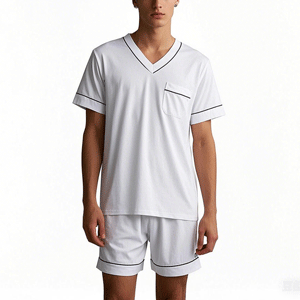
Answer first: Men’s loungewear is the category that sits beyond a single underwear brief: relaxed tops, pants or shorts, and often a set, cut for wear in the house rather than as a first layer under clothing. It shares fibres, knitting and some trims with underwear and with pajamas, but it is not the same product. The fabric is usually heavier, the fit is easier, the pieces have to work together as a set, and the packing is closer to a folded apparel unit than to a polybagged brief. This article is about that category upgrade — from an underwear order to a set order — not a repeat of our pajamas manufacturing product page.
If you already make boxers or briefs with a factory, loungewear is often the natural second programme: the same mill relationship, a related fit block, and a higher unit value per shipment. It only works if the specification is written as loungewear, not as “underwear, but looser.” The notes below cover category boundaries, fabric weight, sets, fit and packing, and how we would take a first set through sampling. They do not invent GSM “industry standards” or prices. Where a number appears in a range, it is a planning range to discuss on a tech pack, not a Finetex price list and not a lab result.
Where loungewear stops being underwear, and where it meets pajamas
Underwear is a next-to-skin foundation garment: briefs, boxer briefs, trunks, boxers. Its job is support, coverage and comfort under clothes. Loungewear is clothing in its own right. A lounge pant or a relaxed long-sleeve top is meant to be seen, to be worn for hours, and often to be sold as a pair. Pajamas, which we manufacture as a category on the pajamas page, are sleepwear: a top and bottom designed as nightwear, with the constructions and coverage that implies. The three categories overlap in fabric and in the same factory, and they overlap in the customer’s wardrobe. They should not overlap in the tech pack.
The practical tests we use in a briefing are simple:
- If the garment is worn under clothes as a first layer, it is underwear. Specify pouch, rise, leg opening and waistband the way you would for a boxer brief.
- If the garment is sold as sleepwear, treat it as a pajama or nightshirt, with the coverage, closure and fabric hand that the pajama page already covers.
- If the garment is meant to be worn around the house, on a sofa or on a short errand, and sold as clothing, it is loungewear. Specify it as a top, a pant or a set, with a lounge fit, a visible surface and a packing method that matches that use.
Mis-briefing is common. A “lounge short” that is actually a boxer short will be costed, graded and packed as the wrong product. A “pajama pant” with a fashion drawcord and a heavy French terry may be loungewear that will sit next to sleepwear on a site and confuse both the customer and the customs description. Keep the category name, the intended use and the specification aligned.
Fabric and weight: write GSM as a decision, not as a mood
Loungewear fabrics are mostly knits: jersey, interlock, French terry, fleece, rib, and sometimes a modal or cotton-modal blend that you may already use in underwear. The difference is usually weight, surface and recovery, not a completely different fibre family. A brief in a fine jersey and a lounge pant in a mid-weight French terry can share a mill and still be different cloths.
GSM (grams per square metre) is the clean way to write that decision. It is not, by itself, a quality grade. Two 280 GSM fleeces can drape and pill differently if the yarn, the knitting and the finish differ. So the tech pack should state fibre, yarn, structure, GSM, width, finish (including any brushing, peaching or bio-polish), and shrinkage and pilling test methods, not only a weight.
Planning ranges we use as a starting conversation — not as required values, not as test data, and not as a promise that every programme will land here — look like this:
| Piece (planning ranges only) | Structures often discussed | A GSM band to start a conversation |
|---|---|---|
| Lounge T-shirt or long-sleeve top | Jersey or interlock | About 180–220 GSM for a year-round cotton or cotton-blend jersey; heavier if you want a substantial drape |
| Lounge short | Jersey, French terry | About 200–280 GSM, depending on whether the short should feel like a tee or like a pant |
| Lounge pant or jogger-like bottom | French terry or fleece | About 280–360 GSM for many mid-weight terry or fleece bottoms |
| Light robe or overshirt | Terry, fleece or a heavier jersey | Set from the drape you want, then confirm with a hand loom or a mill stock |
These bands are a briefing aid. The right number is the one you approve on a fabric swatch and a wear trial, then lock in the pre-production sample. A set should usually share a fibre story even if the top and bottom are not the same GSM: a 200 GSM jersey top can sit with a 320 GSM terry pant if the colour and the hand are designed together. What fails is a top and bottom dyed in isolation, then bagged as a set, with one piece shrinking or fading differently from the other.
For fibre claims (organic, recycled, or a particular cellulosic), use a certified chain and the documents that go with it; see our GOTS versus OCS and GRS versus RCS articles. A lounge set does not get a fibre claim from a hanging “eco” word on a line sheet.
Sets: the upgrade from a brief order to a set order
The commercial reason to move from underwear to loungewear is often the set. A customer who already buys a brief can be offered a matching top and bottom, or a top that pairs with a pant, at a higher ticket. For the factory, a set is not “two garments on one purchase order.” It is a colour, shrinkage, measurement and packing problem that has to be solved as one style family.
Write the set rules before sampling:
- Which pieces constitute the set, and whether they can also be sold as separates. If they are sold both ways, you need a packing method and a barcode plan for each.
- Colour continuity. Tops and bottoms in the same colour name should come from a coordinated dye lot or from a lab-dip process that is approved together. A top that is half a shade off the pant will be obvious in a lifestyle photograph and in a gift box.
- Size pairing. A set sold as M/M or L/L needs a clear rule if your top and bottom size charts are not identical. Do not assume that an underwear medium maps to a lounge-pant medium.
- Replacement pieces. If a pant fails inspection, can the top still ship as a separate, or is the set unsaleable until a replacement pant is made? Decide this at the pre-production stage.
Minimums follow the fabric, not the word “set.” Finetex’s published MOQ is 300–1,000 pieces per style, mixed sizes: stock fabric can start from 300 pieces, and a fully custom knit or dye lot usually starts at 1,000 pieces per colour. On a set, be explicit whether “per style” means per piece or per set, and whether a top and bottom in the same fabric and colour can share a dye lot. That conversation changes the achievable quantity more than a slogan about loungewear MOQ.
Sampling follows the published calendar: a development sample in 5–7 working days after artwork and fabric are confirmed, and a full size set in 10–12 working days. For a set, approve both pieces together, in the same size, including the packed presentation. Bulk production remains 15–45 days from deposit and approved pre-production sample, depending on quantity, fabric availability and trim lead times.
Fit: easier than underwear, easier to get vaguely wrong
Underwear fit is unforgiving at the pouch, the rise and the thigh. Loungewear fit is more forgiving in those areas and more exposed in others: a pant that puddles at the instep, a top that collapses at the shoulder, a waistband that rolls on a mid-weight terry, or a cuff that does not recover after a sit. The customer will wear the garment for a full evening, often without a belt, and will wash it often.
Specify, at least:
- Ease and silhouette. Relaxed is not one pattern. State chest, body length, waist relaxed and stretched, hip, inseam and hem opening, and whether the pant is straight, tapered or jogger-cuffed.
- Waistband. Exposed elastic, covered elastic, drawcord only, or a combination. Drawcord length, tip type and eyelet quality show on a lounge pant the way a waistband logo shows on a brief.
- Pockets and openings. Side pockets, a back pocket, a fly or a mock fly: each is a construction cost and a visual detail. A mock fly that twists after wash is a loungewear complaint, not an underwear complaint.
- Shrinkage and recovery. Wash the sample the way the care label will instruct, then re-measure. A terry pant that shortens into an awkward crop, or a rib cuff that blows out, is a finish and GSM issue as much as a pattern issue.
Grade the size set from the lounge block, not by stretching an underwear grade. Our article on garment measurement points for knit tops, and the grading-rules piece in this series, are the method for the top; the pant needs its own points (waist, hip, rise, inseam, hem). If you plan to extend the range later into bigger sizes, say so at the first size set, because a lounge pant that works at L can fail at 2XL for reasons that have nothing to do with the brief you already produce.
Packing: treat it as apparel, not as a polybagged brief
A brief is often packed in a polybag, sometimes with a header or in a multipack. A lounge set is more often folded, board-inserted, ribboned or boxed, and it is heavier and bulkier in the carton. Packing is part of the product: a set that arrives crushed or with the top wrinkled against a dark pant will not look like the photograph.
Agree, before bulk:
- The unit pack (polybag, wrap, box), any tissue or warning copy, and whether the set is sold in one bag or two pieces in one box.
- Tickets and size identification that work for a set and, if needed, for separates.
- Carton assortment, maximum weight and the fold that you approved on the packed sample.
- Care and fibre labels that match the intended use and the destination market.
Our private packaging page covers polybags, hangtags, carton marks and pre-shipment carton audits. For loungewear, add a packed-sample approval to that list. Quality gates remain the published ones: incoming fabric inspection, in-line checks at 30% and 70%, final AQL 2.5, and a shipment check against the approved sample and packing list. On a set, the shipment check should confirm that tops and bottoms in the same carton belong together in colour and size.
What is fact, what is advice and what is uncertain
Fact: Finetex MOQ, sampling and bulk lead times, payment terms as published, and quality gates are company facts from the live site. The distinction between underwear, pajamas and loungewear is a product-definition aid for briefing, not a legal classification. Customs classification of a lounge garment is a separate question; see our HTS article in this series and confirm with a licensed customs broker.
Advice: the GSM conversation bands, the set rules and the fit list are our practical starting point. Approve fabric and a packed set before bulk.
Uncertain: the “right” GSM and ease for your customer can only be locked on a wear-tested sample. No price, no claimed bestseller and no invented test result is offered here.
Related reading
- Joggers and Sweatpants: Fabric, Fit and Trims
- Men’s Polo Shirt Manufacturing: Pique, Interlock and Collar Construction
- GOTS vs OCS: Which Organic Claim Fits Your T-Shirt
Frequently asked questions
Is loungewear the same as pajamas?
No. Pajamas are specified as sleepwear. Loungewear is specified as clothing for wear around the house, often as a set, with a different fit, a different visible surface and usually a different pack. We produce both, but we brief them separately.
Can I add a lounge set to an existing underwear programme?
Often yes, especially when the fibre and the mill are already known. Treat it as a new style family: new patterns, a coordinated colour process, a set packing rule and a size chart that is not copied blindly from the brief.
What MOQ should I plan for a set?
Finetex’s published MOQ is 300–1,000 pieces per style, mixed sizes, with custom dye lots usually starting at 1,000 pieces per colour. Confirm whether the top and bottom share a dye lot and whether “pieces” means units or sets.
Do the top and bottom have to be the same GSM?
No, but they should be designed as a pair: compatible fibre, colour and shrinkage. A lighter jersey top with a heavier terry pant is common; two pieces that fade or shrink differently are not.
When is the set approved?
When both pieces, in the same size, have been approved as a packed unit, after the agreed wash test, not when a single unbagged top looks right on a hanger.
Sources
Brief a first lounge set from a packed sample
Send us a reference, a fabric direction and whether you want a top, a pant or a full set. We will come back with a sampling plan, a fabric recommendation and a quotation.
Request a sample plan or start on our pajamas manufacturing page.
More factory-floor notes for brand owners
Selling Underwear in Germany: Textilkennzeichnung, LUCID and Packaging Law
German textile labelling, LUCID registration and packaging law for underwear brands after the PPWR and VerpackDG took effect…
Read more →
GSM to Ounce Converter and Fabric Weight Chart
Convert fabric weight between gsm and oz/yd² with the exact factor (1 oz/yd² = 33.906 g/m²), a T-shirt…
Read more →
First-Output Check: The In-Line Inspection That Saves Bulk
What to check on the first garments off each line: measurements, seams, labels and print against the approved…
Read more →
A Fit Session Protocol for Knit Tops: 12 Wearers, 5 Measurements
A recommended fit session protocol for knit tops: recruit 12 wearers, take five measurements, run a movement checklist,…
Read more →
Corporate Uniform Programs: Tendering, Sizing and Reorders
How to run a corporate uniform program with a factory: tender documents, sizing a workforce, producing many sizes…
Read more →
Muscle Fit and Athletic Fit T-Shirts: Pattern Changes That Matter
How muscle fit and athletic fit T-shirts differ from a classic block: chest-to-waist drop, sleeve cap and bicep,…
Read more →Request a sample & pricing information
Send us your tech pack, target price or a reference sample — we reply with a quotation, a realistic lead time and a fabric recommendation within one working day.
- Free sampling plan & cost breakdown
- MOQ from 300 pcs per style
- Reply within 1 working day