
Men’s Underwear Manufacturing: The Nine Stages, and Where Quality Is Decided
Men's underwear production runs through nine stages from fabric knitting to packing. See what happens at each one, which decisions are locked, and where defects are…
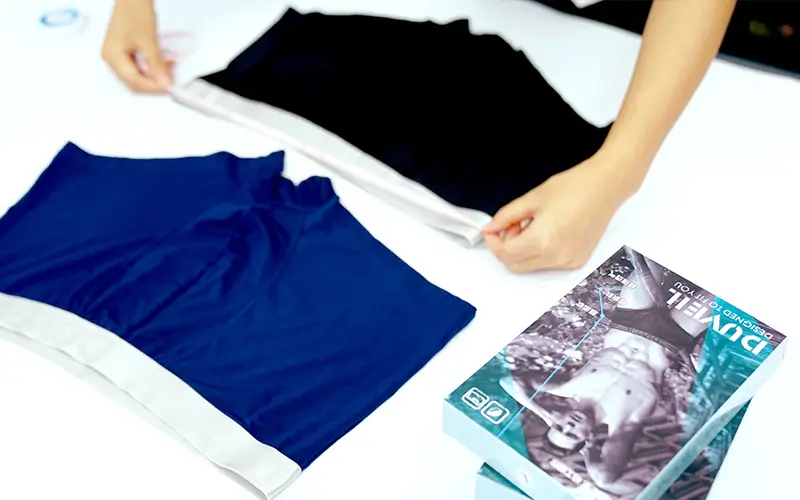
A pair of underwear passes through nine production stages between yarn and export carton, and almost every defect a customer notices traces back to one of three of them. Knowing the sequence is useful; knowing which stages decide the outcome is what allows a buyer to intervene while intervention is still cheap.
Stage 1: how does yarn selection and knitting work?
Yarn becomes fabric at a set weight and gauge.
Yarn is knitted into a tube or an open-width fabric, and the composition, the yarn quality and the knitting gauge together determine how the fabric will feel and behave.
This stage decides properties that cannot be corrected later: the recovery of the knit, the surface smoothness and how the fabric will handle dyeing. Ask for the composition by percentage and the weight in grams per square metre, and ask whether the yarn is a quality the factory runs continuously, because a running quality brings with it experience of how it dyes and how it grades. Where the fabric is developed rather than running, this stage needs its own approval before cutting is discussed.
Stage 2: what happens during dyeing and finishing?
The fabric takes colour and its final surface.
Dyeing sets the shade and finishing sets the hand, and both introduce shrinkage that affects the measurements the garment will finally hold.
This is one of the three stages where quality is decided, because the shrinkage released here determines whether the size chart survives the first wash. Ask what the measured shrinkage is after a defined wash cycle and how the shade is compared against the standard. Where the fabric is garment-dyed rather than piece-dyed, the sequence changes and the measurements have to be taken after the process rather than before, which is a different production plan rather than a variation on the same one.
Stage 3: how are the pattern and grading prepared?
The block is cut and grading increments are set.
Pattern making converts the approved fit into a block, and grading produces the full size range from it, with the increments deciding how the garment behaves at the extremes.
On underwear this stage is unusually consequential, because the garment is small and the tolerance for error is narrow. A block that is correct at medium can pull at the smallest size and cut in at the largest, and neither fault is visible on a single sample. Ask who produces the graded nest and whether a measured size set is part of the programme. Where the block is being adjusted from a reference, change one measurement at a time so the effect of each change remains visible.
Stage 4: what does cutting involve?
Fabric is spread in layers and cut to the pattern.
The marker determines how much fabric is used, and the spreading and cutting determine whether the pieces match the pattern within tolerance.
Cutting is where fabric quality and pattern accuracy meet. A shade variation between fabric lots becomes visible here if pieces from different lots are mixed within a garment, and a pattern that was cut slightly off shows up later as a seam that does not line up. Ask how the fabric is checked before spreading and how pieces from different lots are managed. On a programme with several colours, the lot allocation decided here determines whether a customer can receive two different shades of the same product.
Stage 5: how does sewing and assembly work?
Panels are joined, with the gusset and seams constructed.
Assembly determines seam strength, comfort and how the garment sits, and it is where most visible defects are created.
The construction decisions that matter most are the gusset, which is often a separate panel, and the leg and waist seams, which carry the fit. Ask how the gusset is constructed and finished, because a lumpy join is felt rather than seen. This is also the stage where in-line inspection earns its place, since a seam fault can be corrected while the garment is still on the line and cannot be corrected once it is packed.
Stage 6: why is waistband and elastic attachment critical?
Because elastic is the component that fails first.
The waistband and leg elastics are attached under tension, and the tension set here determines whether the garment keeps its shape through repeated wear and washing.
This is the second of the three stages where quality is decided. Ask which supplier and construction the elastic comes from, how the attachment tension is controlled and how recovery is tested. A band attached with uneven tension produces a wavy waist or a hem that rolls, and neither fault appears in a photograph of a new sample. Name the elastic specification in the approved sample and require written approval before any substitution, because elastic is the component most often changed when stock runs short.
Stage 7: what does decoration and labelling involve?
Marks are applied and the labels are attached.
Printing, transfers and embroidery are applied to the finished garment, and the neck and care labels are attached with the content required for the market.
Decoration on underwear is applied to fabric that stretches, so the method and the placement determine whether the mark survives. Ask for a decorated sample washed repeatedly before approval, and check the care label content against the fabric actually used rather than the one originally specified. This stage is also where a labelling error becomes permanent, because a label attached to a finished garment cannot be corrected without rework.
Stage 8: how are inspection and packing handled?
Goods are inspected and packed to the agreed format.
The final inspection applies an acceptance level to the order, and packing determines how the garment is presented and protected.
Ask what acceptance level is applied, how defects are classified and what the remedy is if the inspection fails. Packing should be specified at the same time as the garment rather than afterwards, because the format affects the carton, the freight and the labour: a pack that has to be assembled by hand adds a cost that does not appear in the garment quotation. Where the order is packed in bulk, the bagging and labelling will happen somewhere, and the factory is usually the cheaper place.
Stage 9: what does export preparation cover?
Cartons, documentation and loading.
The order is cartoned to specification, the commercial documents are prepared, and the goods are staged for collection or loading.
Ask for the carton dimensions and weight with the quotation, because on a light and bulky product the carton efficiency is a direct cost. Confirm which documents the factory provides and which the buyer arranges, since a gap in that list delays a shipment at the port rather than at the factory. Where an inspection is arranged before shipment, the timing matters: too early and the goods are incomplete, too late and the container is already booked.
Treat the loading date as the end of the production schedule rather than the end of the project, and keep the carton specification with the garment specification so the two are quoted together.
Where do defects actually originate?
Mostly in dyeing, elastic attachment and grading.
- Shrinkage released in dyeing and finishing, which moves the measurements after washing.
- Elastic attached under uneven tension, producing wavy or rolled edges.
- Grading increments that hold at the middle size and drift at the extremes.
- Shade variation between fabric lots, visible when pieces are mixed.
- Decoration applied without a wash test, failing after several cycles.
Three of the five are decided before the garment is sewn, which is why the useful control points sit earlier in the sequence than most buyers expect.
A brand that inspects only the finished goods is checking the results of decisions made weeks earlier.
What should a buyer sign off, and when?
Fabric, colour, fit, size set and pre-production sample.
Five approvals cover the stages that decide the outcome, and each should be recorded rather than acknowledged by email.
The fabric and colour approval precedes cutting; the fit approval follows the first sample; the size set confirms the grading; and the pre-production sample confirms that the line can reproduce the approved garment with the final trims and labels. Ask what each approval requires and who signs it, then keep the signed record with the specification. Where a stage is skipped, the risk moves into the following stage, and the correction becomes more expensive.

How should the stages be used in an order?
As checkpoints with named approvals.
The sequence becomes a control plan when each stage has an owner, a check and a document, rather than a description of how garments are made.
That plan is worth writing once and reusing, because the same nine stages apply to every underwear style. Ask the factory to confirm the checkpoints in writing, including the acceptance level at final inspection and the remedy if it fails. The document then becomes the basis for the inspection and for any later comparison between production runs.
FAQ
What are the steps to manufacturing men’s underwear?
Yarn and knitting, dyeing and finishing, pattern and grading, cutting, sewing and assembly, elastic attachment, decoration and labelling, inspection and packing, then export preparation. The stages that decide most of the quality are dyeing, elastic attachment and grading.
Who is the world’s largest underwear manufacturer?
The more useful question for a buyer is which factory runs your style and fabric continuously. Ask which underwear styles shipped in the last twelve months and in which fabrics, then confirm the elastic supply and the size-set process, because those determine how the reorder goes.
Where do underwear defects usually come from?
Most originate in three places: shrinkage released during dyeing and finishing, elastic attached under uneven tension, and grading that drifts at the extremes of the size range. Decoration durability and shade variation between lots account for much of the remainder.
How long does underwear production take?
The schedule depends on the fabric, the dyeing route and the production slot, and it should be quoted per order rather than as a general figure. Ask which weeks the factory would allocate and whether the fabric has to be produced first, since that is usually the longest item on the critical path.
Next step for your team: send the Finetex Global team your style and market, and ask for the production stages, the approval gates and the control points that would apply to your order before you approve a sample.
Sources: OEKO-TEX STANDARD 100; 16 CFR Part 303 textile labelling; Better Work (ILO/IFC); ISO 9001 quality management; Textile Exchange standards.
More factory-floor notes for brand owners

Sample Revision Limits: How to Control Underwear Development Cost and Calendar
A sample revision limit should control scope, not block necessary correction. The buyer and factory need to distinguish…
Read more →
Lab Dips and Strike-Offs for Underwear: Approval Steps That Prevent Delays
A lab dip approves a dyed textile shade; a strike-off approves printed artwork on the intended substrate. They…
Read more →
Color MOQ Planning: How to Share Fabric Across Multiple Underwear Styles
Color MOQ planning works best when a brand treats dyed fabric as a shared material platform rather than…
Read more →
Underwear Fabric Utilization: How Marker Efficiency Changes Unit Cost
Fabric utilization converts a fabric quotation into a garment cost. The calculation must account for pattern area, fabric…
Read more →
Open Costing for Men’s Underwear: Reading Fabric, Trim, Labor and Overhead Lines
An open-cost sheet is useful only when every line is tied to a measurable specification, a purchasing unit…
Read more →Global Apparel Sourcing Outlook 2026: Cotton, Freight and Supply-Chain Risk
A data-led 2026 apparel sourcing outlook on cotton balances, freight volatility, supplier diversification, lead time, compliance and practical…
Read more →Request a sample & pricing information
Send us your tech pack, target price or a reference sample — we reply with a quotation, a realistic lead time and a fabric recommendation within one working day.
- Free sampling plan & cost breakdown
- MOQ from 300 pcs per style
- Reply within 1 working day