
ODM Underwear Manufacturing in China: Choosing From a Library Without Losing Your Brand
ODM underwear programmes let you launch fast from a factory's style library. See how to check library depth, exclusivity, branding limits and the MOQ behind each…
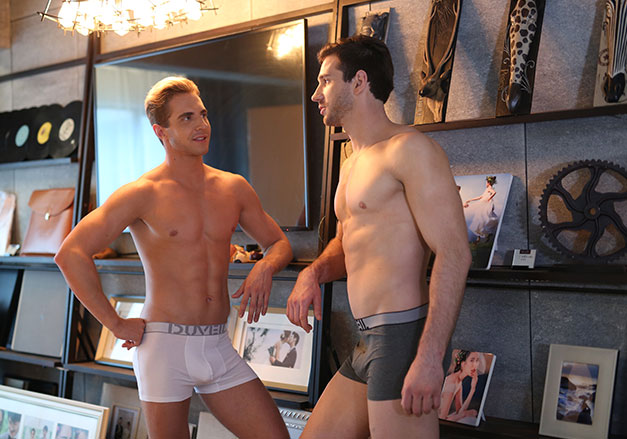
An ODM library lets a brand put underwear on sale in a season rather than a year, because the fit, the pattern and the fabric are already proven. The trade is that the same reference may be available to another buyer next quarter, in your market, at a price you cannot match. Whether that matters depends on what you negotiate before the first order, not on how good the style looks in a photograph.
What does an ODM underwear library actually contain?
Patterns, fabrics and trims that already run.
A working library holds graded patterns for the styles in production, a set of fabrics with published compositions, and a trim and waistband range the factory buys routinely rather than per order.
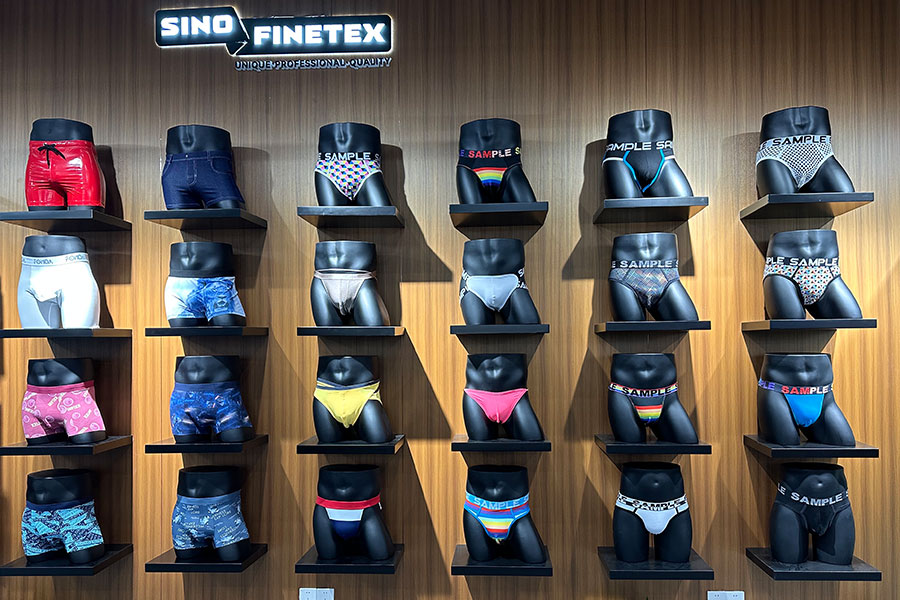
That last part is what separates a library from a catalogue. A catalogue is a set of photographs; a library is a set of documented references with measurements and materials attached, which is why published item codes matter more than the number of styles displayed. In men’s underwear the useful depth is narrow and complete: boxer briefs, trunks, briefs and jockstraps each available in several fabric families, with waistband options that the factory weaves or buys continuously. A factory that maintains references across those four styles can assemble a range without opening a development project, which is precisely the value an ODM programme is meant to deliver.
| Library element | What to look for | Signal of a thin library |
|---|---|---|
| Styles | Item references with measurements attached | Photo gallery with no codes |
| Fabrics | Published compositions and weights | “Premium cotton blend” |
| Waistbands | Woven, jacquard and printed options running now | One elastic, one colour |
| Size range | Graded nests for each style | Sizes quoted per order |
Why are style depth and fabric depth different capabilities?
One is a pattern library, the other a supply relationship.
Style depth is how many garments the factory can make without development; fabric depth is how many fibre options it can offer without a new lot. A factory can be strong in one and weak in the other.
The distinction matters when you plan a range. A brand selling one fit in four fabrics needs fabric depth, because the differentiation comes from modal, bamboo, combed cotton or a nylon blend rather than from a new silhouette. A brand selling four fits in one fabric needs style depth instead. Ask for the compositions of the fabrics currently running, then ask which styles are made in each; the answer usually reveals the factory’s real strength far faster than a product list. Finetex Global publishes eight running blends with exact ratios and stated applications alongside its style references, which is the kind of pairing to look for.
How does exclusivity work in an ODM programme?
It is a clause you negotiate, not a property of the design.
Unless the agreement says otherwise, the factory may sell the same reference to any buyer, in any market, which means your differentiation has to come from branding, fabric or packaging rather than from the style.
Exclusivity should name the territory, the duration and the scope. Territory matters more than buyers expect: a design exclusive to you in Germany can legitimately be sold to a competitor in the United States, and if you sell cross-border the protection is thinner than it appears. Duration decides whether you are protected for one season or for the life of the programme. Scope decides whether the restriction covers the style, one colourway, or the fabric itself — and a fabric-level restriction is often cheaper to obtain than a style-level one, because it constrains less of the factory’s business. Ask which other buyers currently take the reference, described in general terms, and expect a volume or price commitment in exchange for real exclusivity.
What can you still customise on an ODM style?
Everything except the pattern, if you choose well.
Branding is fully customisable, fabric is usually selectable within the running range, and trims and packaging are open; the pattern and the graded nest remain the factory’s.
For underwear brands, the waistband is the highest-value element to customise, because it is the part customers see in use. Woven and jacquard bands, heat-transfer labels, printed logos, woven tags and hangtags are all standard instruments, and Finetex Global lists them within its customisation scope alongside full size grading and ergonomic pattern adjustment where the block allows. Where you want a change that touches the pattern — a longer inseam, a higher rise — treat that as an OEM step rather than an ODM variation, because altering a graded block is development work rather than decoration.
How should you consolidate an ODM order?
Fewer references, deeper quantities, one fabric family.
Minimums in ODM are usually set by the fabric lot, the trim and the colour count rather than by the style, so consolidating across styles that share a fabric reduces the threshold instead of multiplying it.
A practical first order therefore runs two or three references in one fabric family and one or two colours, which also keeps the size curve meaningful per style. Ask the factory which of your chosen references share a fabric, and whether the waistband is common across them: where it is, the tooling is incurred once. Buyers who treat the first ODM order as a range built from shared components usually reach the second order with their branding already amortised, and they can extend the range later by adding a reference rather than by rebuilding the specification.
What should you verify in the first pair?
Fit through a working day, then behaviour after washing.
Wear the sample for a full day before judging the fit, then wash it repeatedly and reassess the waistband, the leg openings and the shape of the gusset before you approve the style.
The checks that matter are unglamorous: whether the waistband recovers to its original circumference, whether the leg elastic rolls, whether the fabric pills where the thighs meet, and whether the colour holds. In an ODM programme you cannot change the construction without leaving the model, so the purpose of the sample is not to correct the garment but to decide whether the reference is good enough to sell. Ask for the fabric composition and weight in writing at the same time, so you can describe the product accurately on your own site.
Two or three wash cycles will usually settle the question. If the waistband has lost its shape, the leg elastic has begun to roll or the surface has pilled after that, the reference is not a product you can build a brand on, however good it looks in a photograph on the day it arrives.
How much branding can an ODM style carry?
Enough to be recognisable, if spent where customers look.
The visible branding positions in underwear are the waistband, the sewn-in label and the packaging, and those three carry more identity than any print placed on the fabric.
Branding depth also affects the minimum, because each element has its own tooling or supplier threshold. A printed band needs artwork and a run; a woven band needs a weaving programme; a heat-transfer mark needs a plate. Decide which single element carries the brand and treat the rest as standard, then confirm what each choice does to the threshold and the lead time. Where a brand is launching its first range, the waistband plus a consistent label set is usually enough to look established without multiplying tooling.
When should you move to your own block?
When the reference reorders reliably.
A competitor appearing in the same design is the second signal, and either one justifies the development cost: a proprietary block converts a product anyone can buy into one only you can sell.
The transition is less disruptive than it sounds. Fabric, trims and the size curve usually carry over; what changes is the pattern, the graded nest and the fit specification, which move from the factory’s library into your ownership. Plan it as a development project rather than a switch, and run the new block in parallel with the ODM reference for one cycle so availability is not interrupted. Buyers who time the upgrade to the second or third order typically keep their listing history and their reviews intact.
What compliance work remains on a design you did not develop?
All of it, because the label is your responsibility.
Fibre content, care instructions, origin marking and any market-specific text belong to the brand placing the goods on the market, whether or not it designed the garment.
Because you did not develop the reference, you also have less visibility of the material chain behind it. Ask which fibres are declared on the composition label and whether those declarations can be evidenced, which tests have been performed on the fabric, and which claims the supplier will support in writing. Keep the answers with the approved sample. If a claim cannot be supported, remove it rather than softening the wording; an unverifiable statement about fibre or performance creates a risk that no amount of good design compensates for.
FAQ
Is an ODM underwear design exclusive to my brand?
Only if the agreement says so. Exclusivity has to name the territory, the duration and the scope, and it is normally exchanged for a volume or price commitment. Ask which other buyers currently take the reference, and consider seeking exclusivity at fabric or colourway level rather than for the whole style, which is often easier to obtain.
How do I choose between OEM and ODM for underwear?
Choose ODM when you need speed and a proven fit, and OEM when you need a pattern you own. Many brands start with ODM to test demand and convert to OEM once a style reorders, keeping the fabric, the trims and the size curve and replacing only the pattern and fit specification.
What should I check on an ODM underwear sample?
Wear it for a working day, then wash it repeatedly. Check that the waistband recovers, the leg elastic does not roll, the gusset keeps its shape and the colour holds. Ask for the fabric composition and weight in writing so your product page describes the garment accurately, and keep the sample as the reference for the reorder.
How much does it cost to brand an ODM style?
Branding cost is driven by the elements you choose rather than by the style. A sewn-in label and printed care label are inexpensive; a woven waistband requires a weaving programme; a heat-transfer logo needs a plate. Decide which single element carries your identity, keep the rest standard, and ask for the tooling and the threshold attached to each option before you commit.
Next step for your team: ask the Finetex Global team for the current underwear references, the fabrics running in each, the waistband options and the exclusivity position per reference, so the ODM decision is made on documented capability rather than on photographs.
Sources: WIPO — industrial designs; USPTO — patent and design protection basics; 16 CFR Part 303 textile labelling; OEKO-TEX STANDARD 100; Textile Exchange standards; ISO 9001 quality management.
More factory-floor notes for brand owners

Sample Revision Limits: How to Control Underwear Development Cost and Calendar
A sample revision limit should control scope, not block necessary correction. The buyer and factory need to distinguish…
Read more →
Lab Dips and Strike-Offs for Underwear: Approval Steps That Prevent Delays
A lab dip approves a dyed textile shade; a strike-off approves printed artwork on the intended substrate. They…
Read more →
Color MOQ Planning: How to Share Fabric Across Multiple Underwear Styles
Color MOQ planning works best when a brand treats dyed fabric as a shared material platform rather than…
Read more →
Underwear Fabric Utilization: How Marker Efficiency Changes Unit Cost
Fabric utilization converts a fabric quotation into a garment cost. The calculation must account for pattern area, fabric…
Read more →
Open Costing for Men’s Underwear: Reading Fabric, Trim, Labor and Overhead Lines
An open-cost sheet is useful only when every line is tied to a measurable specification, a purchasing unit…
Read more →Global Apparel Sourcing Outlook 2026: Cotton, Freight and Supply-Chain Risk
A data-led 2026 apparel sourcing outlook on cotton balances, freight volatility, supplier diversification, lead time, compliance and practical…
Read more →Request a sample & pricing information
Send us your tech pack, target price or a reference sample — we reply with a quotation, a realistic lead time and a fabric recommendation within one working day.
- Free sampling plan & cost breakdown
- MOQ from 300 pcs per style
- Reply within 1 working day