
Jockstrap Manufacturing in China: Building a Support Garment That Survives Sport
A jockstrap is an engineering product: pouch depth, leg-strap angle, elastic modulus and waistband construction decide whether it stays put. See how Chinese factories build them.
.article h2{font:600 21px/1.35 system-ui,sans-serif;margin:34px 0 12px;color:#123a6b}
.article h3{font:600 17px/1.4 system-ui,sans-serif;margin:22px 0 8px}
.article .answer-lede{font-size:17px}
.article table.data{width:100%;border-collapse:collapse;margin:6px 0 20px;font-size:14px}
.article table.data th,.article table.data td{border:1px solid #dfe4ec;padding:9px 11px;text-align:left;vertical-align:top}
.article table.data th{background:#f5f7fb}
.article figure.image-block{margin:22px 0;border:1px solid #dfe4ec;border-radius:8px;padding:10px}
.article figure.image-block img{display:block;width:100%;height:auto;border-radius:5px}
.article figure.image-block figcaption{font-size:13px;color:#5b6675;padding:8px 2px 2px}
.article .faq{border-top:3px solid #123a6b;margin-top:34px;padding-top:6px}
.article .faq-q{font-weight:700;margin:18px 0 4px}
.article .cta{margin-top:30px;background:#f5f7fb;border:1px solid #dfe4ec;border-left:5px solid #123a6b;border-radius:8px;padding:18px 20px}
.article .source-note{font-size:13px;color:#5b6675}
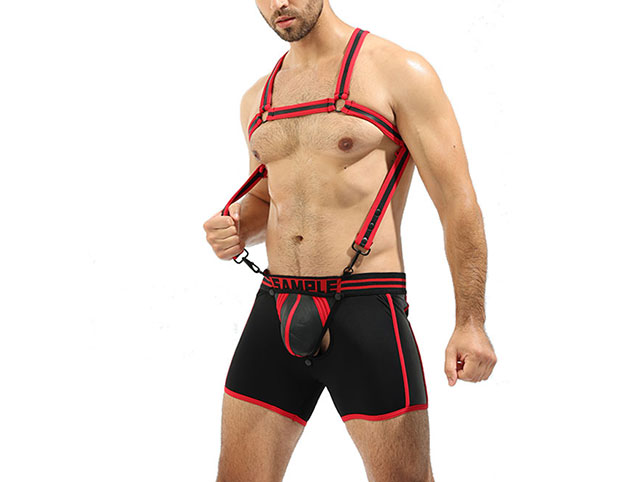
A jockstrap is the most engineering-led garment in men’s underwear and the least tolerant of approximation. It is three components, each with a different job and a different failure mode, and a garment that fails in any one of them is unwearable for its purpose. Construction, not sourcing, is what decides whether it performs.
A jockstrap is three components, each with its own failure mode
Pouch, leg straps and waistband.
The pouch carries and locates, the leg straps hold the pouch in position and take the load in movement, and the waistband anchors the whole assembly, and each of the three fails differently.
The pouch fails when it is too shallow to hold or too deep to sit flat, which produces either migration or bunching. The leg straps fail when the elastic modulus is wrong for the load, which produces either a strap that cuts into the thigh or one that rides up and stops supporting. The waistband fails when it rolls, loses recovery or distorts under the tension that the straps apply to it, which is a load no other underwear waistband experiences. Because the three interact, a fault in one often presents as a fault in another: a strap that migrates may be a strap problem or a waistband problem, and a pouch that feels loose may be correctly made and wrongly angled. Diagnosis starts with separating the three rather than adjusting the whole garment at once.
Pouch construction: depth, contour and support level
The pouch decides where the garment carries.
The pouch has a depth, a contour and a point at which it attaches to the waistband, and those three decisions set whether the garment supports from below or merely contains.
A shallow pouch sits close to the body and relies almost entirely on the straps for support, which is the pattern of a classic athletic support. A deeper pouch with a contoured panel carries more of the load itself and distributes it across the front panel, which is the pattern of a modern performance jockstrap. The attachment point matters as much as the depth: a pouch attached high on the waistband rides differently from one attached lower, and the difference is felt under movement rather than while standing. When reviewing a sample, check what the pouch does when the wearer crouches, twists and runs, because the standing fit tells you very little about a support garment. Where a brand is developing a new block, the useful sequence is to settle the depth first, then the contour, then the attachment point, changing one variable at a time so the effect of each remains visible.
Leg-strap angle and elastic modulus: why cheap straps migrate
Angle and modulus decide whether the strap stays put.
The leg straps hold the pouch in place, and whether they do so depends on the angle at which they leave the waistband and on the elastic modulus of the material rather than on how tight the straps are.
A strap that leaves the waistband at too steep an angle runs across the thigh in a line that the body does not follow, and movement pushes it out of position. A strap that leaves at too shallow an angle can slip towards the groin. The elastic modulus determines how much the strap stretches for a given load and how far it recovers, so a strap with too little modulus will stretch under movement and lose its hold, while one with too much will not stretch enough and will cut. This is where a low-cost garment fails first: the elastic is the component most often substituted, and a substitute with a different stretch behaviour changes the geometry of the whole garment even though it looks the same. The check is a stretch test at the strap, comparing the production against the approved sample for the force needed to reach a given extension and for the recovery afterwards. Where a strap migrates on a correctly measuring garment, the modulus is the first suspect.
Waistband options and the effect on stability under load
The waistband takes a load no other underwear sees.
The waistband anchors the straps, so it experiences a downward and outward pull that a standard brief waistband never encounters, and its construction determines whether the assembly stays stable.
The options are broadly a woven elastic band, a knitted band with a jacquard pattern, and a fabric-covered band with an internal elastic. A woven band provides firmer and more predictable support and is usually the choice for an athletic garment. A knitted band is softer and more comfortable and is more common on a fashion or everyday jockstrap, where the load is lower. A fabric-covered band looks more like a garment and less like sports equipment, and it depends on the internal elastic for its behaviour, which means the internal elastic specification is what should be approved rather than the outer fabric. The measurement that matters is not the relaxed waist but the recovery after being loaded: a band that measures correctly at rest and distorts under a load is the wrong band. Ask how the band is attached, because the attachment seam also carries the load and a weak seam will fail before the elastic does.
Fabric choice: nylon, cotton, performance knits and their feel
The fabric decides the hand, the drying and the durability.
Nylon and spandex blends give the smoothness, durability and quick drying that an athletic garment needs, cotton gives a softer and more familiar feel, and performance knits trade some softness for moisture handling and recovery.
The blend that shows up most often in athletic support garments is a high-elastane knit, and a specification such as an 87 percent nylon and 13 percent spandex knit is representative of the family used where recovery and a close fit are the priority. Cotton and cotton-spandex constructions give a garment that feels like underwear rather than equipment, which suits a brand positioning a jockstrap as an everyday basic rather than a sports item. The practical trade-off is between drying speed, recovery and feel, and it should be decided against the use the garment is being sold for rather than against a general preference. Where the brand sells into a market with restricted-substance requirements, the fabric, the dye and the elastic all have to be checked, which is the subject covered by finished-product testing schemes such as OEKO-TEX STANDARD 100.
Sizing a support garment: the measurements that matter
Size by the strap and the pouch, not by the waist alone.
A jockstrap cannot be sized on waist measurement alone, because the strap length and the pouch depth both vary independently of the waist and both determine whether the garment works.
The measurements that define the fit are the waist at rest and under load, the strap length from the waistband to the pouch attachment, the pouch depth, and the leg opening where the strap passes. Because the strap runs around the top of the thigh rather than around the hip, the thigh measurement matters as much as the waist, and a size range built only from waist figures will fit some customers badly. The grading increments for the strap length are usually smaller than the increments for the waist, because the thigh does not scale proportionally with the waist across a size range. When a size set is approved, the smallest and largest sizes should be worn and moved in rather than only measured, because the extremes are where the geometry fails. This is the point at which a support garment differs most from a standard brief, and it is where most of the fit complaints originate.
Fit testing a jockstrap before bulk approval
Test it in movement, not standing still.
Fit testing has to include movement, load and duration, because a support garment can fit perfectly while standing and fail within minutes of activity.
The test sequence that produces information is to check the fit at rest, then in a squat, then in a stride, then in a run, then after a period of wear long enough for the elastic to warm and relax. Each of those stages reveals a different fault: the squat tests the pouch depth and the strap angle, the stride tests whether the strap rides, the run tests the waistband under repeated load, and the duration tests recovery. Ask the testers to describe what happens rather than whether it fits, because the useful information is directional: did the strap move up, down or inwards, and at which point in the movement. Where a fault appears, changing the strap angle and the strap length separately is what allows the cause to be identified, because the two produce similar symptoms and different corrections.
Wash and stretch-recovery testing across a season of use
Test recovery, not just appearance.
Wash testing matters more on a jockstrap than on a standard garment, because the elastic does the work and the elastic is what laundering degrades first.
The test should run a relevant number of wash and dry cycles and check the strap and the waistband for loss of recovery rather than only for visible damage. Loss of recovery is measured by comparing the relaxed length and the extension behaviour before and after the cycles, not by looking at the garment. The straps are the most sensitive component because they are thin, loaded and repeatedly stretched, and a strap that has lost a small amount of recovery will migrate where it previously held. The waistband’s resistance to rolling should also be checked after cycling, since a band that rolls under a light load before washing will roll sooner after. The number of cycles should reflect how often the garment is laundered in use rather than the default used for a casual garment.
MOQ and colour programmes for a specialist style
The components set the minimum, and the colour range sets the risk.
A jockstrap is a specialist style with several custom components, so its minimum is usually produced by the elastic and the trim rather than by the sewing, and the colour range multiplies that.
Because the garment uses more elastic per unit than a standard brief, and because a custom strap width or jacquard pattern has to be produced to order, the elastic is frequently the component that sets the floor. The pouch fabric adds a second constraint where it is a custom knit or a specific colour, and the waistband adds a third where it is woven or jacquard patterned in a brand-specific design. The practical approach for a first order is to reduce the number of custom components: use a stock elastic width and pattern, standardise the waistband across the range, and concentrate the customisation in the print or the label. That usually allows a small first order in a single or dual colour programme, and it preserves the ability to extend the range later once the sizing and the fit have been validated. Where the colours are the point of the programme, the brand should plan the dye minimum per colour rather than per style, because each colour is a separate lot. The sports-brand jockstrap sourcing guide covers how a programme is structured once the construction has been settled.
Compliance and labelling for sports underwear in the US and EU
The label follows the fabric, and the fabric follows the market.
A sports underwear garment is subject to the same fibre content, care labelling and origin marking requirements as any other apparel item, and those requirements differ between the United States and the European Union.
The United States requires the fibre content to be disclosed and the country of origin to be marked, and the care instructions have to reflect the actual behaviour of the fabric and the elastic. The European Union applies its own labelling framework, and the care symbols and content statements differ enough that a single label design frequently has to be adapted for the two markets. Where the product carries a performance claim, the claim itself is a separate compliance question from the label: a statement about moisture handling or support should be supportable, and a claim that implies a medical or therapeutic function can bring the product within a different regulatory category. For a support garment this boundary deserves attention, because it is easy to write marketing copy that promises a physical effect rather than a garment’s behaviour. The US textile labelling rules set out the base content and care requirements.
Where jockstraps fit in a men’s basics or team range
A specialist style with a specific audience.
A jockstrap is not a volume basic and should not be planned as one, but it can be the style that defines a brand’s sporting credibility in a range of otherwise conventional products.
Three commercial frames work. The athletic frame positions the garment for team sport and training, where the requirements are support, durability and a size range that covers the customer base. The performance frame positions it alongside compression and technical base layers, where the fabric and the construction carry the claim. The fashion frame positions it as an everyday item with a distinctive look, where the fabric, colour and branding carry the value and the support requirement is lighter. Each frame implies a different specification, and a garment built for one will be wrong for another: a fashion jockstrap built to an athletic specification is over-engineered and overpriced for its market, and the reverse is a product that fails in use. Deciding the frame before the specification is what prevents a range that is technically sound and commercially misplaced. Where the brand already runs a men’s basics programme, the jockstrap is best launched as a single well-specified style in a tight size range rather than as a full colour programme, because the sizing behaviour has to be proved on real customers before the range is extended.
FAQ
How should a jockstrap fit at the leg straps?
The straps should sit at the top of the thigh without cutting and without riding up, and they should hold their position through a squat, a stride and a run. If they move, check the strap angle first and the elastic modulus second, before adjusting the strap length.
What elastic is used in jockstrap leg straps?
An elastic chosen for its modulus and recovery rather than its appearance. A strap that stretches too easily loses its hold and migrates; one that is too firm cuts into the thigh. Compare the production against the approved sample for the force needed to reach a given extension, and for recovery afterwards.
What is the MOQ for custom jockstraps from a Chinese factory?
The minimum is usually set by the elastic and the trim rather than by the sewing, because the garment uses more custom elastic per unit than a standard brief. Using stock elastic widths and a standardised waistband is the usual way to reduce it.
How do I wash-test a jockstrap before a bulk order?
Run a relevant number of wash and dry cycles, then measure the relaxed length and the extension behaviour of the straps and the waistband rather than only looking at the garment. The straps are the most sensitive component because they are thin, loaded and repeatedly stretched.
Next step for your team: send the Finetex Global team your jockstrap concept and intended use, and ask which pouch depth, strap angle and elastic specification would suit, plus how the fit and recovery would be tested before bulk approval.
Sources: OEKO-TEX STANDARD 100; 16 CFR Part 303 textile labelling; FTC textile labelling guidance; Textile Exchange standards; ISO 9001 quality management.
{“@context”:”https://schema.org”,”@type”:”FAQPage”,”mainEntity”:[{“@type”:”Question”,”name”:”How should a jockstrap fit at the leg straps?”,”acceptedAnswer”:{“@type”:”Answer”,”text”:”The straps should sit at the top of the thigh without cutting and without riding up, and they should hold their position through a squat, a stride and a run. If they move, check the strap angle first and the elastic modulus second, before adjusting the strap length.”}},{“@type”:”Question”,”name”:”What elastic is used in jockstrap leg straps?”,”acceptedAnswer”:{“@type”:”Answer”,”text”:”An elastic chosen for its modulus and recovery rather than its appearance. A strap that stretches too easily loses its hold and migrates; one that is too firm cuts into the thigh. Compare the production against the approved sample for the force needed to reach a given extension, and for recovery afterwards.”}},{“@type”:”Question”,”name”:”What is the MOQ for custom jockstraps from a Chinese factory?”,”acceptedAnswer”:{“@type”:”Answer”,”text”:”The minimum is usually set by the elastic and the trim rather than by the sewing, because the garment uses more custom elastic per unit than a standard brief. Using stock elastic widths and a standardised waistband is the usual way to reduce it.”}},{“@type”:”Question”,”name”:”How do I wash-test a jockstrap before a bulk order?”,”acceptedAnswer”:{“@type”:”Answer”,”text”:”Run a relevant number of wash and dry cycles, then measure the relaxed length and the extension behaviour of the straps and the waistband rather than only looking at the garment. The straps are the most sensitive component because they are thin, loaded and repeatedly stretched.”}}]}
More factory-floor notes for brand owners

Sample Revision Limits: How to Control Underwear Development Cost and Calendar
A sample revision limit should control scope, not block necessary correction. The buyer and factory need to distinguish…
Read more →
Lab Dips and Strike-Offs for Underwear: Approval Steps That Prevent Delays
A lab dip approves a dyed textile shade; a strike-off approves printed artwork on the intended substrate. They…
Read more →
Color MOQ Planning: How to Share Fabric Across Multiple Underwear Styles
Color MOQ planning works best when a brand treats dyed fabric as a shared material platform rather than…
Read more →
Underwear Fabric Utilization: How Marker Efficiency Changes Unit Cost
Fabric utilization converts a fabric quotation into a garment cost. The calculation must account for pattern area, fabric…
Read more →
Open Costing for Men’s Underwear: Reading Fabric, Trim, Labor and Overhead Lines
An open-cost sheet is useful only when every line is tied to a measurable specification, a purchasing unit…
Read more →Global Apparel Sourcing Outlook 2026: Cotton, Freight and Supply-Chain Risk
A data-led 2026 apparel sourcing outlook on cotton balances, freight volatility, supplier diversification, lead time, compliance and practical…
Read more →Request a sample & pricing information
Send us your tech pack, target price or a reference sample — we reply with a quotation, a realistic lead time and a fabric recommendation within one working day.
- Free sampling plan & cost breakdown
- MOQ from 300 pcs per style
- Reply within 1 working day