
Henley T-Shirts: Placket Construction and Demand
How placket length, button stance and rib collar work together on a Henley T-shirt, and why the style repeats in small brand lines.
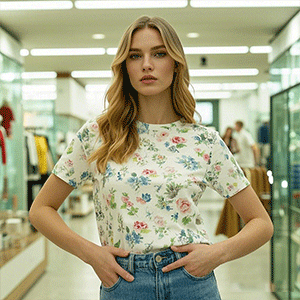
Answer first: A Henley works or fails at the placket. The length of the opening, the number and spacing of the buttons, and the rib collar that finishes the neck have to be designed as one unit. If the placket is too short, the collar distorts when the top button is opened; if it is too long or too soft, the front grows a gap after wash. This article explains that construction, the demand pattern that keeps the style in small brand lines, and how to develop one with a knit factory. It is a construction guide, not a sales forecast. We publish no order volumes or repeat-purchase rates.
A Henley is a knit top with a short buttoned opening at the front of a round or slightly scooped rib neck, rather than a full shirt placket or a plain crew. It sits in the same manufacturing family as the T-shirts covered on our T-shirt manufacturing page and is developed through the same sampling route as other knit tops: a development sample in 5–7 working days after artwork and fabric are confirmed, and a size set in 10–12 working days. Construction detail belongs in the tech pack, not only in a sketch.
Placket construction: length, facing and support
The placket is a reinforced slit. On a cotton or cotton-blend jersey Henley it is usually cut as a separate facing, folded and stitched to the front opening, with a clean finish on the inside so the garment can be worn open at the top button. Two construction choices control most of the appearance:
- Placket length. Measured from the neck seam, or from the high point of the shoulder if you prefer a single reference, down to the bottom of the placket. A short placket, often in the region of two buttons, reads as a T-shirt with a small opening. A longer placket, three or four buttons, reads closer to a light shirt and needs more support so the front does not drop. The length must be written as a measurement, with a tolerance, not only as a button count.
- Placket construction. A self-fabric facing is the usual path on mid-weight jersey. A contrast or herringbone tape can clean the edge on a heavier or slub fabric. A very light single-layer placket looks clean at approval and often rolls or stretches after wash. A fusible or sew-in support in the placket, kept narrow so it does not print through, is the usual remedy. The support has to be washed with the garment in development; do not approve a placket only in the dry state.
The top of the placket has to meet the rib collar in a planned junction, not in a clash of two thicknesses. If the rib is bulky and the placket facing is bulky, the join sits proud and the first button stance is pushed off centre after a few washes. That junction should be sampled in the actual fabric, not in a substitute mid-weight.
Button stance and count
Button stance is the distance from the neck, or from a stated reference point, to the first button, and then the spacing between buttons. It is a measurement set, not a “standard Henley” guess.
A two-button placket is common on a closer, T-shirt-like Henley. A three-button placket is common when the opening is longer and the wearer is meant to leave the top button undone. Four buttons appear on longer or more shirting-like versions. The count is a design choice; the risk is spacing that looks even on a size medium and crowded or gapped on a size small or XL if the placket length is graded and the stance is not.
Write, and then measure on the size set:
- Distance from the neck seam to the first button centre.
- Centre-to-centre spacing of the remaining buttons.
- Button diameter and type (typically a two- or four-hole sew-through, sometimes a small snap on performance fabrics).
- Buttonhole length and whether the holes are horizontal or vertical. Horizontal holes on a knit placket can gape; vertical holes are the usual choice on jersey, but they must be long enough for the actual button, including any wash shrinkage of the hole.
Buttons and thread are findings. They still need a specified colour, a specified attachment (lockstitch or bartack), and a spare-button policy if the brand requires one. A loose or rotating button is a common after-sale complaint, because the placket is handled every wear.
| Design choice | Typical use | What must be specified | What usually goes wrong |
|---|---|---|---|
| Two-button, shorter placket | A T-shirt-like Henley, often worn closed or with only the top button open | Placket length from a stated point, first-button stance, vertical buttonholes | The opening looks tight, or the collar distorts when the top button is undone |
| Three- or four-button, longer placket | A more shirting-like Henley, often worn with the top button open | The same measurements, plus support in the placket so the front does not drop | A soft facing grows a gap after wash; button spacing is not graded with the length |
| Rib collar to placket join | Every Henley, regardless of button count | Rib density and width, even left and right joins, neck drop and opening width | A bulky or stretched join pushes the first button off centre after wash |
The rib collar has to match the placket
The collar on a Henley is usually a rib band, not a shirt collar stand. It has the same jobs as any T-shirt neck rib — recover after being pulled over the head, sit flat, and not grow — plus one more: it has to stay balanced when the placket is open. Our earlier article on T-shirt neck rib stretching out covers recovery and growth; this style adds a break in the circle.
Three construction points matter:
- Rib density and width. A fine, low-density rib on a wide band looks soft at approval and often waves or rolls once the top button is undone. A tighter rib, in a width that is in proportion to the placket width, gives the open neck a clean edge. The rib should be specified by yarn, gauge or density, width, and a recovery or growth method agreed in development — not only by a photo.
- Join to the placket. The rib ends have to be caught securely into the top of the placket, with the same width on left and right. A rib that is stretched onto the neck and then cut to meet a pre-sewn placket will often sit longer on one side after wash.
- Neck drop and opening. Because the placket can be worn open, the neck drop and the width of the opening at the first button should be measured on the body, not only as a collar circumference. If those measurements are missing, two factories will interpret “a classic Henley neck” differently.
If the neck is unstable, changing the placket length alone rarely fixes it. The rib, the tape or support at the neck, and the placket have to be adjusted together. That is the same logic as the three process options in a neckline-stability discussion: rib, taping and interlining are complementary tools, not interchangeable stickers.
Why the style stays in small brand lines
The Henley is a modest fashion idea. It reads as a T-shirt when closed and as a slightly more finished top when open, so a small brand can show two wears from one block. That is the repurchase logic, stated qualitatively: the style can earn a second colour, a long-sleeve version, or a heavier fabric without a new pattern family. We do not invent a repeat-rate or a category share.
What does tend to keep the style in a line, in our development experience, is consistency rather than novelty:
- The same placket length and stance across colours, so a returning customer does not receive a different opening.
- A fabric that can be repeated. A stock or well-controlled jersey is easier to repeat than a one-lot slub that cannot be matched.
- A collar and placket that still look right after wash, because this is a garment people wear as a basic, not only on a shoot.
The same logic is why a poorly specified Henley is a costly basic: a wavy collar or a gapping placket is visible on a product the customer expected to be simple. Construction discipline is the commercial argument, not a trend claim.
How to develop a Henley with the factory
Treat the Henley as a specified knit top, not as a T-shirt with buttons added at the sample stage. A useful development file includes:
- Front and back sketches with the placket length, button count and neck shape dimensioned.
- Fabric specification (composition, weight, gauge) and a rib specification that is separate from the body fabric if the rib is a different yarn or density.
- A measurement chart that includes the placket length, first-button stance, button spacing, neck width, front neck drop and collar width, with tolerances. Our guide to measurement points for knit tops is the place to start; add the placket points to it.
- Button, thread and any fusible or tape details, including a wash method for the first sample.
- A comment on how the garment should be worn in photography and in the size set — top button open, closed, or both — so approval is not made on a single pose.
Sampling follows the published route: a development sample in 5–7 working days after artwork and fabric are confirmed, and a full size set in 10–12 working days. Bulk production is 15–45 days from deposit and an approved pre-production sample, depending on quantity, fabric availability and trim lead times. Standard minimums are 300–1,000 pieces per style, mixed sizes, with stock fabrics able to start at 300 and a fully custom knit or dye lot usually starting at 1,000 pieces per colour.
The design and development path sits on our apparel design page. The manufacturing path sits on T-shirt manufacturing and the custom T-shirt manufacturing guide. Approve the placket and collar on a washed sample in the bulk fabric before you lock the size set.
What is fact, what is advice and what is uncertain
Fact: Finetex’s published sampling times, bulk lead time and minimums are as cited above. A Henley is a knit top and is produced on the T-shirt manufacturing route described on the live product page.
Advice: the placket-length, button-stance and rib-matching points, and the development file list, are our practical construction reading. The repurchase discussion is qualitative and is not a market statistic.
Uncertain: the “right” placket length and button count are brand decisions. Wash behaviour depends on the actual fabric, rib and support; it has to be tested on the sample, not assumed from a previous style.
Related reading
- Men’s Polo Shirt Manufacturing: Pique, Interlock and Collar Construction
- Garment Measurement Points for Knit Tops: The 12 Numbers Buyers Argue About
- Importing T-Shirts into the UK: Post-Brexit Rules, UKCA and Textile Labelling
- Grading Rules for Knit Tops: Where Size Sets Fail
Frequently asked questions
How long should a Henley placket be?
There is no single correct length. Write it as a measurement from a stated reference point, with a tolerance, and match it to the button count and the rib collar. A two-button opening reads closer to a T-shirt; a three- or four-button opening needs more support so the front does not drop after wash.
Why does a Henley collar look uneven after washing?
Usually because the rib, the placket join and any neck support were not developed as one unit. A rib stretched onto the neck, or a bulky join at the top of the placket, often shows up only after wash. Approve a washed sample in the bulk fabric.
Can I add a placket to an existing crew-neck T-shirt pattern?
You can start from that block, but you still need new measurements for placket length, button stance, neck width and neck drop, plus a rib and support specification. Treating it as a last-minute sample change is how gapping and a twisted collar enter bulk.
What should I send to start development?
Dimensioned sketches, a fabric and rib specification, a measurement chart that includes the placket points, and button details. We will work from that file through a development sample and, once the washed placket is approved, a size set.
Sources
- Finetex: Custom T-shirt manufacturer
- Finetex: Apparel design and development
- Finetex: T-shirt neck rib stretching out
- Finetex: Custom T-shirt manufacturing guide
Send a Henley for sampling
Share the fabric direction, the placket length and the button stance you want to lock. We will sample the collar and placket in the actual fabric, wash them, and return a development sample you can measure.
Contact us to request a sample, or start from our T-shirt manufacturing page.
More factory-floor notes for brand owners
Selling Underwear in Germany: Textilkennzeichnung, LUCID and Packaging Law
German textile labelling, LUCID registration and packaging law for underwear brands after the PPWR and VerpackDG took effect…
Read more →
GSM to Ounce Converter and Fabric Weight Chart
Convert fabric weight between gsm and oz/yd² with the exact factor (1 oz/yd² = 33.906 g/m²), a T-shirt…
Read more →
First-Output Check: The In-Line Inspection That Saves Bulk
What to check on the first garments off each line: measurements, seams, labels and print against the approved…
Read more →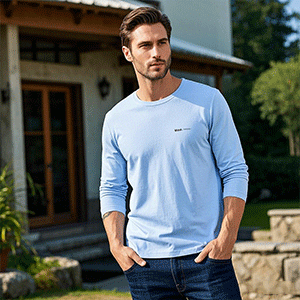
A Fit Session Protocol for Knit Tops: 12 Wearers, 5 Measurements
A recommended fit session protocol for knit tops: recruit 12 wearers, take five measurements, run a movement checklist,…
Read more →
Corporate Uniform Programs: Tendering, Sizing and Reorders
How to run a corporate uniform program with a factory: tender documents, sizing a workforce, producing many sizes…
Read more →
Muscle Fit and Athletic Fit T-Shirts: Pattern Changes That Matter
How muscle fit and athletic fit T-shirts differ from a classic block: chest-to-waist drop, sleeve cap and bicep,…
Read more →Request a sample & pricing information
Send us your tech pack, target price or a reference sample — we reply with a quotation, a realistic lead time and a fabric recommendation within one working day.
- Free sampling plan & cost breakdown
- MOQ from 300 pcs per style
- Reply within 1 working day