
Why does a T-shirt neckline stretch out after washing?
Why a T-shirt neckline stretches out after washing: rib construction, elastane content, rib length and tension, seam and stitch choice, and how to specify and test…
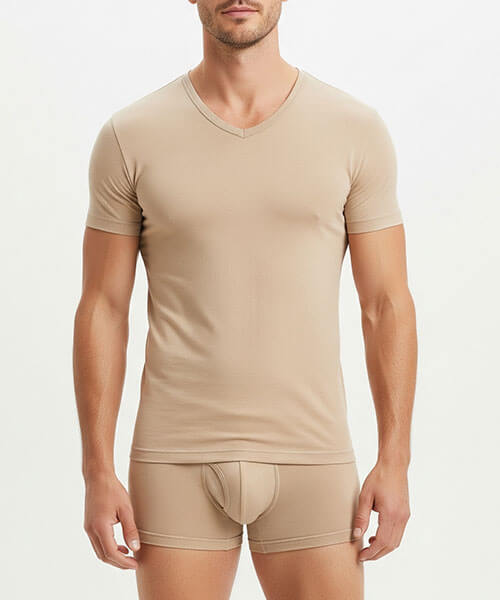
Part of T-Shirts, Undershirts & Tank Tops in Finetex Talk — buyer questions answered by the Finetex editorial team.
A brand's cotton T-shirts look fine when new, but customers complain that the neckline becomes wavy and loose after a few washes. The factory says the rib is standard 1×1 cotton. The team wants to know why and what to change.
Short answer: A neckline stretches out when the rib cannot recover after being pulled over the head and washed. Common causes are a rib with little or no elastane, a rib that is too loose or too short in stitch density, a rib cut too long for the neck opening so it is not under tension, or a seam and stitch that do not hold the rib firmly. Heavy wear and hot drying make it worse. Fix it by specifying a rib with better recovery, often with a small amount of elastane, setting rib length as a ratio of the neck opening, using a suitable seam and stitch, and testing recovery and appearance after washing.
Causes
- 100% cotton rib with low recovery.
- Loose rib knitting or low weight.
- Rib cut too long, so it sits without tension.
- Neck opening too large in the pattern.
- Seam not holding the rib evenly.
- Hot washing and tumble drying.
What to change
- Use a rib with elastane for better recovery.
- Specify rib weight and construction.
- Set rib length as a percentage of neck opening and test it.
- Use a seam with a cover stitch or tape for stability.
- Check neck opening and depth in the pattern.
Testing
- Stretch and recovery of rib fabric, for example with ASTM D4964.
- Dimensional change after washing with ISO 5077, using an ISO 6330 procedure.
- Measure neck width and depth relaxed and after stretching over a head form.
- Wash several times and inspect for waviness.
Production checks
- Check rib length and seam tension on the line.
- Compare neck measurements with the specification.
- Check that rib lots match the approved standard.
A worked example
For the shirts in the question, compare the current rib with a rib containing elastane of similar weight. Shorten the rib slightly relative to the neck opening, sample both, wash five times and measure neck width and waviness. Approve the one that keeps its shape.
Cost
A rib with elastane may cost slightly more and need different heat setting, but it often reduces returns.
Construction choices
A neck with back neck tape and a cover stitch holds shape better than a simple overlocked rib. Bound necks and self-fabric necks behave differently again, so test the construction together with the rib rather than changing the rib alone.
Limits
Neck shape also depends on how customers wear and wash shirts. Tests reduce problems but cannot remove them.
Facts, recommendations and uncertainty
Established: neck rib stretching comes from low recovery, loose or long rib, pattern and seam choices and harsh laundering. Recommendation: specify a recovering rib, control rib length and seam, and test after washing. Uncertain: how much elastane is needed for a given fabric.
Sources and further reading
- ASTM D4964 — Tension and elongation of elastic fabrics
- ISO 5077:2007 — Determination of dimensional change in washing and drying
- ISO 6330:2021 — Domestic washing and drying procedures for textile testing
Standards and regulations are referenced by their published scope. Test parameters, cycles and pass levels should be agreed with your laboratory for the specific product; legal requirements should be confirmed for each destination market.
Three more perspectives
Ask the factory for the rib composition, weight and supplier, and include them in the specification. Request rib samples with and without elastane. Ask how rib length is cut and controlled on the line. Agree neck measurements and tolerances after washing in the purchase specification, so you can check bulk against a clear standard. Ask whether the factory buys rib from the same mill as the body fabric, since matched rib and body make colour and shrinkage easier to control. Ask for wash test results on the finished neck.
In product development, set the rib length ratio and test it on samples. Compare ribs with different elastane levels and weights. Check neck opening on the pattern and adjust if needed. Wash and wear samples to see how the neck behaves over time, and record the approved rib and ratio in the tech pack. Try the shirt on and off several times during fitting, because pulling over the head is what stretches the neck most, not normal wear. Check neck shape in photos after washing.
In quality control, measure neck width and depth on sampled pieces, relaxed and after stretching. Check rib length and seam consistency. Wash a few pieces per lot and inspect for waviness. Compare rib lots with the approved standard, and record problems by sewing line, since tension settings vary between operators. Check neck appearance on finished pieces laid flat before folding, since waviness is easier to see then than after packing.
Related products
Related articles
- V-Neck T-Shirt Manufacturing: Depth, Rib and Why Most V-Necks Undersell
- Crew Neck T-Shirt Manufacturing: Neck Rib, Taping and the Details That Decide Repeat Purchases
- T-Shirt Necklines: Crew, Scoop, and V-Neck Options for Your Line
- T-Shirt Inspection Checklist Ranked by Return Risk
- T-Shirt Manufacturing Step by Step: Twelve Stages From Yarn to Packed Carton
- How to Start a Private Label T-Shirt Brand: Choosing Between POD and Manufactured Stock
- Modal T-Shirt Manufacturing: Specifying a Softness Fabric So It Keeps Its Shape
- Bamboo T-Shirt Manufacturing: Where the Fibre Works and Where It Disappoints
- Organic Cotton T-Shirt Manufacturing in China: The Certification and the Cost Premium
- Garment-Dyed T-Shirts: What the Process Changes in Colour, Shrinkage and Lead Time
← More in T-Shirts, Undershirts & Tank Tops · All Talk topics · Ask us about your programme
More factory-floor notes for brand owners

What should I check on a novelty hoodie such as an eye-mask hood?
What to check on a novelty hoodie such as an eye-mask hood: hood structure and lining, visibility and…
Read more →How should I size a unisex hoodie?
How to size a unisex hoodie: choosing a base block, body measurement ranges, ease, sleeve and body length,…
Read more →What care instructions should a hoodie carry?
What care instructions a hoodie should carry: the elements of a complete washing instruction, warnings for prints and…
Read more →
How do I match colour across hoodie and jogger sets?
How to match colour across hoodie and jogger sets: same fabric lot, rib and trims, dyeing method, shade…
Read more →How many colourways can I order at hoodie MOQ?
How many colourways a hoodie order can include at MOQ: how factories set minimums per style, colour and…
Read more →Why does a dark hoodie stain other clothes?
Why dark hoodies stain other clothes: dye bleeding in washing, rubbing transfer, perspiration, unfixed dye and pigment, and…
Read more →Request a sample & pricing information
Send us your tech pack, target price or a reference sample — we reply with a quotation, a realistic lead time and a fabric recommendation within one working day.
- Free sampling plan & cost breakdown
- MOQ from 300 pcs per style
- Reply within 1 working day