
Big & Tall Men’s Basics: Grading, Stretch and Sizing Gaps
Why 2XL and up is not a scaled-up medium: the shoulder, armhole, hem and fabric recovery changes a big and tall basics range needs before bulk.
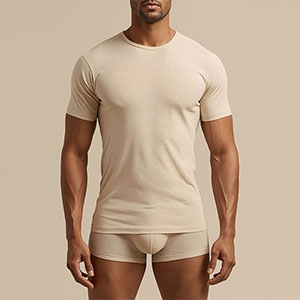
Answer first: A big and tall range is not a medium pattern multiplied by a bigger number. Above 2XL, a basic T-shirt, undershirt or crew needs its own decisions on shoulder width, armhole depth, sleeve opening, body length and hem sweep, and the fabric has to recover from more stretch over a wider panel. Brands that simply extend an S–XL grade into 3XL and 4XL usually get the same complaints: tight upper arms, a hem that rides up over the stomach, a neckline that grows, and a “tall” size that is only longer, not proportioned. The safer method is to treat big (wider) and tall (longer) as two separate problems, build or adapt a block for each, choose fabric for recovery rather than only for weight, and prove the result on a washed, worn size set before bulk.
This article is a factory-side guide for men’s knit basics. It builds on our earlier article on grading rules for knit tops and why 2XL fails first. Finetex publishes a garment size range of XS to 4XL with custom grading on its capabilities page and on its T-shirt manufacturing page. Sizes beyond 4XL, or a separate tall run, are something to confirm in writing at quotation stage, not to assume. The numbers below are illustrations for method only; they are not a Finetex size chart and not a population survey.
Where the sizing gap actually is
Most basics ranges are designed, fitted and wear-tested around a medium or large. The ends of the range get much less attention, and the big end gets the least, because the volume forecast is smaller and the sample budget is spent early. That is where the gap opens.
There are three separate gaps, and they need different fixes:
- The “big” gap. The wearer needs more chest, waist and upper-arm room, often more than the chest grade alone provides. Length may be ordinary.
- The “tall” gap. The wearer needs more body length and sleeve length, while chest and waist may sit within the regular range.
- The “big and tall” overlap. Both apply. This is the hardest block because extra width and extra length change how the fabric hangs and how far the hem travels when the wearer moves.
Published body-measurement tables show why one grade cannot cover all three. ASTM maintains separate standard tables for the regular adult male range and for big men. The current ASTM D6240/D6240M tables list adult male body measurements for chest sizes 34 through 52 in Short, Regular and Tall. A different standard, ASTM D8077/D8077M, lists body measurements for the mature big men figure type, sizes 46–64. Both state that they are body measurements, which can be used as a baseline in designing apparel once fabric type, ease, styling and fit are considered. The fact that the big range is a separate figure type, with its own table, is the practical point: a big body is not simply a regular body scaled up.
Those standards are sold by ASTM and we have not reproduced their values here. Your own return data or customer measurements are usually more specific to your buyer than any general table.
What changes in the pattern above 2XL
The table shows the pattern points that usually need a decision at the big end. The “regular grade habit” column describes a common shortcut; the right-hand column describes what we would check instead. Every number in later sections is illustrative.
| Point | Regular grade habit | What a big or tall block usually needs checked |
|---|---|---|
| Shoulder width | Same step as through the mid sizes | Often a smaller step than chest, so the shoulder seam does not fall onto the upper arm |
| Armhole depth | Grows by a fixed small step | Enough depth for upper-arm girth without dropping so far that the sleeve lifts the body when the arm rises |
| Sleeve opening and bicep | Grows with chest | Checked separately against upper-arm room; a tight sleeve is one of the most common big-size complaints |
| Front and back body | Symmetrical grade | Some blocks add more room to the front than the back; confirm on a wearer rather than on a flat chart |
| Hem sweep | Same as chest | Enough width that the hem does not grip and ride up over the stomach |
| Body length | Fixed step per size | “Big” may need only modest length; “tall” needs extra length at every chest size |
| Sleeve length | Fixed step per size | Tall sizes need more; big-only sizes may not |
| Neck width and drop | Grows with chest | Often grows less than chest; an over-graded neck looks wide and stretches out |
Shoulder and armhole: the first points to go wrong
When a grade is extended mechanically, the shoulder keeps widening at the same rate as the chest. By 3XL the shoulder seam can sit off the shoulder point, the sleeve cap drops, and the top looks like a different, sloppier fit from the medium. The opposite error is common too: the shoulder is held, the chest grows, and the armhole has to absorb all the extra girth. The result is a tight upper arm or a sleeve that pulls the side seam upward.
A practical approach is to agree with the pattern maker that the shoulder grade is allowed to slow down at the big end while the chest, waist and armhole carry more of the increase. Then test it on bodies, not on a flat table.
Hem and length: big is not the same as tall
A big wearer usually needs width through the stomach and hem. If the hem sweep is graded from a slim medium, the hem grips and travels upward as the wearer moves. Adding body length does not solve that; it only makes a longer tight hem. A tall wearer has the opposite need: chest may be regular, but the body and sleeve must be longer, and the armhole often needs to be checked so it does not sit too high.
That is why many brands treat “tall” as a length variant of regular chest sizes (for example L Tall, XL Tall), and “big” as its own chest-and-girth block. The labels are your decision. The important part is that the pattern changes match the label.
Fabric recovery: the part a pattern cannot fix
A wider panel of knit fabric stretches more in use and has further to come back. On a big-size T-shirt, the fabric across the stomach, upper back and upper arm is under more load when the wearer sits, bends or reaches. If it does not recover, the garment bags out at the elbow and hem, grows at the neck, and looks tired after a few wears.
Four fabric decisions matter more at the big end:
- Structure. Single jersey drapes and stretches easily; interlock and rib are more stable or recover more. Finetex’s custom fabric page lists single jersey, 1×1 and 2×2 rib and interlock among its developed structures, with stretch engineered from structure or from 3–20% elastane.
- Elastane or not. A small elastane content can improve recovery on fitted basics. It also changes hand feel, shrinkage behaviour and cost, and it has to be declared correctly on the fibre label. Decide on a sample, not from a catalogue description.
- Weight. Heavier is not automatically better. A heavy jersey with poor recovery still grows. Specify weight together with stretch and recovery targets.
- Neck and hem trims. A rib collar that recovers well at medium can grow at 3XL if the collar length was simply graded up. Check collar ratio and taping on the largest size; our article on neckline stability, rib, taping and interlining covers the methods.
If you want measured stretch figures, agree a test method with the lab. For knitted fabrics with low power, ASTM D2594 is titled “Standard Test Method for Stretch Properties of Knitted Fabrics Having Low Power”. We do not publish pass levels for it here; the lab and the brand agree targets for the specific product. Finetex’s published practice is to test shrinkage, colour fastness, pilling and weight on the bulk fabric before cutting, and to reject lots outside the agreed tolerance.
Shrinkage hurts more at the big end
Residual shrinkage is a percentage. The same percentage takes more centimetres out of a 4XL than out of a medium, both in length and width. The T-shirt manufacturing page explains that a cotton body with residual shrinkage above 5% loses a size in the first wash, and that Finetex tests shrinkage on bulk fabric. For a big and tall range, measure the largest size before and after the agreed wash, not only the sample size.
How to prove a big and tall block before bulk
A size set is the only reliable test. The validation steps below are what we would expect on any new extended range. They also fit Finetex’s published calendar: a development sample in 5–7 working days after artwork and fabric are confirmed, a full size set in 10–12 working days, and bulk in 15–45 days from deposit and approved pre-production sample.
- Decide the size architecture first. Write down which sizes are regular, which are big, and which are tall, and which block each one is cut from. A size chart that mixes three logics without saying so will confuse the pattern room and the customer.
- Sew the ends, not just the middle. At minimum sew the largest big size, the largest tall size and one overlap size, in the bulk fabric or a close substitute.
- Wash before measuring. Measure every point on the tech pack after the agreed wash. Compare against the written rule.
- Fit on real wearers at the big end. Watch shoulder seam position, upper-arm room, hem behaviour when seated, and neck sit after wear. A hanger tells you very little.
- Record the change, then lock it. If 3XL needs a slower shoulder grade, write that into the rule for every size it affects, and re-cut rather than adjusting one sample by hand.
- Carry the rule into inspection. In-line checks at 30% and 70% and the final AQL 2.5 inspection only protect the fit if the measurement chart they use includes the big and tall sizes with agreed tolerances. Finetex’s quality control page sets out those gates.
An illustrative size architecture
The table below shows one way a brand might label and organise an extended basics range. It is an example of structure only. It contains no body or garment measurements and is not a Finetex chart.
| Group (illustrative) | Example labels | Built from | Main differences tested |
|---|---|---|---|
| Regular | S, M, L, XL, 2XL | Regular block, graded from M | Standard chest and length steps |
| Tall | L Tall, XL Tall, 2XL Tall | Regular block plus a tall length variant | Body length, sleeve length, armhole position |
| Big | 3XL, 4XL | Separate big block or a re-proportioned regular block | Shoulder grade, upper arm, hem sweep, neck width |
| Big and tall | 3XL Tall, 4XL Tall | Big block plus tall length variant | All of the above, with extra attention to hem behaviour |
Market and range planning
Extended sizes change the buy as well as the pattern. A few practical points:
- Size ratio. Big and tall sizes usually sell in smaller quantities per size than the core range, and a range with many extended sizes spreads the order thinly. Finetex’s published MOQ is 300 pieces per style on stock fabric, mixed sizes, or around 1,000 pieces per colour for a custom knit or dye lot. Extended sizes can sit inside that style quantity; the risk is too few units per size to learn from. Our article on first order size ratios discusses how to split a first order.
- Fabric width and consumption. Larger patterns use more fabric per piece and may change the marker. Expect the unit cost of the largest sizes to differ; ask whether the quotation prices sizes together or in bands. We do not publish a price difference here because it depends on fabric, width and the marker.
- Separate listing data. Online, show measurements for each extended size and say clearly whether a size is a tall variant or a big block. A clear chart reduces returns more than a generous label.
Extended sizes are quoted through the same T-shirt manufacturing and apparel design process as the core range.
What is fact, what is advice and what is uncertain
Fact: Finetex publishes a size range of XS to 4XL with custom grading, a 300-piece MOQ per style on stock fabric, sampling and bulk lead times, and QC gates as stated on its own pages. ASTM D6240/D6240M (chest 34–52, Short, Regular and Tall) and ASTM D8077/D8077M (mature big men, sizes 46–64) are separate body-measurement standards, as their official scopes state.
Advice: treat big and tall as different problems, slow the shoulder grade at the big end, check upper arm and hem sweep, choose fabric for recovery, and validate the largest washed sizes on real wearers before bulk.
Uncertain: the right increments for your customer. Body proportions differ by market and by brand audience. We have not quoted ASTM values or any population statistics, and sizes beyond 4XL must be confirmed for each programme.
Related reading
- Grading Rules for Knit Tops: Where Size Sets Fail
- Garment Measurement Points for Knit Tops: The 12 Numbers Buyers Argue About
- Henley T-Shirts: Placket Construction and Demand
- Men’s Polo Shirt Manufacturing: Pique, Interlock and Collar Construction
Frequently asked questions
Can a factory just extend my S–XL grade to 3XL and 4XL?
It can, but that is where most big-size fit complaints come from. Above 2XL, shoulder, armhole, upper arm, hem sweep and neck width usually need their own decisions, and the largest sizes should be sewn, washed and worn before bulk.
What sizes does Finetex produce?
The published range on Finetex’s capabilities and T-shirt pages is XS to 4XL with custom grading. Anything beyond 4XL, or a separate tall run, should be confirmed in writing at quotation stage.
Is “tall” just a longer version of the same size?
Body and sleeve length are the main changes, but the armhole position and the proportion of the shirt should be checked too. A tall size that is only longer can still sit wrong under the arm.
Which fabric works best for big and tall basics?
There is no single answer. Specify structure, weight, stretch and recovery together, test the bulk fabric before cutting, and check the largest size after washing. Interlock, rib and small elastane contents are options to sample, not automatic upgrades.
Is there a published body-measurement standard for big men?
Yes. ASTM D8077/D8077M covers the mature big men figure type, sizes 46–64, and ASTM D6240/D6240M covers adult male chest sizes 34–52 in Short, Regular and Tall. Both are sold by ASTM; buy the current edition if you want to use them.
Sources
- ASTM D8077/D8077M: Standard Tables for Body Measurements for Mature Big Men Type, Size Range 46–64
- ASTM D6240/D6240M: Standard Tables of Body Measurements for Adult Male, Chest Size Range 34–52 Short, Regular, and Tall
- ASTM D2594: Standard Test Method for Stretch Properties of Knitted Fabrics Having Low Power
- Finetex: Manufacturing capabilities
- Finetex: T-shirt manufacturer
Send us your largest size first
Tell us the sizes you want to add above 2XL, whether you need tall variants, and the fabric you have in mind. We will confirm what we can grade, sample the largest washed sizes, and quote the extended range against the same specification.
Request a quote or start from our T-shirt manufacturing and apparel design pages.
More factory-floor notes for brand owners
Selling Underwear in Germany: Textilkennzeichnung, LUCID and Packaging Law
German textile labelling, LUCID registration and packaging law for underwear brands after the PPWR and VerpackDG took effect…
Read more →
GSM to Ounce Converter and Fabric Weight Chart
Convert fabric weight between gsm and oz/yd² with the exact factor (1 oz/yd² = 33.906 g/m²), a T-shirt…
Read more →
First-Output Check: The In-Line Inspection That Saves Bulk
What to check on the first garments off each line: measurements, seams, labels and print against the approved…
Read more →
A Fit Session Protocol for Knit Tops: 12 Wearers, 5 Measurements
A recommended fit session protocol for knit tops: recruit 12 wearers, take five measurements, run a movement checklist,…
Read more →
Corporate Uniform Programs: Tendering, Sizing and Reorders
How to run a corporate uniform program with a factory: tender documents, sizing a workforce, producing many sizes…
Read more →
Muscle Fit and Athletic Fit T-Shirts: Pattern Changes That Matter
How muscle fit and athletic fit T-shirts differ from a classic block: chest-to-waist drop, sleeve cap and bicep,…
Read more →Request a sample & pricing information
Send us your tech pack, target price or a reference sample — we reply with a quotation, a realistic lead time and a fabric recommendation within one working day.
- Free sampling plan & cost breakdown
- MOQ from 300 pcs per style
- Reply within 1 working day