
Apparel Quality Control: Designing the Inspection Plan Before Production Starts
Apparel quality control works when the inspection plan is written before production. Define stages, AQL levels, defect classes and remedies, then hold the factory to the…

Apparel quality control works when the inspection plan is written before production begins, not assembled from whatever the factory happens to do. The plan names the stages, the acceptance level, the defect classes and the remedy, and it is agreed while the order can still be changed. What follows is the plan itself, and the reasoning behind each of its parts.
QC is a plan written before production, not a final inspection
The plan comes before the goods, not after.
A final inspection can only report what has already been made, so a quality system that consists of one inspection at the end is measuring the outcome rather than controlling it.
The difference between the two approaches is where the cost lands. A fault caught at incoming fabric can be rejected and replaced before it is cut. The same fault caught at final inspection has already been spread, cut, sewn, trimmed, packed and cartoned, and now has to be sorted, reworked or written off. The purpose of a plan is to move the detection as far upstream as the process allows, and to make the acceptance criteria explicit at each point so that a decision does not depend on who happens to be looking. That is why the plan belongs in the purchase order rather than in a conversation, and why it should be agreed before the first metre of fabric is cut.
Stage 1: incoming fabric and trim inspection
Check the inputs before they enter the line.
Incoming inspection verifies the fabric against the approved specification and confirms that the trims match the approved samples, and it is the cheapest point at which a substitution can be caught.
For fabric, the checks that matter are the composition against the specification, the weight in grams per square metre, the width, the shade against the approved standard and the presence of visible defects such as holes, slubs and oil marks. Shade is the check most often skipped and the one that produces the most complaints, because fabric dyed in different lots can be close enough to pass a casual look and different enough to be visible when two garments are worn together. For trims, check the elastic against the approved sample for width, stretch and recovery, and check that the labels carry the correct content and care information for the destination market. Record what was checked and against which standard, because the record is what allows a later disagreement to be settled.
Stage 2: cutting inspection
Verify the marker, the layers and the cut panels.
Cutting inspection confirms that the fabric was spread accurately, that the pieces match the pattern within tolerance and that pieces from different fabric lots are not mixed within one garment.
The checks worth writing into the plan are the number of plies against the lay record, the marker against the approved consumption, and the panel dimensions against the pattern on a sample of pieces rather than one. The fault that cutting inspection exists to prevent is the shade mix, because once panels from two lots are sewn into one garment the error cannot be corrected by inspection downstream – it can only be detected and the garment removed. Where the order has several colours, the plan should state how the lots are separated, how the bundles are identified and who is responsible for verifying the separation before the line starts.
Stage 3: in-line and end-line checks
Catch the fault while the garment is still in progress.
In-line inspection checks the operation rather than the finished garment, and it is the stage that converts quality control from sorting into prevention.
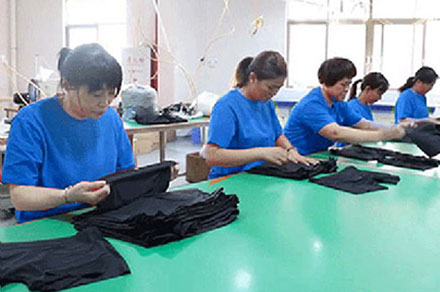
An in-line check is usually a visual check at a defined operation, performed at a defined frequency, with the result recorded against the operator or the machine. On a T-shirt the natural points are the shoulder seam, the neck attachment and the side seam; on underwear they are the gusset join, the waist elastic attachment and the leg opening. End-line inspection then reviews the completed garment before it leaves the line, which catches anything the in-line checks missed and allows correction while the bundle is still open. The plan should name the operations, the frequency and the person responsible, because an in-line check without a named owner and a frequency becomes an intention rather than a control.
Stage 4: final random inspection
Sample the order against a defined acceptance level.
Final inspection draws a sample from the completed order, checks it against the specification, classifies any defects found and compares the result against the acceptance level in the plan.
The value of this stage depends entirely on the sample being random and the criteria being written down. A sample drawn from the cartons the factory chooses is not a random sample, and an inspection judged against an unstated standard produces an opinion rather than a result. The plan should state the sample size, the acceptance level, the defect classification and the action taken if the order fails. It should also state when the inspection happens relative to packing, because an inspection performed after the goods are sealed in cartons makes any subsequent correction more expensive than one performed at a defined point before packing.
Choosing AQL levels by order size and risk
Match the level to the consequence of a defect.
An acceptance quality limit sets how many defects a sample may contain before the order is rejected, and the right level depends on what a defect would cost the brand rather than on a habit.
| Risk profile | Tighter level suits | Why |
|---|---|---|
| Safety or function | Critical defects, zero tolerance | A failure here is not a cosmetic problem |
| Visible on a product page | Major defects, tighter | The customer sees it before they wear it |
| Hidden until worn | Major defects, standard | Discovered in use, affects returns |
| Internal or secondary | Minor defects, looser | Not visible to the end customer |
Tightening an acceptance level always has a cost, because a stricter level rejects more of the same production and the factory prices that rejection into the order. The useful approach is to tighten where the customer will notice and relax where they will not, and to state both in the plan so the factory understands which defects matter. A brand selling online should weight the checks that predict returns heavily, because a return costs far more than the piece. A brand supplying a secondary channel can accept a different balance. The plan should record the choice rather than inherit a default, since a default level applied to every order is the same as having no policy.
Defect classification: critical, major and minor
Three classes, defined before the inspection.
Critical defects affect safety or make the product unusable, major defects are visible and would cause a customer to return the item, and minor defects are visible on close inspection but would not change the purchase.
The value of classification is that it allows a numeric acceptance level to be applied to a subjective judgement. Writing examples into the plan removes most of the argument: a needle or a broken needle part is critical, an open seam or a hole is major, a small uncut thread is minor. On apparel the classifications most worth defining precisely are shade variation, measurement outside tolerance, print or decoration defects and labelling errors, because those four generate the majority of claims and each can be interpreted loosely. The plan should state, for each class, whether a single instance is disqualifying or whether a quantity is permitted, because a strict reading and a lenient reading of the same sentence produce different decisions.
Measurement verification and tolerance
Measure the size set, not one sample.
Measurement verification compares the garment against the graded specification, and it only means anything if the tolerance is stated and the measurements are taken the same way every time.
The common failure is a garment that measures correctly at the middle size and drifts at the extremes, because the grading increments do not hold across the range. Checking a single size therefore proves very little. The plan should state the measurement points, the tolerance for each, the method of measurement and the number of pieces measured per size. It should also state whether the garment is measured before or after washing, because on a knit the washed measurement is the one the customer will experience, and a specification that does not say which is being quoted leaves the two parties measuring different things. Where the fabric shrinkage is significant, a wash-tested measurement is the only version worth writing into the plan.
Third-party inspection: when it earns its cost
Use it where independence is the point.
A third-party inspection earns its cost when the buyer cannot be present, when the order value justifies an independent record, or when the relationship is new and the buyer has no history to rely on.
On a first order from a new factory, an independent inspection produces a document that both parties accept, which is worth more than the check itself if something goes wrong later. On a repeat order with a supplier that has performed consistently, the same inspection adds less, because the information it produces is already known. Budget-limited first orders are a special case, and the small-brand QC article sets out which checks give the most information per unit of cost. The decision should also account for timing: an inspection booked outside the production window, or after the goods have been packed, produces a report that cannot be acted on. The plan should state when the inspection is required, what it covers and what happens if the result falls below the acceptance level, so that the inspection is a defined step in the order rather than an emergency.
Remedies: rework, replacement, deduction or rejection
Write down what happens if the order fails.
An inspection without a stated remedy is a report, and the remedy is the part of the plan that gives the acceptance level its force.
The usual remedies are rework, where the factory corrects the identified defects; replacement, where affected pieces are remade; a price deduction, where the buyer accepts the goods at a reduced price; and rejection, where the order is refused. Each has a different cost profile and each should be attached to a specific defect class rather than left to negotiation. Rework is usually the cheapest remedy when the defect is correctable and the schedule allows it. Replacement is appropriate when the fault is in the material and cannot be repaired. Deduction is the practical answer when the goods are sellable at a lower price point, and it should be calculated from a stated basis rather than improvised. Rejection is the remedy of last resort and should be reserved for genuine failures, because it consumes the most time and leaves both parties worse off.
Recording the plan in the purchase order
Put the plan where the order lives.
Attaching the plan to the purchase order makes it part of the contract, which is what allows a remedy to be applied without reopening the negotiation.
The document should be short enough to be read: the inspection stages, the acceptance level, the defect classes with examples, the measurement points and tolerances, the remedy for each class, and the approvals required before cutting. Attach the approved sample, the approved colour standard and the approved label artwork by reference, so the specification is the set of approved items rather than a description of them. Signed approvals should be dated, and changes should be issued as a revision rather than agreed verbally. This is unglamorous work, but it is the difference between a quality system and a set of expectations, and it is the reason a well-run order rarely has to argue about what was agreed.
FAQ
What are the stages of apparel quality control?
Incoming fabric and trim inspection, cutting inspection, in-line and end-line checks, and final random inspection. The plan also states the acceptance level, the defect classes, the measurement tolerances and the remedy if the order fails.
What AQL level should I use for clothing?
Match the level to the consequence of the defect rather than to a habit. Critical defects generally carry zero tolerance, visible major defects warrant a tighter level, and minor defects that a customer will not notice can carry a looser one.
Is a final inspection enough?
No. A final inspection can only report what has already been made, so a fault found there has already been cut, sewn and packed. Its value comes from being one stage in a plan that begins with incoming materials.
When should a third-party inspection be arranged?
When independence matters: a new supplier, an order the buyer cannot attend, or a value that justifies an independent record. Book it at a defined point before packing, because an inspection after the cartons are sealed cannot be acted on.
Next step for your team: send the Finetex Global team your product and destination market, and ask for the inspection stages, acceptance level and remedy clauses that would apply to your order before the first cut.
Sources: ISO 9001 quality management; OEKO-TEX STANDARD 100; 16 CFR Part 303 textile labelling; FTC textile labelling guidance; Better Work (ILO/IFC).
More factory-floor notes for brand owners

Sample Revision Limits: How to Control Underwear Development Cost and Calendar
A sample revision limit should control scope, not block necessary correction. The buyer and factory need to distinguish…
Read more →
Lab Dips and Strike-Offs for Underwear: Approval Steps That Prevent Delays
A lab dip approves a dyed textile shade; a strike-off approves printed artwork on the intended substrate. They…
Read more →
Color MOQ Planning: How to Share Fabric Across Multiple Underwear Styles
Color MOQ planning works best when a brand treats dyed fabric as a shared material platform rather than…
Read more →
Underwear Fabric Utilization: How Marker Efficiency Changes Unit Cost
Fabric utilization converts a fabric quotation into a garment cost. The calculation must account for pattern area, fabric…
Read more →
Open Costing for Men’s Underwear: Reading Fabric, Trim, Labor and Overhead Lines
An open-cost sheet is useful only when every line is tied to a measurable specification, a purchasing unit…
Read more →Global Apparel Sourcing Outlook 2026: Cotton, Freight and Supply-Chain Risk
A data-led 2026 apparel sourcing outlook on cotton balances, freight volatility, supplier diversification, lead time, compliance and practical…
Read more →Request a sample & pricing information
Send us your tech pack, target price or a reference sample — we reply with a quotation, a realistic lead time and a fabric recommendation within one working day.
- Free sampling plan & cost breakdown
- MOQ from 300 pcs per style
- Reply within 1 working day