
OEM Men’s Clothing Manufacturer: What You Supply, What the Factory Owns
An OEM men's clothing programme splits work between your brand and the factory. See exactly which tasks sit on each side, what MOQ that implies, and…
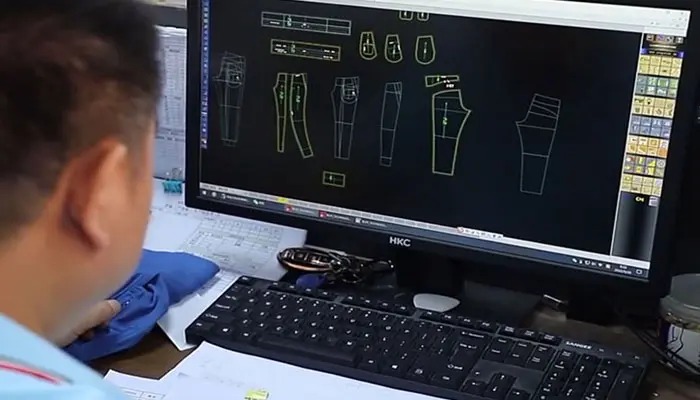
An OEM programme rarely fails on price. It fails on an unwritten assumption about who owns which deliverable, usually discovered when a trim arrives in the wrong colour two weeks before shipping. Working with an OEM men’s clothing manufacturer means your brand owns the design intent and the factory owns the execution — and the value of the relationship depends on how precisely that line is drawn before the first sample is cut.
What does OEM mean in men’s clothing?
You own the design; the factory owns the making.
The brand supplies the design direction and the manufacturer converts it into a pattern, a sample and bulk garments, owning construction while the brand owns the fit and the market position.
That direction can be a drawing, a reference sample or a written specification; what matters is that the fit and the market position remain yours, and that the factory’s responsibility is the making rather than the product concept.
That distinction drives the entire commercial relationship. Because the design is yours, the pattern, grading and fit decisions belong to you as well, and the factory’s job is to reproduce them consistently across sizes and lots. Because the making is theirs, the factory decides how the garment is assembled, which machines the seams require and how the line is balanced — decisions that change your cost per piece without changing the design you own. OEM sits apart from ODM, where the manufacturer owns the design and you select from a library, and from cut-and-sew contracts, where you often supply fabric as well as design.
| Deliverable | OEM: brand | OEM: factory | ODM: factory |
|---|---|---|---|
| Design and fit intent | Owns | Executes | Owns |
| Pattern and grading | Approves | Develops to the approved spec | Owns |
| Fabric and trim approval | Approves swatches | Sources and submits | Owns |
| Pre-production sample | Signs off | Prepares | Presents |
| Mass production and packing | Specifies format | Owns | Owns |
What must the factory receive before it can quote?
Enough specification to price the making, not just the idea.
A quotable enquiry carries the style, quantities, fabric direction, trims, decoration, packing and destination market.
Each of those changes either the labour content or the material cost, which is why a quotation produced from a thin brief is an estimate rather than a price, and why the same package should go to every candidate factory.
If you are still developing the design, that is workable — Finetex Global develops from a client drawing, sample or idea, or from its own product reference library — but a quotation produced from an incomplete brief is only an estimate, and it will move. The disciplined approach is to send the same package to every candidate factory, so that differences in the reply reflect capability rather than the questions each supplier happened to ask. A factory that answers a thin brief with a confident price is telling you something about its estimating culture, not about the cost of your product.
How much design detail is enough for a first sample?
Enough to fix the fit block, the seams and the trim set.
A measurement chart with tolerances, technical drawings, seam specification, fabric composition with weight, and the placement of every label, print and embroidery element.
Buyers who over-specify tend to slow the first round rather than improve it, because the sample room spends its time reconciling contradictions instead of building a block. Buyers who under-specify get a sample that is pleasing to look at and impossible to reproduce, because nothing about the fit was fixed. If you do not have a technical pack, the practical route is to start from a garment you already consider correct, send it as a fit reference, and let the factory produce its own specification from it for your approval. Finetex Global maintains a reference library precisely because many brands arrive with a visual direction rather than a written one.
Who owns the pattern, the artwork and the trim specification?
Whoever paid for them, unless the contract says otherwise.
In most OEM relationships the brand pays development, so the pattern, graded nest and artwork should belong to the brand, with the factory licensed to produce only your orders.
Trim specifications follow the same logic, and the point is practical rather than legalistic: this is the clause that decides whether you can move a programme to another supplier later without rebuilding the pattern, the grading and the artwork from scratch.
This is the clause that decides whether you can move a programme later without rebuilding it. Where the pattern is developed by the factory, ask explicitly for ownership or a transferable licence, and for the graded nest to be handed over in a usable format. Where the artwork is prepared by the factory’s print department, confirm that colour separation files and mesh or DTG settings transfer with the design. Ownership of industrial designs and their registration differs by jurisdiction, which is why the contract, not the developing party’s habit, is the document that settles it.
Two practical points follow. First, if the factory retains ownership and licenses the design to you, the licence should state the field of use, the territory and the term, otherwise a reorder three seasons later may sit outside the agreement. Second, ask for the development file list in the quotation, because a pattern that exists only in a supplier’s CAD system is not an asset you can rely on. Buyers who request that list before sampling usually find the gap between what they assumed they owned and what they actually owned while it is still cheap to correct.
How does OEM change the minimum order quantity?
A new pattern adds a minimum of its own.
A bespoke block, a new colour and a non-stocked trim each carry their own minimum, and those minimums are additive rather than averaged, so the threshold is confirmed per design and per colour.
The reason is arithmetic rather than policy. A pattern has to be graded, a marker has to be made, a dye lot has to be scheduled and a line has to absorb the changeover — costs that are fixed per style and therefore fall as quantity rises. That is why the same factory can quote a stock-fabric programme and a developed-fabric programme with materially different thresholds. In practice, the way to reduce an OEM minimum is to reduce what is new: use a fabric already running, keep the trim set standard, and prove the design in one colourway before extending the range.
What does the sampling chain look like in an OEM build?
Four gates, each answering a different question.
A fit sample tests the block, a size set tests the grading, and a pre-production sample tests whether the line can reproduce the approved garment, with fabric and trim approvals running alongside them.
Where a brand cuts gates to save a fortnight, the risk moves into bulk, where it costs far more to correct. The pre-production sample is the most important of the four because it is built with production fabric, production trims and production methods; approving it means approving what the line will actually do. Finetex Global’s apparel design process describes the same progression — design layout, custom sample, fabric sourcing, pre-production approval, then cutting and mass production — and any OEM supplier should be able to describe its version of that chain without prompting.
Where do OEM programmes usually fail?
Silent specification changes and unapproved substitutions.
Trim swapped for a cheaper equivalent, fabric accepted from a different mill, a seam simplified to speed the line, or a measurement that drifted within what someone judged to be tolerance.
These changes rarely appear in a final inspection report, because the garment still functions. They appear in the second order, when the waistband behaves differently, or in the review section, when the collar loses shape after six washes. The counter-measure is a change-control clause that names the approver, defines what counts as a change, and requires written approval with a photograph of the substitute before it enters production. Ask every candidate factory what it does when a specified trim is unavailable; the answer separates partners who stop the line from partners who solve the problem quietly and tell you afterwards.
A workable clause is short enough to be read on one screen. It lists the elements that may not change without written approval — fibre composition, fabric weight, trim supplier, waistband construction, colour reference, measurements outside tolerance — names one approver on each side, and states the consequence of an unapproved change: rejection at the buyer’s option, or rework at the factory’s cost. Factories that already operate this way will recognise the language; those that do not will often negotiate, which is itself a useful signal about how the programme will be managed.

What drives cost in an OEM quote, and how do you compare two?
Compare identical scopes, then compare the making.
Two OEM quotes compare only when fabric, trim set, decoration, packing and quantity are identical; after that, the difference is labour minutes, efficiency and risk carried.
| Line in the quote | What it should say | What makes quotes incomparable |
|---|---|---|
| Fabric | Composition, weight, mill and lot basis | “Cotton blend” with no weight or source |
| Making | Per-piece cost with the seam and finish standard named | A single price with no construction detail |
| Decoration | Method, placements, colour count, setup treatment | Setup excluded and added later |
| Packing | Format, tags, inserts and carton specification | Retail-ready assumed but quoted as bulk |
| Sampling and tooling | What is charged, and whether it is credited against bulk | Sampling cost disclosed after approval |
| Terms | Payment milestones, inspection level, remedy on failure | Deposit requested before these are stated |
What should you send an OEM manufacturer before you commit?
Send the brief, the reference and your questions.
Include the specification or fit reference, quantity and size curve, fabric and trim direction, decoration and packing requirements, destination market, and the approvals that will govern production.
- Which stages run in-house and which are subcontracted, with the partner named.
- How the minimum is composed for your design, fabric and colour count.
- Which pattern, artwork and trim documents you will receive, and in what format.
- The approval gates, the named approver on each side and the change-control rule.
- The inspection level applied and the remedy if the final inspection fails.
- The reorder assumption: which fabric, trim and pattern will still be available next season.
What separates a workable OEM partnership from an expensive one
The difference is rarely the quotation. A workable OEM partner can describe its own process without prompting, prices the same scope twice without changing assumptions, names the documents it will hand over, and tells you when something deviates. An expensive one is cheaper on paper and more costly in rework, spent samples and the second order that does not match the first. If you want the technical detail behind the brief itself, see our guide to briefing a factory without a design team.
FAQ
How can I find a manufacturer to make my own clothing?
Start from the product rather than a directory. Identify factories that already produce your category at a comparable order size, send an identical brief to each, and compare replies on scope rather than headline price. The brief should state style, quantity, fabric direction, decoration, packing and destination market, plus the in-house capability question, so that differences in the answers are meaningful.
How do I reach out to a clothing manufacturer for the first time?
Send a structured enquiry rather than a general message. Include the style reference or a photograph, target quantities, fabric and trim direction, decoration and packing needs, your delivery window and your market. Ask which stages the factory performs in-house and how the minimum is composed for your design. A factory that replies with specific questions is more useful than one that replies with a price.
How do I buy directly from a manufacturer without a technical pack?
Use a physical reference. Send a garment you consider correct as a fit and construction reference, ask the factory to produce a measurement chart and specification from it, and approve that document before sampling. Finetex Global develops from a client drawing, sample or idea, or from its own reference library, so an unwritten design direction does not block the process.
Who owns the pattern in an OEM clothing programme?
Ownership follows the contract, not the habit. Where the brand pays development, the pattern, graded nest and artwork should transfer to the brand with the factory licensed to produce only the orders placed. Confirm this in writing, including the file formats you will receive, because it determines whether the programme can be moved to another supplier later without rebuilding it from scratch.
Next step for your team: send the Finetex Global team your OEM brief — style reference, quantities, fabric direction and packing requirements — and ask for the work split, the approval gates and the document list in writing before sampling begins.
Sources: 16 CFR Part 303 textile labelling; 19 CFR Part 134 country of origin marking; U.S. Customs and Border Protection; USITC Harmonized Tariff Schedule; Supima — extra-long staple cotton specification; ISO 9001 quality management; Better Work (ILO/IFC).
More factory-floor notes for brand owners

Sample Revision Limits: How to Control Underwear Development Cost and Calendar
A sample revision limit should control scope, not block necessary correction. The buyer and factory need to distinguish…
Read more →
Lab Dips and Strike-Offs for Underwear: Approval Steps That Prevent Delays
A lab dip approves a dyed textile shade; a strike-off approves printed artwork on the intended substrate. They…
Read more →
Color MOQ Planning: How to Share Fabric Across Multiple Underwear Styles
Color MOQ planning works best when a brand treats dyed fabric as a shared material platform rather than…
Read more →
Underwear Fabric Utilization: How Marker Efficiency Changes Unit Cost
Fabric utilization converts a fabric quotation into a garment cost. The calculation must account for pattern area, fabric…
Read more →
Open Costing for Men’s Underwear: Reading Fabric, Trim, Labor and Overhead Lines
An open-cost sheet is useful only when every line is tied to a measurable specification, a purchasing unit…
Read more →Global Apparel Sourcing Outlook 2026: Cotton, Freight and Supply-Chain Risk
A data-led 2026 apparel sourcing outlook on cotton balances, freight volatility, supplier diversification, lead time, compliance and practical…
Read more →Request a sample & pricing information
Send us your tech pack, target price or a reference sample — we reply with a quotation, a realistic lead time and a fabric recommendation within one working day.
- Free sampling plan & cost breakdown
- MOQ from 300 pcs per style
- Reply within 1 working day