
Subcontracting: How to Know If Your Order Is Outsourced
Six signs your apparel order has been subcontracted, the contract clauses that control it, and how to check factory capacity before work is sent out.

Answer first: Subcontracting is common in apparel and not always a problem: printing, embroidery or washing are often done by specialist workshops. The problem is unauthorised subcontracting, where your order is moved to a facility you have not approved, audited or even heard of. The OECD’s due diligence guidance for the garment sector notes that outsourcing can decrease supply chain transparency and has been shown to increase the risk of labour abuses in higher-risk contexts. Six signals suggest an order may be outsourced: a price or lead time that does not fit the factory’s capacity, resistance to visits during your production, work-in-progress photos that do not match the audited site, quality that changes between batches, vague explanations for delays, and documents that name another company or address. The most reliable prevention is a contract that requires disclosure and approval of every facility, combined with a capacity check before you place the order, because “not enough capacity” is the usual reason work is sent out.
This article draws on the OECD Due Diligence Guidance for Responsible Supply Chains in the Garment and Footwear Sector, read on 17 November 2026, and on our experience as a manufacturer. It is not legal advice.
Why factories subcontract
The OECD guidance defines subcontracting as when a person or enterprise performs a service or activity necessary for the completion of another enterprise’s contract. It describes the practice as fairly common at many stages of the supply chain, used to respond to short lead times and order changes, or to outsource specialised tasks such as screen printing. Its sector risk table notes that subcontracting is common in cut-make-trim and finishing globally.
From the buyer’s side, the reasons fall into three groups:
| Reason | Typical trigger | Risk to the buyer |
|---|---|---|
| Specialist process | Print, embroidery, garment wash, pleating | Low, if disclosed and approved |
| Overflow capacity | Too many orders for the same delivery window | Medium to high: quality and labour standards unknown |
| Price arbitrage | Order taken at a price the factory cannot meet itself | High: hidden facility, often lower standards |
The OECD guidance also links subcontracting to purchasing practices: when a buyer changes specifications or places orders late without changing the lead time, the pressure to subcontract rises. It recommends that a buyer who prohibits subcontracting should reduce incentives to subcontract, for example by amending the lead time when specifications change.
Six signals your order may be outsourced
None of these proves subcontracting on its own. Two or three together justify asking direct questions.
1. The quote does not fit the factory
A price well below comparable quotes, or a lead time shorter than the factory’s stated capacity allows, can mean the work will be placed elsewhere. Our article on comparing factory quotes shows how to check whether a price is internally consistent.
2. Visits are welcome before the order, not during it
A factory that is happy to show the showroom and sample room, but becomes hard to visit while your order is on the line, may not be producing it there. Ask to see your style on the sewing floor at a specific stage, such as the first output.
3. Work-in-progress photos do not match the site
Compare production photos with what you saw in the audit or visit: floor layout, machine types, wall colours, lighting, carton marks and staff uniforms. Photos with no context, or only close-ups, are a weak form of evidence.
4. Quality changes between batches
If the same style arrives with different stitch quality, thread colour or packing method between shipments, more than one facility may be producing it. Inspection reports that differ in style and handwriting are another hint.
5. Delays without operational detail
A factory that runs the order itself can usually explain a delay precisely: which operation, which line, which material. Vague answers (“the workers are busy”) are a signal worth following up.
6. Documents name someone else
Packing lists, test reports, certificates or export documents that carry another company’s name or address, or a shipping origin far from the factory, should be explained in writing. For certified programmes, transaction and scope certificates name the certified sites; a facility missing from the scope cannot carry the claim.
Contract clauses that control subcontracting
The OECD guidance asks enterprises to set clear expectations on whether subcontracting is authorised. If it is permitted, the guidance suggests prequalifying subcontractors as rigorously as direct suppliers and asking direct suppliers to disclose their intent to subcontract, the selected pre-approved subcontractor, up-to-date information on that subcontractor and the size of the allocation. Translated into a purchase contract:
| Clause | What it says | Why |
|---|---|---|
| Facility disclosure | All facilities used for cutting, sewing, printing, embroidery, washing and packing are listed with name and address | You know where the product is made |
| Prior written approval | No subcontracting without the buyer’s written approval for a named facility | Prevents silent outsourcing |
| Same standards | Approved subcontractors meet the same quality, social and chemical requirements | Avoids a weaker link |
| Right to audit | Buyer or its agent may visit any listed facility, including at short notice | Makes disclosure verifiable |
| Traceability | Production records show which facility performed each operation | Supports origin and certification claims |
| Consequences | Defined remedies if undisclosed subcontracting is found | Gives the clause weight |
For US imports, facility disclosure also matters for customs. US Customs and Border Protection enforces the UFLPA rebuttable presumption against goods made wholly or in part in Xinjiang or by entities on the UFLPA Entity List. An undisclosed facility in your chain is a gap in the documentation you may need; our article on forced labor screening explains audit trails.
Audits and what they can prove
A social audit covers the facility that was audited, on the dates it was audited. It does not prove your order was made there. To connect the two:
- Ask for the audit report of each facility on the disclosure list, not only the main factory. Our guide to factory audit types explains what BSCI, SMETA and WRAP reports cover.
- Schedule an in-line inspection while your order is being sewn, and ask the inspector to confirm the facility address and photograph your style on the line.
- Match the inspection report, packing list and shipping origin to the same address.
- For certified fibres, check that every processing site appears in the relevant scope certificates.
Capacity evidence: the early warning
Most unauthorised subcontracting starts with a capacity gap. Check capacity before you confirm the order.
What to ask for
- Number of sewing lines and operators for your product category.
- Current loading: which orders occupy the lines in your production window.
- Standard minute value (SMV) for your style and the planned output per line per day. Our article on line balancing and SMV shows how output is calculated.
- Machine list for special operations, such as flatlock, coverstitch or bartack.
- Which processes are done by partners, and who they are.
A simple capacity check
Planned output per day ≈ operators on the line × working minutes per day × line efficiency ÷ SMV.
If your quantity divided by that daily output is longer than the sewing time in the schedule, the factory either needs more lines, overtime or another facility. Ask which. A clear answer, even “we will use a second approved facility for 30% of the order”, is better than a schedule that cannot be met. Our article on weekly WIP reports lists the numbers that show a capacity gap early.
What we publish about our own capacity
Finetex’s About page states 5,652 m² of factory space, more than 500 staff and, since 2024, 600,000 pieces of monthly capacity across twelve lines. Our FAQ also states that knitting, dyeing, cutting, sewing, printing, embroidery, labels, hangtags and retail packaging sit inside our own supply chain. Ask any factory, including us, to name the partner for each process in your order before you confirm it.
What to do if you suspect outsourcing
- Ask directly and in writing which facilities produced each operation for the order.
- Request evidence: production records, line photos with context and the inspection report address.
- Inspect the next shipment in-line, not only at final inspection.
- Decide on approval or exit: if the subcontractor is acceptable, approve and audit it; if not, agree a corrective plan and timeline.
- Fix the cause: if the trigger was your late approvals or short lead time, adjust the order calendar, as the OECD guidance recommends.
Fact, advice and uncertainty
Fact: the OECD guidance describes subcontracting as common in garment supply chains and recommends clear supplier expectations, prequalification and disclosure when it is permitted, and reduced incentives when it is prohibited.
Advice: require facility disclosure and prior approval in the contract, check capacity before ordering, and confirm the production address during an in-line inspection.
Uncertain: no single signal proves subcontracting. Treat signals as reasons to ask, and base conclusions on evidence from the production floor.
Related reading
- Factory Audit Types: BSCI, Sedex, WRAP and What Each Proves
- Weekly WIP Reports: Five Numbers That Predict a Late Shipment
- Line Balancing and SMV: Why Your Order Takes 35 Days
- First-Output Check: The In-Line Inspection That Saves Bulk
Frequently asked questions
Is subcontracting in apparel always bad?
No. Specialist processes such as printing or embroidery are often subcontracted. The risk lies in undisclosed facilities whose quality and labour standards you have not checked.
How can I prove where my order was sewn?
Combine a facility disclosure list, an in-line inspection that records the address and your style on the line, and documents such as packing lists that match that address.
What contract clause prevents subcontracting?
A clause requiring disclosure of all facilities and prior written approval for any subcontractor, with a right to audit and defined consequences.
Why is capacity shortage a warning sign?
A factory that has taken more orders than its lines can produce in the window must add lines, run overtime or send work elsewhere. Checking capacity before ordering shows which.
Sources
- OECD Due Diligence Guidance for Responsible Supply Chains in the Garment and Footwear Sector (PDF)
- U.S. Customs and Border Protection: Uyghur Forced Labor Prevention Act
Ask us where your order will be made
Send your style and quantity and ask us about lines, schedule and partner processes before you place the order. Buyer-appointed inspectors can visit at any stage of production.
Request a quote or read our clothing factory sourcing guide and quality control process.
More factory-floor notes for brand owners
Importing Apparel into Japan: JIS Care Symbols and Quality Labelling
Japan's Household Goods Quality Labeling Act for apparel: fibre composition terms, JIS L 0001:2024 care symbols, labeller details…
Read more →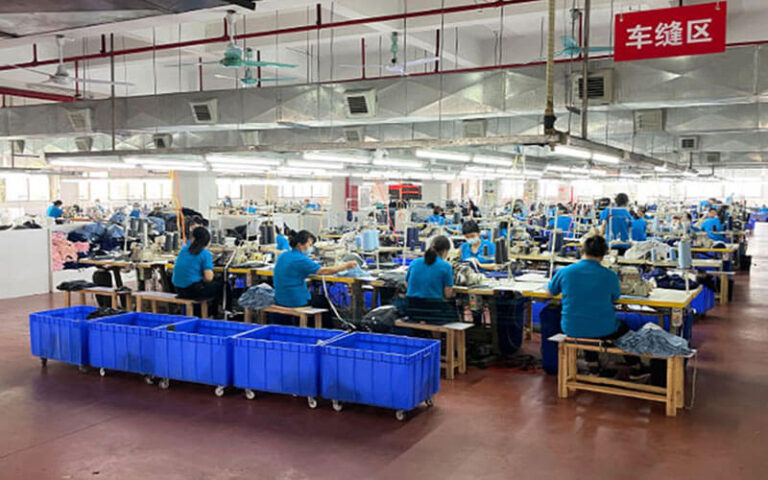
Apparel Manufacturing Glossary: 120 Terms
120 garment manufacturing terms in English and Chinese with one-line explanations, grouped in 12 topics, for buyers working…
Read more →
Tolerance Stack-Up: Right Measurements, Wrong Fit
Why garment measurements can pass tolerance while the fit is still small: how shrinkage, cutting and sewing deviations…
Read more →
Gym, Studio and Team Kit: Low-Volume Custom Orders
How gyms, studios and teams can order custom kit in small runs: one blank body, names and numbers,…
Read more →
Raglan and Baseball Tees: Construction and Decoration
How raglan and baseball T-shirts are built: raglan seams, collar attachment, print placement across seams, two-colour shade control…
Read more →
The Cost of Poor Quality: Rework, Chargebacks and Air Freight
Calculate the full cost of a 2% defect incident in an apparel order: rework, re-inspection, air freight, chargebacks…
Read more →Request a sample & pricing information
Send us your tech pack, target price or a reference sample — we reply with a quotation, a realistic lead time and a fabric recommendation within one working day.
- Free sampling plan & cost breakdown
- MOQ from 300 pcs per style
- Reply within 1 working day