
How do I choose T-shirt sleeve length and width?
How to choose T-shirt sleeve length and width: the effect on look and comfort, regular, fitted, boxy and longline options, measuring points and testing fit.
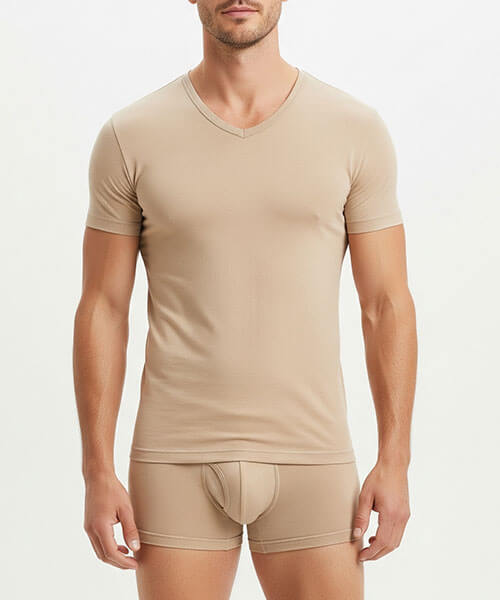
Part of T-Shirts, Undershirts & Tank Tops in Finetex Talk — buyer questions answered by the Finetex editorial team.
A brand's regular fit tee gets feedback that the sleeves look too long and wide on slimmer customers but too tight on muscular customers. The team wants to know how to set sleeve length and width and whether to offer different options.
Short answer: Sleeve length and width are part of the overall fit. A regular tee usually has a sleeve ending around mid-upper arm with moderate width; a fitted tee has a shorter, narrower sleeve that hugs the arm; a boxy or oversized tee has a dropped shoulder and a wider, often longer sleeve. Because shoulder position changes where the sleeve starts, sleeve length should be judged together with shoulder width. Define the bicep width, sleeve opening and sleeve length on a reference size, check them on testers with different arm sizes, and grade them sensibly so sizes keep the same proportion. If your customers vary a lot, a separate fitted or relaxed style may work better than trying to make one sleeve suit everyone.
Measuring points
- Sleeve length from shoulder point or from centre back neck.
- Bicep width measured a set distance below the armhole.
- Sleeve opening width.
- Armhole depth.
Options
- Regular: moderate length and width.
- Fitted: shorter and narrower, often with stretch fabric.
- Boxy: dropped shoulder, wider and longer sleeve.
- Longline: often slimmer and longer.
Testing
Fit samples on testers with slim and muscular arms. Check comfort when lifting arms and whether the sleeve rides up. Use body measurement data, such as from ISO 8559, to understand arm girth ranges.
A worked example
The brand compares its sleeve with competitors and finds its bicep is wider and the sleeve longer. It reduces the sleeve length slightly and keeps bicep width for comfort, then launches a separate fitted tee with a narrower sleeve for slimmer customers.
Sleeve details that change the look
- Hem depth and stitch at the sleeve opening, which affect how the sleeve sits.
- Rolled or cuffed sleeves for a workwear look.
- Set-in versus dropped shoulder, which moves the sleeve start point.
- Fabric weight, since heavy jersey holds a wider sleeve away from the arm while light jersey falls closer.
Agree these details on the reference sample, as a small change can alter fit feedback as much as length does.
Grading sleeves
Grade sleeve length in small steps and bicep width in line with chest grading, so a large does not end up with a disproportionately tight arm.
Limits
Sleeve preferences vary by market and trend. Customer feedback is the best guide.
Facts, recommendations and uncertainty
Established: sleeve length and width are judged together with shoulder position. Recommendation: define key points on a reference size and test on varied testers. Uncertain: which proportion your customers prefer.
Sources and further reading
Standards and regulations are referenced by their published scope. Test parameters, cycles and pass levels should be agreed with your laboratory for the specific product; legal requirements should be confirmed for each destination market.
Three more perspectives
Track feedback about sleeves separately from general fit comments. If complaints are concentrated in one size, check that grading for that size follows the specification. Ask the factory to confirm sleeve measurements on pre-production samples, since sleeves are an easy place for small cutting errors to change the look. Compare return comments by market too, as preferred sleeve length differs between regions.
Fit samples on testers with different arm sizes and photograph them from the front and side. Adjust bicep width, sleeve opening and length in small steps. Record the approved measurements and show them in the tech pack with how each is measured, so every factory measures the same way. Try a quarter-sleeve change in length before changing width, since it shifts the look quickly.
Measure sleeve length, bicep and opening on each size during inspection. Check both sleeves, since differences between left and right are a common defect. Record results by size. Check that the sleeve hem is even all round and the cuff or hem width matches the specification. Twisted sleeves after washing usually point to off-grain cutting.
Related products
Related articles
- Long-Sleeve T-Shirt Manufacturing: Cuff, Sleeve Length and the Seasonal Selling Window
- Sleeveless Undershirt Manufacturing: Cut, Rib and the Layering Geometry Buyers Get Wrong
- What Is a Curved Hem Men's T-Shirt and Its Benefits? Curved vs Straight Hem for Brands
- Seamless T-Shirts: A Cost-Benefit Check for Online Sellers
- Oversized vs Classic Fit T-Shirts: What Online Shoppers Are Buying
- Long-Sleeve Undershirts: A Year-Round Product for Basics Brands
- Tank Top Undershirts: The Sleeveless Basics Opportunity
- Oversized T-Shirt Manufacturing: Getting Drop Shoulder and Boxy Fit Right at Production Scale
← More in T-Shirts, Undershirts & Tank Tops · All Talk topics · Ask us about your programme
More factory-floor notes for brand owners

Why did my reorder price go up?
Why an apparel reorder price can go up: fabric and trim costs, smaller quantities, specification changes, labour and…
Read more →
How do I read an underwear quotation line by line?
How to read an underwear quotation line by line: fabric, elastic and trims, labour, packaging, testing, overheads and…
Read more →
How do peak seasons affect apparel factory capacity?
How peak seasons and holidays affect apparel factory capacity and lead times, why fabric and shipping are also…
Read more →
Should I split one style across two factories?
Whether to split one apparel style across two factories: the benefits for capacity and risk, the risks for…
Read more →
What are the biggest risks on a small brand’s first order?
The biggest risks on a small brand's first apparel order, from unclear specifications and sample approval to payment,…
Read more →
What changes should a factory notify before production?
Which changes a factory should notify the buyer about before production, such as fabric, dye, trims, subcontracting or…
Read more →Request a sample & pricing information
Send us your tech pack, target price or a reference sample — we reply with a quotation, a realistic lead time and a fabric recommendation within one working day.
- Free sampling plan & cost breakdown
- MOQ from 300 pcs per style
- Reply within 1 working day