
What does enzyme washing or silicone softening do to a T-shirt?
What enzyme washing or silicone softening does to a T-shirt: bio-polishing, surface fibre removal, softness, pilling, strength loss, shrinkage, absorbency and printing considerations.
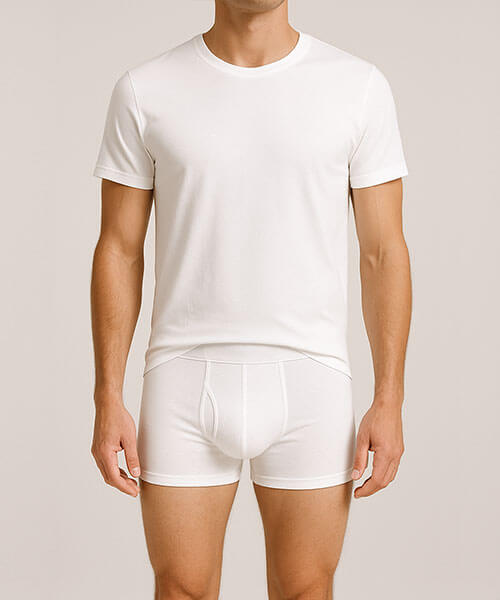
Part of T-Shirts, Undershirts & Tank Tops in Finetex Talk — buyer questions answered by the Finetex editorial team.
A brand wants its basic tees to feel softer and look smoother, and the factory offers an enzyme wash, a silicone softener or both. The team wants to know what each does and whether there are trade-offs.
Short answer: An enzyme wash, often called bio-polishing for cotton, uses cellulase enzymes to remove protruding surface fibres. This gives a smoother, cleaner surface, a softer feel and usually less fuzzing and pilling. It also removes some fibre, so too aggressive a treatment can reduce strength and weight. A silicone softener coats fibres, giving a very soft, slick or silky hand and better drape. Silicones can reduce absorbency, may make printing and some trims harder to bond, and the feel can change after repeated washing. Many brands combine a mild enzyme wash with a moderate softener. Test treated fabric or garments for pilling with ISO 12945-2, dimensional change with ISO 5077, colour fastness with ISO 105-C06 and print adhesion before approving.
What enzyme washing does
- Removes surface fibres for a smoother face.
- Gives a softer, cleaner hand and brighter colour.
- Reduces fuzzing and pilling.
- Can lower strength and weight if overdone.
What silicone softeners do
- Coat fibres for a soft, slick or silky hand.
- Improve drape.
- Can reduce absorbency and print adhesion.
- Hand may change after washing.
Trade-offs
- Over-processing weakens fabric.
- Garment washing can change shrinkage and shade.
- Print before or after washing affects the result.
A worked example
The brand compares untreated, enzyme-washed and enzyme plus softener tees. The combination feels softest, but printed samples on the softened fabric show weaker adhesion. The brand prints first, then garment-washes with a mild softener, and confirms adhesion and wash fastness.
Testing
- ISO 12945-2 pilling, ISO 5077 dimensional change and ISO 105-C06 colour fastness to washing on treated samples.
- Check print adhesion and absorbency after treatment.
Process questions to ask
- Is the treatment done on fabric before cutting or on finished garments?
- What enzyme dose, temperature and time are used, and how is the reaction stopped?
- Is the softener hydrophilic or a standard silicone, which affects absorbency?
- How is the recipe kept the same between batches?
Fabric treatment is usually more consistent across large orders, while garment washing gives a more lived-in look but more variation in shade and size between batches.
Absorbency and comfort
If the tee is sold for sport or hot weather, check that the softener does not leave the fabric feeling slick or slow to absorb sweat. A simple drop test comparing treated and untreated fabric shows the difference quickly.
Limits
The effect depends on enzyme type, dose, time, softener and process control. Results vary between factories.
Facts, recommendations and uncertainty
Established: enzymes remove surface fibres and silicones coat them; both soften but with trade-offs. Recommendation: test treated samples for pilling, shrinkage, fastness and print adhesion. Uncertain: how long the soft hand lasts for your fabric.
Sources and further reading
- ISO 12945-2:2020 — Pilling, fuzzing or matting, modified Martindale method
- ISO 5077:2007 — Determination of dimensional change in washing and drying
- ISO 105-C06:2010 — Colour fastness to domestic and commercial laundering
Standards and regulations are referenced by their published scope. Test parameters, cycles and pass levels should be agreed with your laboratory for the specific product; legal requirements should be confirmed for each destination market.
Three more perspectives
Specify the treatment, such as bio-polish and softener type, in the purchase order, and ask for process records. Treatments add cost and lead time; include them in quotes and plan when printing happens. Ask whether the chemicals used meet your restricted substances list. Compare the cost of fabric-stage and garment-stage treatment, including any extra loss from washing.
Develop the hand feel with the factory on a few small trials and compare after several washes. Decide the order of printing and washing early, since it affects adhesion and look. Record the approved recipe and keep a washed reference garment. Note whether the soft hand comes mostly from the enzyme or the softener, since a softener effect can fade.
Check treated lots for hand feel, shade and GSM against the reference. Wash a few garments and check shrinkage and print. Record results by lot so changes in the washing process are visible. Check weight loss on treated lots against the approved figure, as heavy loss can mean over-processing and weaker fabric. Feel treated garments against the reference by touch with eyes closed for a fair comparison.
Related products
← More in T-Shirts, Undershirts & Tank Tops · All Talk topics · Ask us about your programme
More factory-floor notes for brand owners

What should I check on a novelty hoodie such as an eye-mask hood?
What to check on a novelty hoodie such as an eye-mask hood: hood structure and lining, visibility and…
Read more →How should I size a unisex hoodie?
How to size a unisex hoodie: choosing a base block, body measurement ranges, ease, sleeve and body length,…
Read more →What care instructions should a hoodie carry?
What care instructions a hoodie should carry: the elements of a complete washing instruction, warnings for prints and…
Read more →
How do I match colour across hoodie and jogger sets?
How to match colour across hoodie and jogger sets: same fabric lot, rib and trims, dyeing method, shade…
Read more →How many colourways can I order at hoodie MOQ?
How many colourways a hoodie order can include at MOQ: how factories set minimums per style, colour and…
Read more →Why does a dark hoodie stain other clothes?
Why dark hoodies stain other clothes: dye bleeding in washing, rubbing transfer, perspiration, unfixed dye and pigment, and…
Read more →Request a sample & pricing information
Send us your tech pack, target price or a reference sample — we reply with a quotation, a realistic lead time and a fabric recommendation within one working day.
- Free sampling plan & cost breakdown
- MOQ from 300 pcs per style
- Reply within 1 working day