
Why do polo shirt collars curl, and how do I prevent it?
Why polo shirt collars curl and how to prevent it: flat-knit collar construction, yarn and tension, shrinkage differences, interlining, pressing and washing tests.
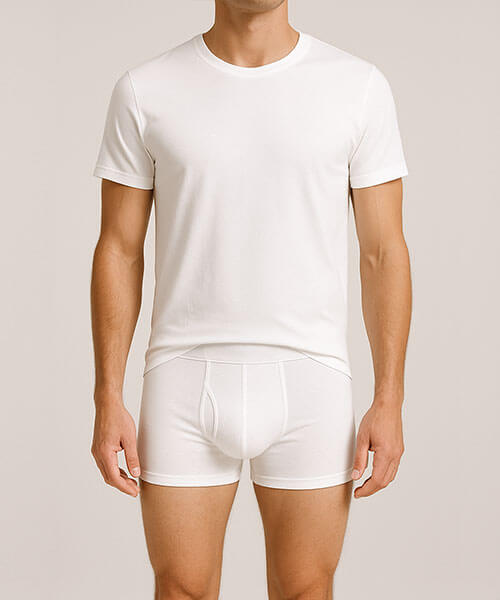
Part of T-Shirts, Undershirts & Tank Tops in Finetex Talk — buyer questions answered by the Finetex editorial team.
A brand's polo shirts look smart when new, but after a few washes the collar points curl upwards and the collar edge waves. Customers say the shirt looks old quickly.
Short answer: Polo collar curling usually comes from the collar itself. Most polos use a flat-knit collar, knitted to shape on a flat machine. If the knit tension, yarn twist or structure is unbalanced, the collar naturally curls, and washing releases the stress. If the collar shrinks differently from the body or placket, the collar edge can wave or the points lift. Poor setting during knitting or finishing, too light a yarn and lack of support in the collar stand also contribute. Prevent it by approving collars from a supplier that knits them with balanced tension, matching shrinkage of collar and body, considering a light stabilising interlining in the collar stand for woven-style collars, and testing collars after several washes before bulk.
Common causes
- Unbalanced knit tension or yarn twist in the flat-knit collar.
- Collar and body shrinking by different amounts.
- Light collar yarn that lacks body.
- Poor heat setting or finishing of the collar.
- Tight stitching where collar joins the neck.
Prevention
- Specify collar yarn, gauge and weight, and approve physical collars.
- Ask the collar supplier how collars are set and finished.
- Check dimensional change of collar and body with ISO 5077 after ISO 6330 washing.
- Use the right stitch tension when attaching the collar.
- Advise customers to reshape collars while damp and avoid high heat.
Testing
Wash sample shirts five to ten times, dry as the care label allows, and lay the collars flat. Compare curling, waviness and collar length with new samples.
A worked example
For the shirts in the question, the collars shrink about 6% while the body shrinks 3%, pulling the collar edge into waves. The brand switches to a collar supplier that heat sets collars, matches shrinkage within 1%, and confirms collars stay flat after ten washes.
Collar construction options
Flat-knit rib collars are standard for knit polos. Self-fabric collars cut from the body piqué, sometimes with a light fusible interlining, give a softer, more casual look but can curl at the points if the fabric is unstable. Woven collars with interlining, as on some hybrid polos, stay flat but feel more formal. Choose the construction for the look, then test it after washing.
Limits
Some movement after many washes is normal for flat-knit collars. Pressing restores most of the shape.
Facts, recommendations and uncertainty
Established: collar curling comes mainly from flat-knit collar tension and shrinkage mismatch. Recommendation: specify and approve collars, match shrinkage and test after washing. Uncertain: how many washes your customers expect before the collar shows wear.
Sources and further reading
- ISO 5077:2007 — Determination of dimensional change in washing and drying
- ISO 6330:2021 — Domestic washing and drying procedures for textile testing
Standards and regulations are referenced by their published scope. Test parameters, cycles and pass levels should be agreed with your laboratory for the specific product; legal requirements should be confirmed for each destination market.
Three more perspectives
Treat collars as a separate component with its own specification and approved supplier. Ask for collar shrinkage data and a sample after washing. If changing collar suppliers, re-approve with washed samples. Keep collar and body lots linked so problems can be traced. Ask the collar knitter for its quality checks, such as length, width and flatness per batch, and request those records with each delivery.
Develop collar and body together and check that their shrinkage matches. Choose collar yarn and weight that give the collar enough body for the shirt's weight. Record the approved collar specification and supplier in the tech pack. Check collar fit against the neckline on each size, since a collar cut too short for the neck is stretched during sewing and curls after washing.
Check incoming collars for flatness, size and shade against the standard before sewing. Wash a few finished shirts per lot and check collar flatness. Record results by collar lot. Lay collars flat on a table and measure the lift at the points against an agreed limit. Keep a washed approved shirt at the inspection table for comparison.
Related products
← More in T-Shirts, Undershirts & Tank Tops · All Talk topics · Ask us about your programme
More factory-floor notes for brand owners

What should I check on a novelty hoodie such as an eye-mask hood?
What to check on a novelty hoodie such as an eye-mask hood: hood structure and lining, visibility and…
Read more →How should I size a unisex hoodie?
How to size a unisex hoodie: choosing a base block, body measurement ranges, ease, sleeve and body length,…
Read more →What care instructions should a hoodie carry?
What care instructions a hoodie should carry: the elements of a complete washing instruction, warnings for prints and…
Read more →
How do I match colour across hoodie and jogger sets?
How to match colour across hoodie and jogger sets: same fabric lot, rib and trims, dyeing method, shade…
Read more →How many colourways can I order at hoodie MOQ?
How many colourways a hoodie order can include at MOQ: how factories set minimums per style, colour and…
Read more →Why does a dark hoodie stain other clothes?
Why dark hoodies stain other clothes: dye bleeding in washing, rubbing transfer, perspiration, unfixed dye and pigment, and…
Read more →Request a sample & pricing information
Send us your tech pack, target price or a reference sample — we reply with a quotation, a realistic lead time and a fabric recommendation within one working day.
- Free sampling plan & cost breakdown
- MOQ from 300 pcs per style
- Reply within 1 working day