
What should I check when a moisture-wicking undershirt does not wick?
Troubleshooting moisture-wicking undershirts: fibre and knit, finish durability, fabric softener residue, fit and how to test wicking with AATCC TM195.
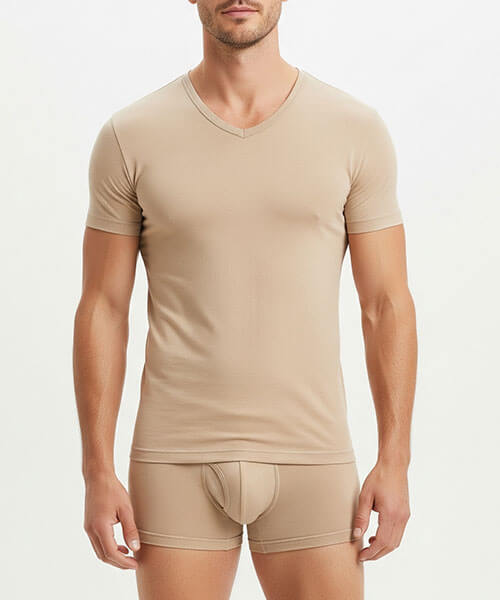
Part of T-Shirts, Undershirts & Tank Tops in Finetex Talk — buyer questions answered by the Finetex editorial team.
A brand launched moisture-wicking undershirts. Early feedback was positive, but some customers now say the shirts feel damp and clingy, and the buyer wants to know whether the fabric is wrong or something else is happening.
Short answer: Start by separating the fabric from the care routine. Wicking performance comes from fibre, yarn and knit structure, and sometimes a hydrophilic finish. Fabric softener residue, a finish that washes out, or a fit that does not touch the skin can all make a correctly specified fabric feel like it is not wicking. Test before and after laundering to know which applies.
How wicking works
A wicking fabric moves liquid sweat away from the skin by capillary action through fibres and yarn channels, then spreads it so it can evaporate. Synthetic yarns with engineered cross-sections and certain knit structures do this mechanically; other fabrics rely partly on a chemical finish that makes fibres attract water. Finishes can lose effect as they wear out with laundering.
Common reasons it stops working
- Fabric softener: softeners coat fibres and can block moisture transport. Many performance care labels advise against them.
- Finish durability: a finish-dependent fabric may wick well when new and less after repeated washes.
- Fibre and blend: high cotton content absorbs and holds water rather than moving it.
- Fit: a loose undershirt does not touch the skin, so it cannot pull sweat away.
- Expectation: wicking helps comfort but does not stop sweating; in heavy sweating any fabric becomes wet.
How to test and specify
- Use a recognised method such as AATCC TM195, which measures and classifies liquid moisture management of fabrics. Agree the classification you require.
- Test after an agreed number of washes using a defined procedure such as ISO 6330, not only on new fabric.
- Write care instructions that match the tested conditions, including softener guidance.
Limits
Do not publish performance claims such as "dries X times faster" without test data that supports the exact wording. If the fabric is finish-dependent, describe it honestly and avoid durability promises you have not tested.
Facts, recommendations and uncertainty
Established: softener residue and finish wear can reduce moisture transport. Recommendation: test before and after washing with a named method. Uncertain: performance in heavy sweating, where every fabric eventually becomes wet.
Sources and further reading
- AATCC TM195 — Liquid moisture management properties of textile fabrics
- ISO 6330:2021 — Domestic washing and drying procedures for textile testing
- U.S. FTC — Care Labeling Rule (16 CFR Part 423)
Standards and regulations are referenced by their published scope. Test parameters, cycles and pass levels should be agreed with your laboratory for the specific product; legal requirements should be confirmed for each destination market.
Three more perspectives
Ask whether wicking comes from the yarn and construction or from a finish, and request results after washing. Mechanical wicking is usually more durable, but often costs more and feels different.
A slightly closer fit in the chest and back improves wicking on a light undershirt. The main answer assumes everyday wear; for sports base layers the fibre choice and fabric weight should be revisited.
When complaints arrive, ask for one returned piece and retest it against a retained sample from the same lot. If the retained sample still wicks, the issue is likely care or use, and the response becomes clearer.
Related products
Related articles
- Moisture-Wicking Undershirts: Building the Spec and the Evidence Behind the Claim
- Moisture-Wicking Undershirts: Claims Sellers Can Actually Prove
- Moisture-Wicking Fabric Selection: Reading a Mill Spec Sheet Before You Buy a Roll
- Performance Underwear Manufacturing: Specifying Moisture, Odour and Support Claims You Can Test
← More in T-Shirts, Undershirts & Tank Tops · All Talk topics · Ask us about your programme
More factory-floor notes for brand owners

What should I check on a novelty hoodie such as an eye-mask hood?
What to check on a novelty hoodie such as an eye-mask hood: hood structure and lining, visibility and…
Read more →How should I size a unisex hoodie?
How to size a unisex hoodie: choosing a base block, body measurement ranges, ease, sleeve and body length,…
Read more →What care instructions should a hoodie carry?
What care instructions a hoodie should carry: the elements of a complete washing instruction, warnings for prints and…
Read more →
How do I match colour across hoodie and jogger sets?
How to match colour across hoodie and jogger sets: same fabric lot, rib and trims, dyeing method, shade…
Read more →How many colourways can I order at hoodie MOQ?
How many colourways a hoodie order can include at MOQ: how factories set minimums per style, colour and…
Read more →Why does a dark hoodie stain other clothes?
Why dark hoodies stain other clothes: dye bleeding in washing, rubbing transfer, perspiration, unfixed dye and pigment, and…
Read more →Request a sample & pricing information
Send us your tech pack, target price or a reference sample — we reply with a quotation, a realistic lead time and a fabric recommendation within one working day.
- Free sampling plan & cost breakdown
- MOQ from 300 pcs per style
- Reply within 1 working day