
Reshoring vs Offshoring for Men’s Basics: A Total-Cost Model
A total-cost model for reshoring vs offshoring men's basics: landed cost, inventory holding, reorder speed and stock-out loss, plus a break-even threshold.
Answer first: Reshoring men’s basics pays off only when the domestic unit price is below a break-even threshold: offshore landed cost, plus the extra inventory holding cost, stock-out loss and markdown loss that a long lead time creates, minus domestic freight. Compare those four lines per unit, not FOB against ex-works. In the illustrative model below (invented inputs, real US duty rates checked 21 November 2026), a China-made cotton T-shirt with a $4.00 FOB carries a 36.5% US duty stack and still costs about $7.74 per unit sold all-in, so a US factory would need to quote under roughly $7.00 to win. For stable, high-volume basics, offshore usually stays cheaper; for volatile, fashion-adjacent items, the threshold moves towards reshoring.
The debate about where to make basics is often argued as a matter of principle. This article turns it into arithmetic you can repeat with your own numbers. It complements our landed cost calculator and landed cost sheet, which cover the first cost line in detail.
The four cost lines that decide the comparison
A fair comparison puts every option on the same basis: total cost per unit sold. Four lines matter.
| Cost line | What it captures | Why lead time changes it |
|---|---|---|
| 1. Landed cost | FOB or ex-works price, freight, insurance, brokerage, duty | Offshore adds ocean freight and import duty |
| 2. Inventory holding | Capital tied up in stock and in transit, plus storage | Longer lead times force bigger orders and more safety stock |
| 3. Stock-out loss | Margin lost when a size or colour runs out | Slow replenishment means longer gaps |
| 4. Markdown loss | Discount on leftovers when the forecast was too high | Committing a season ahead means larger forecast errors |
Most sourcing comparisons stop at line 1. Lines 2 to 4 are where a shorter supply chain earns its premium, and they are measurable from your own sales and inventory data.
Line 1: landed cost and the US duty stack
For a US importer, duty is levied on the customs value, generally the transaction value of the goods. For a men’s cotton knit T-shirt classified in HTS subheading 6109.10.00, the general (MFN) rate is 16.5%; for men’s cotton knit briefs in 6107.11.00 it is 7.4% (USITC HTS, checked 21 November 2026).
Products of China face two additional layers on top:
- Section 301, List 4A (heading 9903.88.15): + 7.5%. USITC’s China tariffs reference list shows both 6109.10.00 and 6107.11.00 under this heading. USTR’s Federal Register notice of 7 October 2026 continued the China Section 301 actions. Our Section 301 guide explains the lists.
- Section 301 forced-labour action (heading 9903.05.31 for China): + 12.5%, for goods entered on or after 12:01 a.m. eastern time on 24 July 2026, per USTR’s Federal Register notice.
That gives a stack of 16.5% + 7.5% + 12.5% = 36.5% for a China-made cotton T-shirt. The same USTR notice applies 12.5% to products of Vietnam and many other economies, so the forced-labour layer does not separate China from most offshore alternatives; List 4A does.
Goods cut and sewn in the US are not imported garments, so no garment duty applies. Under 19 CFR 102.21, a knit garment that is not knit to shape takes its origin from the country where it was wholly assembled. Imported fabric still pays its own duty, and under 16 CFR 303.33 the label must disclose it, for example “Made in USA of imported fabric”.
The illustrative model: inputs
All inputs below are invented for the arithmetic. They are not Finetex prices, not quotes from any US factory and not market averages. Only the duty rates are real.
| Input | Offshore (China) | Reshored (US) |
|---|---|---|
| Unit price | $4.00 FOB | $7.50 ex-works |
| Freight, insurance, brokerage per unit | $0.45 | $0.15 |
| Duty (on $4.00) | 36.5% = $1.46 | none on the garment |
| Landed cost per unit | $5.91 | $7.65 |
| Order-to-warehouse lead time | 75 days | 21 days |
| Order covers | 120 days of demand | 30 days of demand |
| Days in transit (paid stock) | 30 | 0 |
| Average demand | 50 units per day | 50 units per day |
| Daily demand variability (standard deviation) | 20 units | 20 units |
| Service factor (about 95% cycle service) | 1.65 | 1.65 |
| Annual carrying-cost rate | 25% | 25% |
| Retail price | $24.00 | $24.00 |
Annual demand is 50 × 365 = 18,250 units.
Line 2: inventory holding cost
Holding cost has three parts: cycle stock (half of each order, on average), safety stock, and pipeline stock you have paid for but cannot sell yet.
Safety stock grows with the square root of lead time: service factor × daily variability × √lead time.
- Offshore: 1.65 × 20 × √75 ≈ 1.65 × 20 × 8.66 ≈ 286 units
- Reshored: 1.65 × 20 × √21 ≈ 1.65 × 20 × 4.58 ≈ 151 units
Average stock on hand = half the order quantity + safety stock.
- Offshore: (120 × 50) / 2 + 286 = 3,000 + 286 = 3,286 units
- Reshored: (30 × 50) / 2 + 151 = 750 + 151 = 901 units
Holding cost per unit sold = average stock × landed cost × carrying rate ÷ annual demand.
- Offshore on hand: 3,286 × $5.91 × 25% ≈ $4,855 a year → $0.27 per unit
- Offshore in transit: 30 days × 50 = 1,500 units × $5.91 × 25% ≈ $2,216 a year → $0.12 per unit
- Offshore total: $0.39 per unit
- Reshored: 901 × $7.65 × 25% ≈ $1,723 a year → $0.09 per unit
The difference is about $0.30 per unit in favour of the shorter chain. Payment terms shift this line: on 30% deposit and 70% against the bill of lading, part of the offshore capital is tied up even before the goods sail.
Line 3: reorder speed and stock-out loss
Reorder speed is the main reason brands consider reshoring. A 21-day replenishment cycle lets you react to a size running out within the same season; a 75-day cycle often means the gap lasts until the next order lands.
Measure it from your own data: the share of demand lost because the item was out of stock. In the model we assume (invented) 4% of demand lost offshore and 1.5% reshored. The loss per lost sale is the margin you would have earned: retail minus landed cost.
- Offshore: 4% × ($24.00 − $5.91) = 4% × $18.09 ≈ $0.72 per unit
- Reshored: 1.5% × ($24.00 − $7.65) = 1.5% × $16.35 ≈ $0.25 per unit
Difference: about $0.48 per unit. Note the asymmetry: the cheaper product loses more margin per missed sale, because its margin is bigger.
Line 4: markdown loss on leftovers
Committing 120 days of demand at once means a bigger forecast error. Assume (invented) 6% of offshore units end up marked down by $12.00, against 2% for the reshored programme.
- Offshore: 6% × $12.00 = $0.72 per unit
- Reshored: 2% × $12.00 = $0.24 per unit
Difference: about $0.48 per unit.
Putting it together
| Per unit sold | Offshore (China) | Reshored (US) |
|---|---|---|
| Landed cost | $5.91 | $7.65 |
| Inventory holding | $0.39 | $0.09 |
| Stock-out loss | $0.72 | $0.25 |
| Markdown loss | $0.72 | $0.24 |
| Total cost per unit sold | $7.74 | $8.23 |
With these inputs, offshore is still about $0.49 cheaper per unit, even after a 36.5% duty stack and after charging it for slower replenishment. The gap between the two FOB/ex-works prices was $3.50; the lead-time lines closed more than a third of it.
The decision threshold
Rearranging the model gives the domestic ex-works price at which the two options cost the same:
Break-even domestic price ≈ offshore landed cost + (holding gap + stock-out gap + markdown gap) − domestic freight
With the illustrative inputs: $5.91 + ($0.30 + $0.48 + $0.48) − $0.15 ≈ $7.02, so in this model a US factory must quote about $7.00 or less to match a $4.00 FOB from China. That is roughly 75% above the offshore FOB. (The domestic lines move slightly with the domestic price, so treat the result as an approximation.)
How the threshold moves:
- Remove the two Section 301 layers (duty back to 16.5%, or $0.66): offshore landed cost falls by $0.80 and the threshold drops to about $6.20.
- Briefs instead of T-shirts (7.4% MFN + 20% for China): the duty and the threshold both change; rerun line 1 with the right subheading.
- Higher demand variability (fashion colours, new styles with no sales history): safety stock, stock-outs and markdowns all grow on the long chain, and the threshold rises towards reshoring.
- Stable, never-out-of-stock basics (black, white and navy core sizes): forecast error is small, lines 3 and 4 shrink, and offshore usually wins.
- Other offshore countries: for a product of Vietnam the stack for 6109.10.00 is 16.5% + 12.5% = 29%, without List 4A. Our Mexico and Central America comparison covers nearshore options in between.
How to run the model on your own range
- Split the range into stable core styles and volatile styles. Run the model separately; mixing them hides the answer.
- Use measured inputs: your actual stock-out rate, markdown rate and carrying cost, not industry rules of thumb.
- Use real quotes from both sides for the same specification, fabric weight and size range, with the same trims and packing.
- Check the duty stack on the day you decide, for the exact HTS subheading and country of origin, with your customs broker.
- Decide per style, not per brand. A common outcome is a split: core basics offshore with deep stock, fast-turn colours or test styles closer to the market. Our cost structure breakdown looks at the offshore side in more detail.
Where we fit in the model
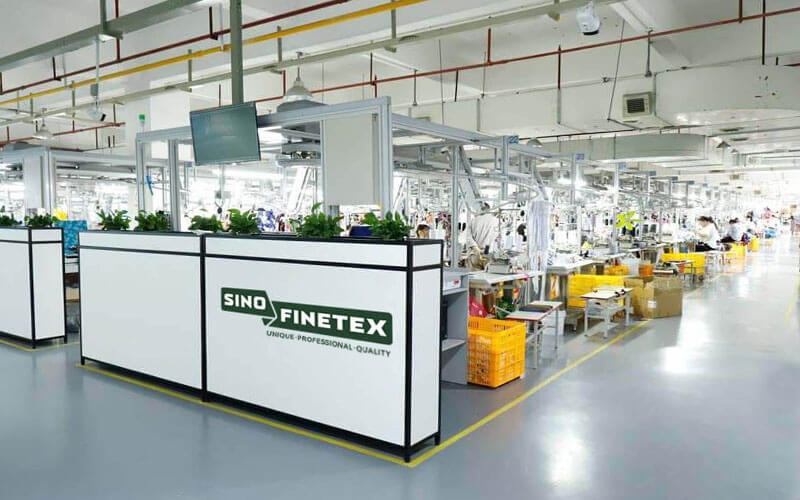
We are an offshore option, so we cannot be neutral about the conclusion; what we can do is give you real inputs for line 1 and honest lead times for lines 2 to 4. Since 2004 we have made knit basics in Shenzhen; our about page lists the factory floor, staff and lines. Our published terms: from 300 pieces per style on stock fabric, development samples in 5–7 working days, bulk in 15–45 days from deposit and approved pre-production sample, T/T 30% deposit and 70% against a copy of the bill of lading, and quotations valid for 90 days. For the stable core of a range, that is the input set to put in the offshore column.
Fact, advice and uncertainty
Fact (checked 21 November 2026): HTS 6109.10.00 carries a 16.5% general rate and 6107.11.00 7.4%; heading 9903.88.15 adds 7.5% for listed products of China and heading 9903.05.31 adds 12.5% for products of China entered from 24 July 2026; 19 CFR 102.21 and 16 CFR 303.33 set origin and labelling rules.
Advice: compare total cost per unit sold across four lines, run core and volatile styles separately, and confirm the duty stack with your customs broker before you decide.
Uncertain: Section 301 actions can be modified, and every non-duty input in this article is illustrative. Your own stock-out, markdown and carrying-cost data decide the answer.
Related reading
- Mexico and Central America for US Brands: Speed, Duty and Minimums
- China vs Portugal and Turkey: Nearshoring for EU Brands
- Is China Still Competitive for Apparel in 2027? A Cost-Structure Breakdown
- Building a Landed Cost Sheet: FOB, Freight, Duty, Fees
- Landed Cost Calculator: FOB to Door in Six Inputs
Frequently asked questions
Is reshoring apparel manufacturing cheaper than offshoring?
Usually not on unit price, and sometimes yes on total cost. Reshoring wins when the extra inventory holding, stock-out and markdown cost of a long lead time is larger than the gap in landed cost. That is more likely for volatile styles than for stable basics.
What is a total-cost model for clothing sourcing?
A per-unit comparison that adds four lines for each option: landed cost (price, freight, duty), inventory holding cost, stock-out loss and markdown loss. It replaces a simple FOB versus ex-works comparison.
What US duty applies to a cotton T-shirt made in China?
As checked on 21 November 2026: 16.5% general rate for HTS 6109.10.00, plus 7.5% under Section 301 List 4A and 12.5% under the Section 301 forced-labour action, 36.5% in total. Confirm with your customs broker for your entry date.
Does a garment sewn in the US from imported fabric count as made in the US?
For customs origin, a knit garment not knit to shape takes the origin of the country where it was wholly assembled (19 CFR 102.21). For labelling, the FTC rule requires disclosure such as “Made in USA of imported fabric” (16 CFR 303.33).
Sources
- USITC HTS: 6109.10.00 general rate
- USITC HTS: 6107.11.00 general rate
- USITC: China tariffs reference list (Section 301)
- Federal Register, 28 July 2026: Notice of actions in Section 301 investigations of various economies
- Federal Register, 7 October 2026: Continuation of actions, China Section 301
- CBP: Section 301 trade remedies FAQ
- eCFR: 19 CFR 102.21, Textile and apparel products
- eCFR: 16 CFR 303.33, Country of origin labelling
Get real offshore inputs for your model
Send your style list, specifications and annual volumes. We will return FOB quotations valid for 90 days, sample and bulk timings, and packing data for freight, so the offshore column is built on numbers rather than guesses.
Request a quote or read our clothing factory sourcing guide.
More factory-floor notes for brand owners

Naturally Dyed Underwear: What Should Buyers Test Before Bulk?
Plan naturally dyed underwear testing for wash and rub fastness, shade variation, and reorder approval. Match color and…
Read more →
Hidden Pockets in Boxer Briefs: Where Should They Sit?
Choose hidden pockets in boxer briefs by testing placement, access, load, and movement in comparable samples before approving…
Read more →
Silk Underwear Sourcing: What Can a Buyer Approve from a Sample?
Use a silk underwear sourcing checklist to verify fiber composition, compare stretch and seams, and approve care and…
Read more →
Adaptive Men’s Underwear: How Do You Test Side Openings?
Test side openings in adaptive men's underwear with seated and one-handed dressing checks, closure placement reviews, and a…
Read more →Microfiber Underwear Fabric: What Should Buyers Specify?
Specify microfiber underwear fabric by verified fiber content, knit structure, stretch, and wash performance. Use a sample checklist…
Read more →Skin-Tone Underwear Color Matching: How Do You Approve a Range?
Plan skin-tone underwear color matching with physical swatches, stretch checks, and a repeatable shade approval record for production…
Read more →Request a sample & pricing information
Send us your tech pack, target price or a reference sample — we reply with a quotation, a realistic lead time and a fabric recommendation within one working day.
- Free sampling plan & cost breakdown
- MOQ from 300 pcs per style
- Reply within 1 working day