
Factory Onboarding: A 30-Day Ramp for a New Supplier
A 30-day onboarding plan for a new apparel factory: documents, first sample, trial order and ramp-up, with four go/no-go gates and what each must prove.
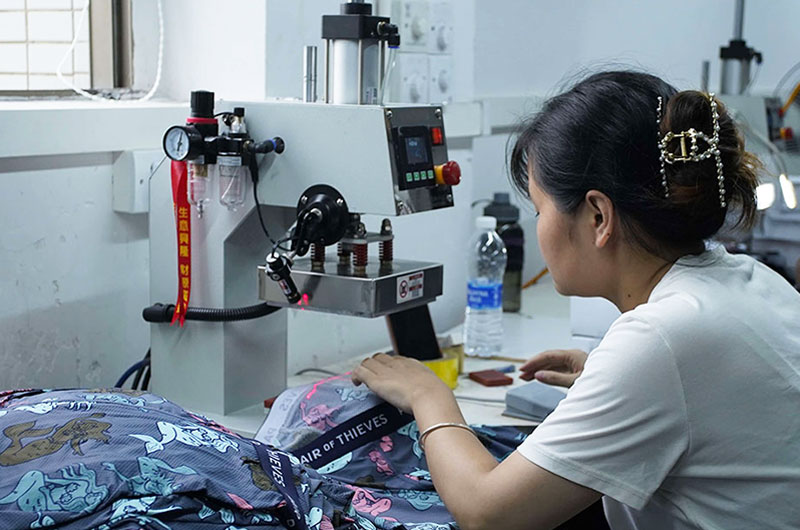
Answer first: Onboarding a new apparel factory works best as a fixed 30-day plan with four gates: (1) documents verified, (2) first sample approved against a written specification, (3) trial order placed with dates, inspections and payment terms agreed, and (4) a written ramp-up plan for volume. Each gate has a pass condition; if it fails, you stop or fix it before money and fabric are committed. Thirty days is enough to clear the first three gates with a responsive factory. The trial order itself runs after day 30, because bulk production takes weeks on its own; at our factory the published range is 15–45 days from deposit and approved pre-production sample.
This plan complements our on-site factory visit checklist, which covers what to look at on the floor. Here the focus is the process from first contact to a factory you can scale with.
The 30-day plan at a glance
| Days | Workstream | Gate at the end |
|---|---|---|
| 1–7 | Documents, quote, specification review | Gate 1: documents |
| 5–20 | Development sample, fabric approvals, fit comments | Gate 2: first sample |
| 15–30 | Size set, pre-production sample, trial order terms | Gate 3: trial order |
| 25–30 | Ramp-up plan, capacity, reorder process | Gate 4: ramp plan |
| After day 30 | Trial order production, inspection, shipment, review | Go or no-go for volume |
Overlaps are deliberate: the sample can start while documents are still being checked, but no deposit is paid before Gate 1 passes.
Gate 1: documents (days 1–7)
Ask for the documents before the sample, not after the first order. A factory that cannot produce them in a week will not produce them under customs pressure.
| Document | What it proves | Check |
|---|---|---|
| Business licence and export registration | The legal entity you are paying | Name matches the bank account and the proforma invoice |
| Social audit report (for example BSCI or Sedex) | A third party has checked wages, hours and safety | Date, scope, site address, open findings |
| Product certificates (OEKO-TEX, GOTS, GRS) | The claim you want to make is supported | Certificate scope covers your product and site |
| Test reports for the proposed fabrics | Shrinkage, colour fastness, fibre content | Tested on the fabric you will actually buy |
| Fibre traceability documents for cotton | Origin evidence for US customs | Chain from fabric back to yarn and cotton |
| NDA and pattern ownership terms | Your design stays yours | Signed before tech packs are shared in full |
| Payment terms and bank details | Who gets paid, when | Confirmed in the proforma invoice |
Two regulatory points shape this list:
- US forced-labour enforcement. CBP applies the Uyghur Forced Labor Prevention Act’s rebuttable presumption that goods made wholly or in part in Xinjiang, or by an entity on the UFLPA Entity List, are prohibited from import. The presumption can only be overcome by clear and convincing evidence. For cotton garments that means traceability documents, which take time to assemble. Collect them now. Our article on UFLPA and cotton documents lists them.
- US product certificates. For US sales, 16 CFR Part 1110 sets the content of certificates of compliance for products subject to CPSC rules. Agree now who issues them and on which test reports.
Our article on factory audit types explains what each audit does and does not prove.
Gate 1 passes when: every document matches the legal entity and site that will make your goods, and open audit findings have a written correction plan.
Gate 2: first sample (days 5–20)
The sample tests the factory’s understanding of your product as much as its sewing.
- Send a complete tech pack: measurements with tolerances, fabric by weight and composition, trims, labels and packing. Our tech pack template lists what to include.
- Approve fabric first: lab dip, hand-feel swatch and, where relevant, shrinkage and colour fastness tests.
- Receive the development sample. Our published timing is 5–7 working days after artwork and fabric are confirmed.
- Measure it yourself against your chart, and compare with the factory’s own measurement sheet. A factory whose measurements match yours is a factory whose inspection you can trust.
- Send comments once, in writing, in one consolidated document.
Gate 2 passes when: the sample is within tolerance on all key points, the fabric matches the approved swatch, and the factory’s measurement sheet agrees with yours.
Gate 3: trial order (days 15–30)
A trial order is a real order at a size you can afford to lose. It should be large enough to test production, not just sampling: on our published terms, styles on stock fabric start from 300 pieces per style.
Before you place it:
- Size set. A graded size set checks the grading; our published timing is 10–12 working days.
- Pre-production (PP) sample in the final fabric and trims, signed by both sides. At our factory, the signed PP sample releases bulk production, and the deposit is scheduled against that point.
- Written schedule with approval dates. Every decision you owe the factory needs a date.
- Inspection plan. Agree the in-line checks and the final inspection standard. Our process runs in-line checks at 30% and 70% of the run and a final AQL 2.5 audit, and you may appoint a third-party inspector at any stage.
- Payment terms. Our standard is a 30% deposit and 70% against the copy of the bill of lading, with the final inspection report issued before the balance is due.
Gate 3 passes when: the PP sample is signed, the schedule and inspection plan are in the purchase order, and the deposit is paid against the PP sign-off rather than a verbal go-ahead.
Gate 4: ramp-up plan (days 25–30)
Plan the volume stage before the trial order ships, so a good result can be acted on immediately.
- Capacity. Which lines, how many pieces per week, and what else is booked in your season? Our article on line balancing and SMV explains how capacity is calculated.
- Weekly reporting. Agree the format now. Our article on weekly WIP reports lists the five numbers to ask for.
- Subcontracting rules. Write down whether any operation may be subcontracted and how you will be told. See how to know if your order is outsourced.
- Reorder process. Locked block, retained samples, fabric reorder lead time and price validity.
- Forecast sharing. The OECD’s garment due diligence guidance recommends that buyers set final order placement dates, share purchasing plans with suppliers and track how often orders are placed late or changed, because rushed and changed orders are linked to excessive overtime and low wages. A ramp plan with dates protects both sides.
Gate 4 passes when: you have a written capacity commitment, a reporting format, subcontracting rules and a reorder process.
After day 30: run and review the trial order
When the trial order ships, review it in one meeting with four questions:
- Did it ship on the confirmed date, and if not, which approval or production step slipped?
- What did the in-line and final inspections find, and were corrective actions written down?
- Did the measurement report match your own checks on arrival?
- Were the documents (commercial invoice, packing list, certificate of origin, test reports) complete and correct?
If all four are clean, move to volume. If not, decide whether the problem was the factory’s, the specification’s or your own approval timing. Our quality control page describes the gates and reports we use, and Two Factories, One Decision gives a scorecard if you are comparing suppliers.
How we onboard new customers
Our process has eight published steps from first enquiry to delivered shipment: brief, costed quotation within one working day, written specification, fabric approval, fit sample and size set, PP sign-off releasing bulk, production with in-line checks and a final AQL 2.5 audit, then packing, carton audit and export documents. One named merchandiser owns the programme and answers in writing, and the approval calendar lists every decision with its date. Customers, auditors and third-party inspectors are welcome at any stage.
Fact, advice and uncertainty
Fact: our published timings are 5–7 working days for a development sample, 10–12 working days for a size set and 15–45 days for bulk; CBP’s UFLPA page and the OECD guidance were read on 21 November 2026, and 16 CFR 1110 sets certificate content for CPSC-regulated products.
Advice: run onboarding as four gates with written pass conditions, collect documents before the sample, pay the deposit against the signed PP sample, and plan ramp-up before the trial order ships.
Uncertain: the trial order is the real test. Thirty days of onboarding reduces risk; it does not remove it.
Related reading
- Factory Audit Types: BSCI, Sedex, WRAP and What Each Proves
- First-Output Check: The In-Line Inspection That Saves Bulk
- Subcontracting: How to Know If Your Order Is Outsourced
- Weekly WIP Reports: Five Numbers That Predict a Late Shipment
- Two Factories, One Decision: A One-Page Scorecard
Frequently asked questions
How long does it take to onboard a new clothing factory?
About 30 days to clear documents, first sample, trial order terms and a ramp-up plan with a responsive factory. Production of the trial order then takes several weeks more, so the full cycle to a reviewed first shipment is longer.
What documents should I ask a new garment supplier for?
Business licence, a recent social audit report, product certificates for any claim you will make, fabric test reports, cotton traceability documents for US imports, an NDA and written payment terms.
How big should a trial order be?
Large enough to test real production, not just sampling, and small enough to absorb a problem. For many knit basics that is the factory’s minimum per style; on our terms, from 300 pieces per style on stock fabric.
When should I pay the deposit to a new factory?
After the documents are verified and the pre-production sample is signed. Paying against a signed PP sample, rather than a verbal go-ahead, protects both sides.
Sources
- CBP: Uyghur Forced Labor Prevention Act
- OECD Due Diligence Guidance for Responsible Supply Chains in the Garment and Footwear Sector (PDF)
- eCFR: 16 CFR Part 1110, Certificates of compliance
Start a 30-day onboarding with us
Send your tech pack, target quantity and the documents your compliance team requires. We will reply with a quotation, the document set and a dated approval calendar for sample, size set and PP sign-off.
Request a quote or read our clothing factory sourcing guide.
More factory-floor notes for brand owners
Naturally Dyed Underwear: What Should Buyers Test Before Bulk?
Plan naturally dyed underwear testing for wash and rub fastness, shade variation, and reorder approval. Match color and…
Read more →
Hidden Pockets in Boxer Briefs: Where Should They Sit?
Choose hidden pockets in boxer briefs by testing placement, access, load, and movement in comparable samples before approving…
Read more →
Silk Underwear Sourcing: What Can a Buyer Approve from a Sample?
Use a silk underwear sourcing checklist to verify fiber composition, compare stretch and seams, and approve care and…
Read more →
Adaptive Men’s Underwear: How Do You Test Side Openings?
Test side openings in adaptive men's underwear with seated and one-handed dressing checks, closure placement reviews, and a…
Read more →Microfiber Underwear Fabric: What Should Buyers Specify?
Specify microfiber underwear fabric by verified fiber content, knit structure, stretch, and wash performance. Use a sample checklist…
Read more →Skin-Tone Underwear Color Matching: How Do You Approve a Range?
Plan skin-tone underwear color matching with physical swatches, stretch checks, and a repeatable shade approval record for production…
Read more →Request a sample & pricing information
Send us your tech pack, target price or a reference sample — we reply with a quotation, a realistic lead time and a fabric recommendation within one working day.
- Free sampling plan & cost breakdown
- MOQ from 300 pcs per style
- Reply within 1 working day