
How do I make an undershirt invisible under a dress shirt?
How to make an undershirt invisible under a dress shirt: colour close to skin tone, neckline depth, flat seams and hems, tagless labels, fabric weight and…
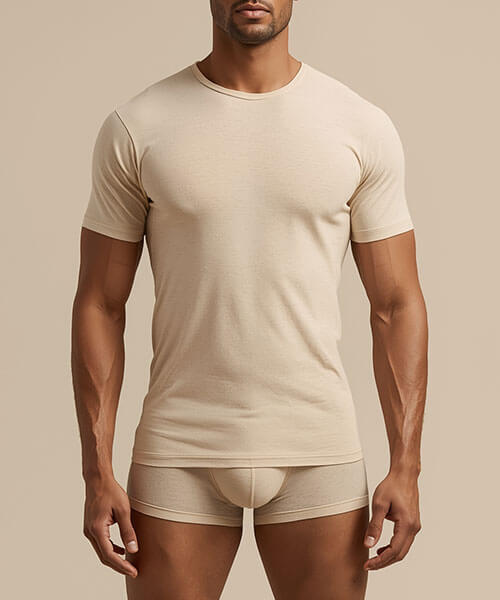
Part of T-Shirts, Undershirts & Tank Tops in Finetex Talk — buyer questions answered by the Finetex editorial team.
An office-wear brand launches a white crew-neck undershirt. Customers like the comfort, but several say the neckline, sleeve hems and even the shape of the undershirt show through their light blue and white dress shirts, especially under office lighting.
Short answer: An undershirt becomes visible for three reasons: contrast, edges and folds. White fabric under a thin white shirt contrasts with the skin around it, so the outline of the undershirt shows; a colour close to the wearer's skin tone usually shows far less. Edges such as a high neckline, sleeve hems, raised seams and printed or sewn labels create lines the shirt fabric reveals. Loose fabric folds and wrinkles create shadows. To make an undershirt close to invisible, offer skin-tone shades, choose a V or deep V neck that sits below an open collar, use flat seams, raw-cut or bonded hems and tagless printed labels, keep the fabric light and smooth, and cut a close but not tight fit so the body does not wrinkle under the shirt. Test every change under real dress shirts and office lighting.
What makes an undershirt show
- Colour contrast: bright white often shows more than a muted skin-tone shade.
- Necklines that sit above the shirt collar or show in the open neck.
- Sleeve hems that end mid-arm, creating a visible band under thin sleeves.
- Thick seams, overlocked edges and sewn-in labels.
- Excess fabric that folds and bunches at the waist and back.
Design levers
- Offer two or three skin-tone shades rather than one nude.
- Use a V or deep V for customers who wear open collars.
- Use flatlock seams or bonded edges, and raw-cut or bonded sleeve hems.
- Print care information instead of a sewn label at the neck.
- Choose a light, smooth jersey or a modal or microfibre blend.
- Grade a close fit using body measurement data such as ISO 8559.
Keeping it invisible after washing
A close fit only helps if it survives washing. Check dimensional change of the fabric with ISO 5077, because a body that shrinks in width becomes tight and shows lines, while one that grows becomes loose and folds.
A worked example
As an illustration, a brand could fit its white crew neck and a skin-tone V-neck under a thin white shirt and a light blue shirt on several testers, photographing both under office lighting. If the V-neck in the closer shade shows only faintly while the white crew shows its neckline and sleeve hems, that gives a clear basis for adding the skin-tone V to the range.
Limits
No undershirt is invisible under every shirt. Very thin or sheer shirts reveal almost anything, and skin tones vary widely, so one shade will not suit every customer.
Facts, recommendations and uncertainty
Established: contrast, edges and folds make undershirts visible. Recommendation: offer skin-tone shades, low necklines, flat edges and tagless labels, and test under real shirts. Uncertain: which shades and necklines suit your customer base.
Sources and further reading
- ISO 8559-1:2017 — Size designation of clothes: anthropometric definitions for body measurement
- ISO 5077:2007 — Determination of dimensional change in washing and drying
Standards and regulations are referenced by their published scope. Test parameters, cycles and pass levels should be agreed with your laboratory for the specific product; legal requirements should be confirmed for each destination market.
Three more perspectives
Ask the factory which flat seam and bonded hem options it can run in bulk, their minimums and the added cost per piece. Skin-tone shades need lab dip approval like any colour, so plan dye lots for each shade and check the minimum per colour with the fabric mill before deciding on two or three shades. Ask also whether the factory can supply a neutral or matching thread for each shade, because a white seam on a skin-tone body becomes a visible line under a thin shirt.
Fit samples under real dress shirts in white and light blue, in daylight and under office lights, and photograph front, back and side. Check the neckline with the top button open, sleeve hems with arms bent, and the waist when seated. Record the approved neckline depth, hem finish and fit for each size. Compare a crew and a V-neck in the same fabric so the team can see how much of the effect comes from the neckline and how much from colour.
Check that bonded hems lie flat and do not curl after washing, since a curled edge shows through a shirt. Compare shade with the approved standard under the agreed light source, and check that tagless prints do not show through the fabric. Measure body width and length after washing. Keep a washed, approved garment at the inspection table and compare each lot visually under a thin white shirt.
Related products
Related articles
- Men's Undershirt Manufacturing in China: Necklines, Weights and the White-Opacity Problem
- V-Neck Undershirts Under Dress Shirts: A Spec for the Commuter Customer
- Sleeveless Undershirt Manufacturing: Cut, Rib and the Layering Geometry Buyers Get Wrong
- Moisture-Wicking Undershirts: Building the Spec and the Evidence Behind the Claim
- Cotton Undershirt Supply: Combing, Count and What Actually Stops Shrinkage
- Wholesale Men's Undershirts: Blank Supply, Private Label and the Terms That Decide Both
- Private Label Undershirts: Pack Architecture and the Branding Layers That Pay
- Custom Undershirt Manufacturing: What Is Worth Changing on a Layering Garment
- Undershirt Trends for Basics Brands: The Subtle Updates That Matter
- Sustainable Undershirts: Marketing Organic Cotton and Bamboo Honestly
← More in T-Shirts, Undershirts & Tank Tops · All Talk topics · Ask us about your programme
More factory-floor notes for brand owners

What should I check on a novelty hoodie such as an eye-mask hood?
What to check on a novelty hoodie such as an eye-mask hood: hood structure and lining, visibility and…
Read more →How should I size a unisex hoodie?
How to size a unisex hoodie: choosing a base block, body measurement ranges, ease, sleeve and body length,…
Read more →What care instructions should a hoodie carry?
What care instructions a hoodie should carry: the elements of a complete washing instruction, warnings for prints and…
Read more →
How do I match colour across hoodie and jogger sets?
How to match colour across hoodie and jogger sets: same fabric lot, rib and trims, dyeing method, shade…
Read more →How many colourways can I order at hoodie MOQ?
How many colourways a hoodie order can include at MOQ: how factories set minimums per style, colour and…
Read more →Why does a dark hoodie stain other clothes?
Why dark hoodies stain other clothes: dye bleeding in washing, rubbing transfer, perspiration, unfixed dye and pigment, and…
Read more →Request a sample & pricing information
Send us your tech pack, target price or a reference sample — we reply with a quotation, a realistic lead time and a fabric recommendation within one working day.
- Free sampling plan & cost breakdown
- MOQ from 300 pcs per style
- Reply within 1 working day