
What helps prevent sweat stains on undershirts?
What helps prevent sweat stains on undershirts and dress shirts: underarm coverage, absorbent or wicking fabrics, fit, colour, care and perspiration fastness tests.
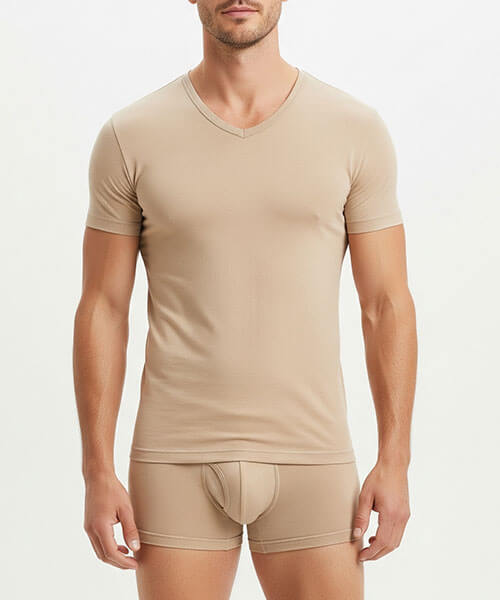
Part of T-Shirts, Undershirts & Tank Tops in Finetex Talk — buyer questions answered by the Finetex editorial team.
A brand sells undershirts mainly to men who want to protect their dress shirts from underarm sweat marks. Customers ask whether the undershirt will stop stains on the shirt, and the team wants to know what design really makes a difference.
Short answer: An undershirt helps protect a dress shirt by sitting between the underarm and the shirt and absorbing or spreading sweat before it reaches the shirt fabric. It can only do this if it covers the underarm area fully and stays in place, so sleeve coverage and a close underarm fit matter most: a sleeveless or short cap sleeve leaves the shirt exposed. Fabric choice decides what happens to the sweat. Cotton and viscose absorb and hold moisture, which protects the shirt but can feel damp; wicking polyester or nylon blends spread sweat so it dries faster but may pass moisture on if the volume is high. Some brands add a double layer or absorbent panel in the underarm. Yellow marks on the undershirt itself usually come from sweat combined with antiperspirant residues, so care advice and colour choice also matter. No undershirt can promise zero stains for heavy sweaters, so describe the benefit honestly.
Design factors
- Sleeve length and armhole depth that cover the full underarm.
- A close underarm fit so the fabric stays between skin and shirt.
- Absorbent or wicking fabric chosen for the climate and customer.
- Optional double layer or absorbent underarm panel.
- Flat seams under the arm to avoid rubbing.
Colour and fastness
Coloured or skin-tone undershirts should not bleed onto shirts when damp with sweat. Test colour fastness to perspiration with ISO 105-E04 and check staining on the adjacent fabric. Light skin-tone shades also hide yellowing better than bright white.
Testing performance
Liquid moisture management can be measured with AATCC TM195 to compare fabrics. Wear tests in warm conditions under real dress shirts show more than any lab result.
Care advice for customers
Advise washing undershirts after each wear, letting antiperspirant dry before dressing, and avoiding chlorine bleach on stains. Washing procedures for testing follow ISO 6330.
A worked example
As an illustration, a brand comparing a short-sleeve cotton undershirt with one having a double underarm layer could run a wear test with testers in light shirts on warm days, then compare shirt marks and comfort.
What the undershirt cannot fix
Shirt fabric, fit and the customer's antiperspirant all affect stains. A tight dress shirt presses the undershirt against the skin and can push moisture through, and some antiperspirants leave residues that mark both garments regardless of the undershirt.
Limits
Heavy sweating and some antiperspirants can mark shirts despite any undershirt. Avoid absolute claims.
Facts, recommendations and uncertainty
Established: underarm coverage and fit matter most; fabric decides absorb versus spread. Recommendation: cover the underarm, choose fabric for the customer and test perspiration fastness. Uncertain: how much protection your customers get in practice.
Sources and further reading
- ISO 105-E04:2013 — Colour fastness to perspiration
- ISO 6330:2021 — Domestic washing and drying procedures for textile testing
- AATCC TM195 — Liquid moisture management properties of textile fabrics
Standards and regulations are referenced by their published scope. Test parameters, cycles and pass levels should be agreed with your laboratory for the specific product; legal requirements should be confirmed for each destination market.
Three more perspectives
If you plan an underarm panel or double layer, ask the factory how it is sewn and the effect on cost and line speed. Request perspiration fastness results for coloured fabrics before bulk. Keep marketing claims to what wear tests show, such as helps protect shirts, rather than stain-proof. Compare the cost of a panel style with a plain style and decide whether it belongs in a premium line rather than the core range.
Develop armhole depth and sleeve length so the underarm stays covered when arms move. Compare cotton, modal and wicking blends in wear trials under real shirts. Check that any underarm panel lies flat and does not show through thin shirts. Record armhole depth and sleeve length for each size, and confirm the coverage on large sizes, where the underarm area is bigger. Check the panel does not stiffen after washing.
Test coloured lots for perspiration fastness and staining. Check underarm seams for flatness and strength, since this area takes the most movement. Record wear test results and customer comments on staining by fabric lot and style. Wash a few garments from each lot and check that underarm panels stay flat and colour stays even. Keep fastness results with the lot record so any staining complaint can be checked quickly.
Related products
Related articles
← More in T-Shirts, Undershirts & Tank Tops · All Talk topics · Ask us about your programme
More factory-floor notes for brand owners

What should I check on a novelty hoodie such as an eye-mask hood?
What to check on a novelty hoodie such as an eye-mask hood: hood structure and lining, visibility and…
Read more →How should I size a unisex hoodie?
How to size a unisex hoodie: choosing a base block, body measurement ranges, ease, sleeve and body length,…
Read more →What care instructions should a hoodie carry?
What care instructions a hoodie should carry: the elements of a complete washing instruction, warnings for prints and…
Read more →
How do I match colour across hoodie and jogger sets?
How to match colour across hoodie and jogger sets: same fabric lot, rib and trims, dyeing method, shade…
Read more →How many colourways can I order at hoodie MOQ?
How many colourways a hoodie order can include at MOQ: how factories set minimums per style, colour and…
Read more →Why does a dark hoodie stain other clothes?
Why dark hoodies stain other clothes: dye bleeding in washing, rubbing transfer, perspiration, unfixed dye and pigment, and…
Read more →Request a sample & pricing information
Send us your tech pack, target price or a reference sample — we reply with a quotation, a realistic lead time and a fabric recommendation within one working day.
- Free sampling plan & cost breakdown
- MOQ from 300 pcs per style
- Reply within 1 working day