
How is a men’s thong constructed differently from a brief?
How a men's thong is constructed differently from a brief: back panel, leg and back elastics, pouch, seams, fabric choices, sizing and fit testing.
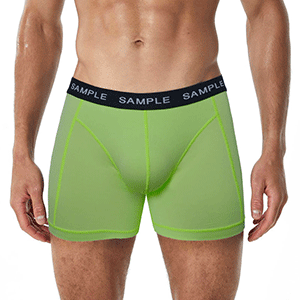
Part of Underwear Fit, Styles & Construction in Finetex Talk — buyer questions answered by the Finetex editorial team.
A brand that makes men's briefs wants to add a thong. The team wonders whether it can reuse the brief pattern with a narrow back, or whether the construction is different enough to need its own development.
Short answer: A men's thong shares the front with a brief, but the back is very different. A brief has a full back panel that covers the seat and anchors the leg openings. A thong replaces this with a narrow strip of fabric or elastic running from the waistband to the crotch, so the front pouch is held mainly by the waistband and this back strip. That changes how tension is distributed, where seams sit and which elastics are used. Reusing a brief pattern with a narrowed back usually gives poor support or a strip that rubs. A thong is best developed as its own style, ideally sharing the waistband and pouch shape with the brief.
Back construction
- Fabric strip: a narrow fabric back, sometimes widening towards the crotch.
- Elastic back: a single elastic or tubular strip.
- T-back: a strip that joins the waistband at a T-junction.
Each feels different and must be comfortable between the buttocks.
Leg finishes
Brief legs are finished around a full opening. On a thong, the leg elastics run from the pouch to the back strip and carry more tension. Soft or plush elastics help comfort.
Pouch
The pouch must support more on a thong, because there is no back panel to help. A contoured pouch with a centre seam or shaped panels works better than a flat front. Pouch fabric needs good recovery.
Seams and comfort
Seams near the back strip need to be flat and soft. The join between back strip and pouch is a high-stress point and a common place for rubbing or breakage. Bartacks or reinforced stitching are often used.
Fabric
Stretchy, smooth fabrics with good recovery work best, often modal, microfibre or cotton with elastane. Compare elastic tension objectively, for example with a tension and elongation method such as ASTM D4964.
Sizing
Thongs are chosen mainly by waist. The back strip length should be graded with seat and hip measurements, based on consistent body points such as those defined in ISO 8559-1.
Testing
Wear-test while walking, sitting and bending, noting rubbing at the back strip, pouch support and leg elastic pressure. Wash and measure with ISO 5077 and repeat.
Limits
Thongs are a preference product, and comfort expectations vary widely. Testing with customers who wear thongs is essential.
Facts, recommendations and uncertainty
Established: a thong uses a narrow back strip, so tension, seams and pouch support differ from a brief. Recommendation: develop the thong as its own pattern, sharing waistband and pouch shape where possible. Uncertain: which back construction your customers prefer.
Sources and further reading
- ISO 8559-1:2017 — Size designation of clothes: anthropometric definitions for body measurement
- ISO 5077:2007 — Determination of dimensional change in washing and drying
- ASTM D4964 — Tension and elongation of elastic fabrics
Standards and regulations are referenced by their published scope. Test parameters, cycles and pass levels should be agreed with your laboratory for the specific product; legal requirements should be confirmed for each destination market.
Three more perspectives
A thong uses less fabric but has more elastic and more careful sewing, so the cost may not be lower than a brief. Ask the factory for a price breakdown. Use the same waistband and fabric as the brief to keep minimums low. Order samples in two back constructions if possible, because customer preference between fabric and elastic backs is hard to predict.
In the pattern, keep the brief's front and waistband, then draft the back strip and leg lines separately. Set leg elastic lengths with care, since they carry more tension. Check pouch depth on the model, as it may need to increase slightly for support. Grade back strip length with the seat rather than with the waist alone. Fit-test both backs on the same model.
In inspection, check the back strip join and leg elastic seams for strength and neat finishing, because defects there are both uncomfortable and visible. Measure back strip length and leg elastic length for each size. Track returns mentioning rubbing or breakage at the back, as these point to construction rather than to size. Pull-test the back strip join on a few pieces from each lot.
Related products
← More in Underwear Fit, Styles & Construction · All Talk topics · Ask us about your programme
More factory-floor notes for brand owners
Why did my reorder price go up?
Why an apparel reorder price can go up: fabric and trim costs, smaller quantities, specification changes, labour and…
Read more →
How do I read an underwear quotation line by line?
How to read an underwear quotation line by line: fabric, elastic and trims, labour, packaging, testing, overheads and…
Read more →
How do peak seasons affect apparel factory capacity?
How peak seasons and holidays affect apparel factory capacity and lead times, why fabric and shipping are also…
Read more →
Should I split one style across two factories?
Whether to split one apparel style across two factories: the benefits for capacity and risk, the risks for…
Read more →
What are the biggest risks on a small brand’s first order?
The biggest risks on a small brand's first apparel order, from unclear specifications and sample approval to payment,…
Read more →
What changes should a factory notify before production?
Which changes a factory should notify the buyer about before production, such as fabric, dye, trims, subcontracting or…
Read more →Request a sample & pricing information
Send us your tech pack, target price or a reference sample — we reply with a quotation, a realistic lead time and a fabric recommendation within one working day.
- Free sampling plan & cost breakdown
- MOQ from 300 pcs per style
- Reply within 1 working day