
Why do boxer brief leg openings ride up — fabric or pattern?
Leg ride-up on boxer briefs: the roles of inseam length, leg opening, gusset shape, fabric stretch and leg finish, and how to diagnose it in fit…
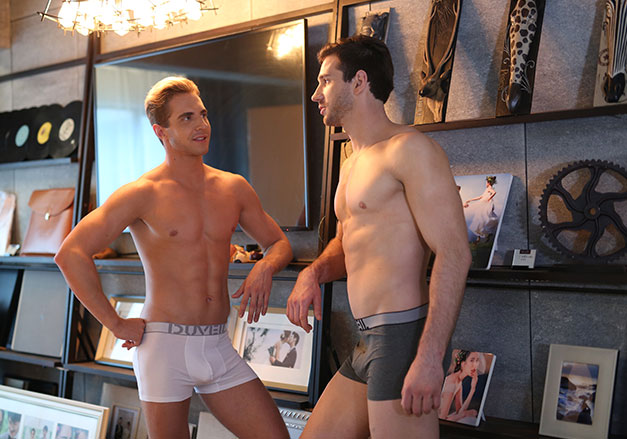
Part of Underwear Fit, Styles & Construction in Finetex Talk — buyer questions answered by the Finetex editorial team.
A brand's boxer briefs are praised for softness, but reviews repeat the same complaint: the legs "ride up" during the day. The product team wants to know whether to change the fabric or the pattern.
Short answer: Ride-up is usually a pattern and finish problem first and a fabric problem second. Inseam length, leg-opening circumference, gusset shape, the angle of the leg seam and how the leg hem is finished decide whether the leg stays in place; fabric stretch and recovery then determine how well that geometry holds through the day and after washing.
How a leg stays in place
A boxer brief leg stays down when the opening grips the thigh lightly and the fabric above it has room to move with the hip. If the opening is loose, the leg slides up as the wearer walks. If the gusset or seat is too tight, the fabric is pulled upward from above. Short inseams have less surface to grip and ride up more easily.
Factors to check
- Inseam length: longer legs hold better but feel warmer; trunk lengths need firmer leg finishes.
- Leg opening: measured relaxed and extended against the size chart.
- Gusset and seat shape: a narrow gusset or shallow seat pulls the leg up when the wearer sits or walks.
- Leg finish: a plain coverstitch hem, a bonded edge or a leg band grip differently.
- Fabric recovery: fabric with low elastane or weak recovery grows during wear, so the opening loosens over the day.
How to diagnose it
- Fit-test on several wearers across at least two sizes, including movement: sitting, walking and climbing stairs.
- Compare samples with the same pattern in two fabrics, and the same fabric with two patterns, to separate the causes.
- Measure the leg opening before and after a defined wash procedure to see whether recovery is the issue.
Limits
Tightening the leg opening reduces ride-up but can create marks or discomfort, especially on larger thighs. Silicone grippers and leg bands add cost and can affect breathability. Any change should go through a new fit sample rather than a production-floor adjustment.
Facts, recommendations and uncertainty
Established: inseam, opening, gusset and fabric recovery all affect ride-up. Recommendation: separate pattern and fabric effects in sampling. Uncertain: the best fix for your customers until wear tests across sizes confirm it.
Sources and further reading
- ASTM D4964 — Tension and elongation of elastic fabrics
- ISO 6330:2021 — Domestic washing and drying procedures for textile testing
- ISO 5077:2007 — Determination of dimensional change in washing and drying
Standards and regulations are referenced by their published scope. Test parameters, cycles and pass levels should be agreed with your laboratory for the specific product; legal requirements should be confirmed for each destination market.
Three more perspectives
When a style moves to a new fabric, ask the factory whether the pattern was adjusted for the different stretch. A pattern built for cotton/elastane rarely fits the same way in a high-stretch modal or polyester blend.
Collect where the ride-up starts — inner thigh or outer leg — from returns and wear tests. Inner-thigh ride-up often points to gusset width and inseam angle; outer-leg ride-up more often to opening size and hem grip. Performance styles may need a different approach altogether.
Add leg opening relaxed and extended to the inspection measurement chart with tolerances. Many inspections measure only waist and length, which misses the dimension that drives this complaint.
Related products
Related articles
- Boxer Briefs Manufacturing in China: Specs That Decide Fit, Cost and Reorder Rate
- How to personalize a custom boxer briefs waistband: A Manufacturer's Walkthrough
- Wholesale Boxer Briefs: What a Volume Buyer Should Demand Before Paying
- Private Label Boxer Briefs: The Branding Stack and What It Costs to Add
- Custom Boxer Briefs: Deciding What to Customise and What to Leave Alone
- Jockstraps vs Boxer Briefs for Athletic Brands: Choosing the Right Program
- Sports Underwear Programs: Jockstraps, Compression Briefs, and Athletic Boxers
- Boxer Briefs Factory Selection: A Buyer's Checklist for E-Commerce Brands
- Boxer Briefs vs Trunks vs Briefs: What to Stock for Your E-Commerce Brand
- How can I find a reliable men's boxer briefs manufacturer?
← More in Underwear Fit, Styles & Construction · All Talk topics · Ask us about your programme
More factory-floor notes for brand owners

What should I check on a novelty hoodie such as an eye-mask hood?
What to check on a novelty hoodie such as an eye-mask hood: hood structure and lining, visibility and…
Read more →How should I size a unisex hoodie?
How to size a unisex hoodie: choosing a base block, body measurement ranges, ease, sleeve and body length,…
Read more →What care instructions should a hoodie carry?
What care instructions a hoodie should carry: the elements of a complete washing instruction, warnings for prints and…
Read more →
How do I match colour across hoodie and jogger sets?
How to match colour across hoodie and jogger sets: same fabric lot, rib and trims, dyeing method, shade…
Read more →How many colourways can I order at hoodie MOQ?
How many colourways a hoodie order can include at MOQ: how factories set minimums per style, colour and…
Read more →Why does a dark hoodie stain other clothes?
Why dark hoodies stain other clothes: dye bleeding in washing, rubbing transfer, perspiration, unfixed dye and pigment, and…
Read more →Request a sample & pricing information
Send us your tech pack, target price or a reference sample — we reply with a quotation, a realistic lead time and a fabric recommendation within one working day.
- Free sampling plan & cost breakdown
- MOQ from 300 pcs per style
- Reply within 1 working day