
Why do T-shirt side seams twist after washing?
Why T-shirt side seams twist after washing: spirality from yarn twist and circular knitting, fabric finishing, cutting off-grain, and how to test spirality with ISO 16322-3…
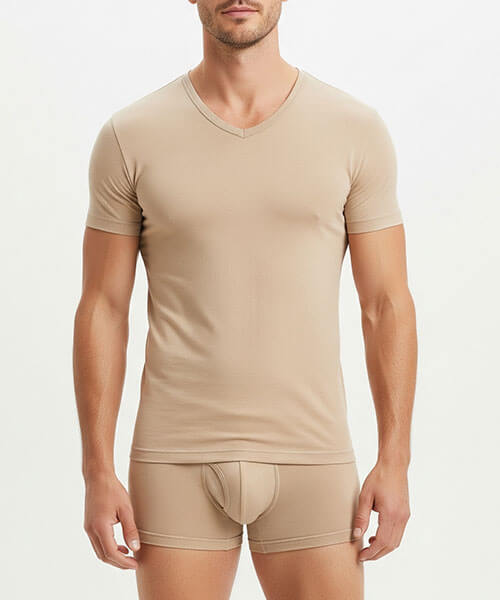
Part of T-Shirts, Undershirts & Tank Tops in Finetex Talk — buyer questions answered by the Finetex editorial team.
A brand's plain cotton T-shirts look straight when new, but after washing the side seams move toward the front and the hem looks crooked. Customers call it "twisting". The team wants to understand the cause and fix it in the next order.
Short answer: Side seam twisting is called spirality or torque. It mostly comes from the fabric: single jersey knitted on circular machines tends to have wales that are not perfectly vertical, and the twist in the yarn wants to relax, so the fabric skews when washing releases stresses. If the fabric is finished without correcting this skew, or panels are cut off-grain, the garment twists after washing. Ways to reduce it include using lower-twist or balanced yarns, fabric finishing that sets the fabric straight, compacting, cutting on grain and checking skew before cutting. ISO 16322-3 gives methods to measure spirality of knitted garments after domestic laundering, and the standard notes that garments from circular knitted fabrics can have inherent nonverticality of wale alignment.
Causes
- Yarn twist and twist liveliness in single jersey.
- Circular knitting creating inherent skew.
- Fabric finishing that does not correct skew.
- Cutting panels off-grain.
- Washing releasing stresses.
Ways to reduce it
- Choose yarns with suitable twist for knitting.
- Ask the mill for skew control in finishing and compacting.
- Check fabric skew before cutting and cut on grain.
- Consider fabric structures less prone to spirality.
- Use tubular or side-seamless construction carefully, since it can show twist more.
Testing
- Measure garment spirality after washing with ISO 16322-3, which uses ISO 6330 laundering.
- Measure dimensional change with ISO 5077.
- Compare results with an agreed limit in the specification.
Production checks
- Check fabric skew on each roll or lot.
- Check marker and cutting alignment.
A worked example
For the shirts in the question, measure spirality on washed pieces with ISO 16322-3 and check fabric skew on retained rolls. If fabric skew is high, ask the mill to adjust finishing; if fabric is straight, check cutting. Retest before bulk.
Specifying limits
Include a maximum spirality percentage after a stated wash procedure in the fabric and garment specification, and agree it with the mill and factory.
Design choices
Some designs make twist more visible. Stripes, contrast side panels and long body lengths show any skew clearly, while relaxed fits and darker plain colours hide it better. If a design is sensitive, set a tighter spirality limit for that style.
What the standard measures
ISO 16322-3 marks reference lines on the garment, launders it with ISO 6330 procedures and expresses spirality as the sideways displacement as a percentage of a marked distance. It offers different procedures, and the standard notes that results from different procedures might not be comparable, so state the procedure in your specification.
Limits
Some spirality is inherent in single jersey. Aim to control it within agreed limits.
Facts, recommendations and uncertainty
Established: side seam twist is spirality from yarn twist, circular knitting and finishing, and ISO 16322-3 measures it after laundering. Recommendation: control yarn, finishing and cutting and set a spirality limit. Uncertain: the right limit for each fabric.
Sources and further reading
- ISO 16322-3:2021 — Spirality after laundering: woven and knitted garments
- ISO 6330:2021 — Domestic washing and drying procedures for textile testing
- ISO 5077:2007 — Determination of dimensional change in washing and drying
Standards and regulations are referenced by their published scope. Test parameters, cycles and pass levels should be agreed with your laboratory for the specific product; legal requirements should be confirmed for each destination market.
Three more perspectives
Ask the mill for fabric skew and spirality data for each lot, and include a maximum spirality after washing in the purchase specification. Ask how finishing controls skew. If complaints rise, request retained fabric for testing. Agree with the factory who checks fabric skew before cutting and how rolls outside the limit are handled. Ask whether the mill can supply fabric from one knitting machine group for a style, since different machines can produce different skew. Request skew data with each shipment of fabric.
In product development, test spirality on washed samples using ISO 16322-3. Compare fabrics from different mills or finishes. Check whether design features such as side seams or a tubular body make twist more visible. Record the approved fabric, finish and spirality result, and keep a washed reference garment for comparison. Check the cutting marker: panels laid at an angle to save fabric can add twist. Decide with the factory whether fabric efficiency or straight grain matters more for the style.
In quality control, check fabric skew on incoming rolls and cutting alignment. Wash a few garments per lot and measure spirality. Compare with the approved limit and reference. Record results by fabric lot and mill so problems can be traced and discussed with suppliers quickly. Lay washed garments flat and measure how far the side seam has moved at the hem, so you have a quick check alongside the formal test. Record results by lot and share them with the mill.
Related products
Related articles
- Best nylon spandex seamless t shirts for running — Buyer's Guide
- Seamless T-Shirts: A Cost-Benefit Check for Online Sellers
- T-Shirt Inspection Checklist Ranked by Return Risk
- T-Shirt Manufacturing Step by Step: Twelve Stages From Yarn to Packed Carton
- How to Start a Private Label T-Shirt Brand: Choosing Between POD and Manufactured Stock
- Modal T-Shirt Manufacturing: Specifying a Softness Fabric So It Keeps Its Shape
- Bamboo T-Shirt Manufacturing: Where the Fibre Works and Where It Disappoints
- Organic Cotton T-Shirt Manufacturing in China: The Certification and the Cost Premium
- Garment-Dyed T-Shirts: What the Process Changes in Colour, Shrinkage and Lead Time
- Custom Logo T-Shirts at Production Volume: Matching the Method to the Artwork
← More in T-Shirts, Undershirts & Tank Tops · All Talk topics · Ask us about your programme
More factory-floor notes for brand owners

Why did my reorder price go up?
Why an apparel reorder price can go up: fabric and trim costs, smaller quantities, specification changes, labour and…
Read more →
How do I read an underwear quotation line by line?
How to read an underwear quotation line by line: fabric, elastic and trims, labour, packaging, testing, overheads and…
Read more →
How do peak seasons affect apparel factory capacity?
How peak seasons and holidays affect apparel factory capacity and lead times, why fabric and shipping are also…
Read more →
Should I split one style across two factories?
Whether to split one apparel style across two factories: the benefits for capacity and risk, the risks for…
Read more →
What are the biggest risks on a small brand’s first order?
The biggest risks on a small brand's first apparel order, from unclear specifications and sample approval to payment,…
Read more →
What changes should a factory notify before production?
Which changes a factory should notify the buyer about before production, such as fabric, dye, trims, subcontracting or…
Read more →Request a sample & pricing information
Send us your tech pack, target price or a reference sample — we reply with a quotation, a realistic lead time and a fabric recommendation within one working day.
- Free sampling plan & cost breakdown
- MOQ from 300 pcs per style
- Reply within 1 working day