
Adding a Category Without a New Factory: A 90-Day Plan
How to add a new apparel category with your current knit factory: a capability check, block reuse, fabric migration, a test order and scale-up in 90…
Answer first: The fastest way to add a category, say loungewear to an underwear line or sweatshirts to a T-shirt line, is to stay inside what your current factory already runs: the same knit structures, the same machine types and, where possible, the same pattern blocks. You change the fabric, the length or the proportion, not the whole construction. A knit factory can usually move from jersey tops to rib tanks or from underwear to sleep shorts in one development cycle; it cannot become a denim, woven shirt or outerwear factory by adding a style. With published sampling and production lead times, a disciplined plan gets a tested first order into production inside 90 days.
This guide uses our own published capabilities as the worked example. Your factory’s numbers will differ, so ask for theirs in writing.
Step 1: Capability check (days 1–10)
Before sketching the new category, map it against three things the factory already does: knit structure, machinery and finishing.
| Question | Why it decides feasibility | What to ask for |
|---|---|---|
| Does the factory already sew this fabric structure? | Rib, interlock, fleece and French terry behave differently under the needle | Current styles in that structure, with photos |
| Are the right machines and stations on the line? | Coverstitch, flatlock, elastic and waistband stations, hood and pocket operations | Line list per programme |
| Can it finish the garment? | Washes, brushing, garment dyeing, printing and embroidery may run in-house or at partners | Which steps are in-house and which are partnered |
| Is the size range covered? | A new category often needs new grading | Size range and grading method |
| Is there line time? | A new category competes with existing programmes | Capacity commitment for the launch window |
As an example, our published range covers boxer briefs, trunks, briefs, jockstraps, thongs, undershirts, T-shirts, tank tops, polos, sweatshirts and hoodies, in single jersey, 1×1 and 2×2 rib, interlock, fleece, French terry, mesh and jacquard, from 120 to 420 gsm, sizes XS to 4XL with custom grading. Our twelve lines are configured for knit underwear, jersey tops and fleece, with dedicated waistband and elastic stations. That makes a move into loungewear, joggers, knit shorts or polos a development question. A woven shirt or a padded jacket is outside that range and needs a different factory.
Rule of thumb: if the new category needs a fabric family or a key operation the factory has never run in bulk, budget for an extra sampling round or choose a different supplier.
Step 2: Block reuse (days 5–25)
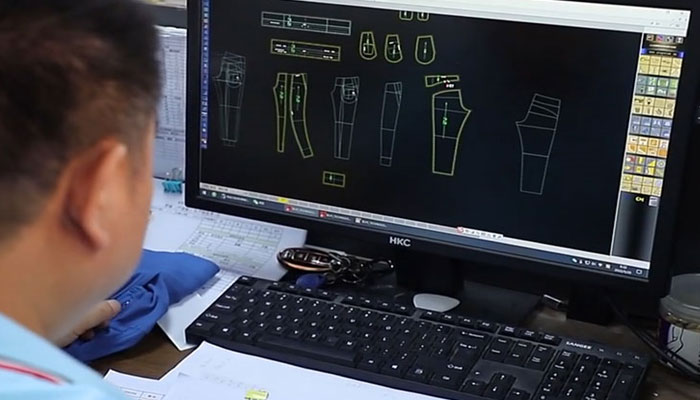
A pattern block that has already been corrected in bulk is the most valuable asset in your current programme. Reusing it removes the biggest risk in a new category: fit.
Blocks that travel well
- T-shirt to long sleeve, henley or raglan. Body block unchanged; sleeve, placket or armhole changes only.
- Undershirt to tank top or base layer. Same neckline and body proportions; fabric and armhole change.
- Boxer brief to sleep short or lounge short. Waistband construction carries over; leg length, rise and ease grow.
- Sweatshirt to hoodie or zip. Body and sleeve block reused; hood, pocket and placket added.
What to lock and what to change
Write down which measurements stay identical to the existing graded block and which change. Keep the grading rules of the parent style where the new style shares measurement points, and re-grade only the new ones. Our article on grading rules for knit tops shows where size sets usually break.
Our private label page describes this logic for a first collection: choose a block we already produce, such as a boxer brief, brief, crew neck undershirt, tank top or classic T-shirt, and put your fabric, colourway, waistband and branding on it. Because the pattern is already proven in bulk, a private label first order can usually ship in four to six weeks rather than three months.
Step 3: Fabric migration (days 10–35)
Most category extensions are really fabric changes. A lounge short is often an underwear waistband on a heavier jersey; a hoodie is a sweatshirt block on French terry or brushed fleece.
| From | To | Fabric change | Watch for |
|---|---|---|---|
| Single jersey T-shirt | Heavyweight or boxy tee | Higher gsm jersey | Shrinkage, neck rib recovery, print behaviour |
| Rib undershirt | Rib tank or base layer | Rib with elastane, or mesh | Stretch and recovery, armhole binding |
| Modal or cotton brief | Sleep short or lounge pant | Heavier jersey or interlock | Waistband tension on a heavier garment |
| Jersey tee | Sweatshirt or hoodie | French terry or brushed fleece | Pilling, raised-surface flammability classing |
Two published constraints shape fabric choice for a test:
- Stock fabric keeps the minimum low. Our MOQ starts at 300 pieces per style on stock fabric. A fully custom knit or dye lot usually starts at 1,000 pieces per colour, and our custom fabric page notes most mills need 500–1,000 kg per colour, typically 1,500–3,000 garments depending on weight.
- Fabric is tested before cutting. Shrinkage, colour fastness, pilling and weight are checked on the bulk lot. If a lot fails, it goes back to the mill before it is cut.
Specify the new fabric by behaviour, not by name: weight in gsm, stretch and recovery, shrinkage after the wash the garment must survive. See our apparel fabric selection guide for how to write the specification.
Compliance changes with the category
A new category can bring new rules even when the factory stays the same. In the US, every textile product still needs fibre content, origin and identity labelling under the Textile Fiber Products Identification Act rules in 16 CFR Part 303, and a permanent care label under 16 CFR Part 423. Beyond that:
- Raised-surface fabrics such as brushed fleece are classified differently from plain-surface fabrics under the general flammability standard, 16 CFR Part 1610. Plain-surface fabrics of 2.6 ounces per square yard or more, and fabrics made entirely of certain fibres including polyester and nylon, are exempt from testing to support guaranties. Our article on 16 CFR 1610 explains the classes.
- Children’s sleepwear up to size 6X falls under 16 CFR Part 1615, with Part 1616 covering sizes 7 to 14; tight-fitting garments and infant garments as defined in the rule are exempt from the flame-resistance requirement. Extending an adult loungewear line into kids is a regulatory change, not just a grading change.
- Children’s upper outerwear with drawstrings is listed as a substantial product hazard under 16 CFR Part 1120. A kids’ hoodie is not simply a small adult hoodie.
Rules were read on eCFR on 22 November 2026; confirm with a product compliance adviser or testing lab for your market.
Step 4: Test order (days 35–75)
With the block and fabric chosen, run the shortest sampling path the factory publishes and approve each stage on a fixed date.
| Stage | Our published timing | Your decision |
|---|---|---|
| Development sample | 5–7 working days after artwork and fabric are confirmed | Fit, proportion, hand feel |
| Graded size set | 10–12 working days | Fit across sizes |
| Pre-production sample in bulk fabric and trims | Before any bulk cutting | Final sign-off |
| Bulk production | 15–45 days from deposit and approved pre-production sample | Quantity and delivery date |
A realistic 90-day plan therefore looks like this: capability check and specification in the first ten days, development and size set by around day 35, fabric testing and pre-production approval by around day 45, and bulk production for a test quantity between roughly days 45 and 75, leaving time for shipping or a reorder decision. The plan only holds if approvals arrive on schedule; our FAQ notes that delays are almost always late approvals rather than slow production.
Keep the test small and focused:
- One or two styles, not a full range.
- Stock fabric in two or three colours you already sell.
- The same trims and packaging as the parent category where possible, so component minimums do not set the quantity. Our article on trims and tooling inventory covers who holds the leftovers.
- A clear success measure agreed before the goods land: sell-through, return reasons, reviews.
Step 5: Scale-up (day 75 onwards)
If the test sells, the second order is where the category becomes efficient.
- Lock the block and specification. Fix the approved sample, size chart and fabric standard as the production specification, version-controlled and signed by both sides.
- Move to custom fabric only when volume supports it. Once quantity per colour reaches the mill minimum, a custom knit or colour becomes viable.
- Plan line time. Our lines are set up per programme, and we keep roughly 20% of line time uncommitted for new programmes and reorders. Share a forecast so the new category has a slot.
- Price the volume. Our article on volume tiering shows how price breaks work as quantities grow.
If the test does not sell, the loss is limited to a small run on stock fabric and a pattern you still own. Our FAQ states that patterns and development created for your programme are yours and are not sold to another customer.
Fact, advice and uncertainty
Fact: our published capabilities cover the knit garment types, structures, weights and sizes listed above; MOQ is 300–1,000 pieces per style; development samples take 5–7 working days and size sets 10–12; bulk takes 15–45 days; the US labelling and flammability rules cited were read on eCFR on 22 November 2026.
Advice: extend into categories that share structure, machines and blocks with what the factory already makes; test on stock fabric; and approve every stage on a calendar.
Uncertain: the 90-day plan depends on approval speed, fabric availability and trim lead times. Children’s categories and new markets add testing that can lengthen it.
Related reading
- Men’s Loungewear Manufacturing: The Category Beyond Underwear
- Joggers and Sweatpants: Fabric, Fit and Trims
- Men’s Polo Shirt Manufacturing: Pique, Interlock and Collar Construction
- Knit and Terry Shorts: Fit, Drawcords and Linings
- Big & Tall Men’s Basics: Grading, Stretch and Sizing Gaps
- Men’s Sleep Shorts: Woven vs Knit for Sleepwear
Frequently asked questions
Can my underwear factory make loungewear or T-shirts?
Often yes, if it already sews the knit structures involved and has the right machines. Ask which styles it runs in bulk today. Wovens, denim and outerwear usually need a different factory.
How long does it take to add a new clothing category?
With an existing block and stock fabric, a test order can be in production inside 90 days, using 5–7 working days for development samples, 10–12 for a size set and 15–45 days for bulk. Late approvals are the main risk.
Should I use a new fabric for a new category?
Use stock fabric for the test so the minimum stays at 300 pieces per style. Move to a custom knit once quantities reach the mill minimum, which is often 1,000 pieces or more per colour.
Do compliance rules change when I add a category?
Sometimes. Fibre and care labelling apply to all textile products in the US, but raised-surface fleece, children’s sleepwear and children’s drawstring outerwear bring extra flammability or hazard rules.
Sources
- eCFR: 16 CFR Part 303, Rules under the Textile Fiber Products Identification Act
- eCFR: 16 CFR Part 423, Care labeling of textile wearing apparel
- eCFR: 16 CFR Part 1610, Standard for the flammability of clothing textiles
- eCFR: 16 CFR Part 1615, Children’s sleepwear sizes 0 through 6X
- eCFR: 16 CFR Part 1616, Children’s sleepwear sizes 7 through 14
- eCFR: 16 CFR Part 1120, Substantial product hazard list
Plan your next category with us
Send the style you sell now and the category you want to add. We will tell you which block and fabric we would start from, what the test quantity would be on stock fabric, and the sampling calendar. Request a quote, see our apparel design and development services or our underwear manufacturing.
More factory-floor notes for brand owners

Naturally Dyed Underwear: What Should Buyers Test Before Bulk?
Plan naturally dyed underwear testing for wash and rub fastness, shade variation, and reorder approval. Match color and…
Read more →
Hidden Pockets in Boxer Briefs: Where Should They Sit?
Choose hidden pockets in boxer briefs by testing placement, access, load, and movement in comparable samples before approving…
Read more →
Silk Underwear Sourcing: What Can a Buyer Approve from a Sample?
Use a silk underwear sourcing checklist to verify fiber composition, compare stretch and seams, and approve care and…
Read more →
Adaptive Men’s Underwear: How Do You Test Side Openings?
Test side openings in adaptive men's underwear with seated and one-handed dressing checks, closure placement reviews, and a…
Read more →Microfiber Underwear Fabric: What Should Buyers Specify?
Specify microfiber underwear fabric by verified fiber content, knit structure, stretch, and wash performance. Use a sample checklist…
Read more →Skin-Tone Underwear Color Matching: How Do You Approve a Range?
Plan skin-tone underwear color matching with physical swatches, stretch checks, and a repeatable shade approval record for production…
Read more →Request a sample & pricing information
Send us your tech pack, target price or a reference sample — we reply with a quotation, a realistic lead time and a fabric recommendation within one working day.
- Free sampling plan & cost breakdown
- MOQ from 300 pcs per style
- Reply within 1 working day