
Knit and Terry Shorts: Fit, Drawcords and Linings
How to develop men's knit and French terry shorts: fabric weights, waistband and drawcord construction, liners, pockets, and matching shorts to your hoodies.
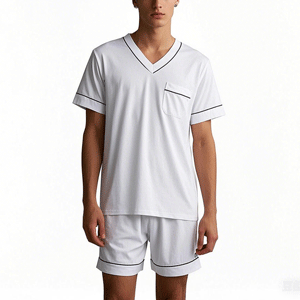
Answer first: Knit and terry shorts look simple, but four decisions decide whether they sell and survive the wash: the fabric (jersey, French terry or fleece, and its weight), the waistband and drawcord (elastic type, channel width, eyelets or buttonholes, and an anchored cord), the liner (none for lounge shorts, a brief liner for training shorts), and the pockets (side-seam, slant, back patch or zip, with a pocket bag that does not show through). If the shorts are sold as a set with a hoodie or sweatshirt, cut both from the same fabric lot and test shrinkage on each piece, otherwise the colours and sizes drift apart after the first wash.
This guide covers men’s lounge, sweat and casual training shorts made from knit fabric. Woven boxer-style sleep shorts are covered in Men’s Sleep Shorts: Woven vs Knit.
Fabric: match the weight to the use
The fabric weight sets the drape, the price and the season. These are the ranges we publish for lounge and sweat programmes:
| Fabric | Weight we publish | Best for | Watch out for |
|---|---|---|---|
| Cotton jersey | 160–200 gsm | Sleep and lounge shorts | Leg hems can twist; pocket bags show through |
| Cotton/elastane jersey | 180–230 gsm | Fitted lounge and gym shorts | Elastane recovery after heat setting |
| Cotton/modal or micro modal | 150–210 gsm | Premium lounge | Soft drape needs a stable waistband |
| French terry | 240–320 gsm | Lounge sets, summer sweat shorts | Loop side can snag on Velcro and zips |
| Brushed fleece (80/20 cotton/polyester) | 320–420 gsm on our hoodies | Matching sweat sets | Heavy for shorts; bulky waistband and pockets |
French terry is the default for sweat shorts: lighter than fleece, with a flat face for printing and a loop back that breathes. If you want shorts to match a 320–420 gsm fleece hoodie, many brands use a lighter terry in the same colour rather than the hoodie fleece itself. That is a design choice you should sample, not an assumption. Our French terry vs fleece article covers the trade-off.
Fit: four measurements that decide it
Shorts are graded from the waist, but customers judge them on four points:
- Inseam. The single most visible style decision. Set it per size and keep the grade small; a long inseam on a large size changes the look.
- Rise. Front and back rise control comfort when sitting. Lounge shorts usually carry a deeper rise than training shorts.
- Thigh and leg opening. Too narrow rides up; too wide flares. Measure the leg opening relaxed and, for shorts with side splits, at the split.
- Waist relaxed and extended. With elastic waistbands, specify both. The extended measurement tells you whether the shorts can be pulled on over the hips.
Write each as a point of measure with a tolerance in the tech pack. Our article on grading rules for knit tops explains why a size set must be checked before bulk; the same logic applies to bottoms.
Waistband and drawcord construction
The waistband is where knit shorts fail first.
Elastic and channel
| Choice | Pros | Cons |
|---|---|---|
| Elastic enclosed in a self-fabric channel | Clean look, soft on the skin | Elastic can roll or twist if the channel is too wide |
| Exposed jacquard or printed elastic | Brand visibility | Custom elastic carries its own minimum and lead time |
| Elastic stitched through (multi-needle) | Stops rolling, very stable | Stiffer hand |
Specify the elastic width and type, the channel width and the stitching. A channel slightly wider than the elastic lets it recover; a channel much wider lets it roll.
Drawcords
Our drawcord and eyelets guide for lounge shorts covers the details. The essentials:
- Buttonholes or eyelets. For soft lounge fabric, buttonholes are usually the safer choice unless the design needs metal eyelets. Metal eyelets need reinforcement behind them and rust-resistance checks. For EU sales, ask for nickel release evidence on metal parts.
- Cord width. Size the cord to the channel so it slides without twisting.
- Anchor at centre back. A bar tack at centre back stops the cord being pulled out, the most common customer complaint.
- Cord ends. Tipped, knotted or heat-sealed ends; check fraying after washing.
- Shrinkage. Cotton cord can shrink at a different rate from the waistband. Wash samples and check cord length after washing.
Children’s sizes
If you add kids’ shorts to a family set, cords become a safety issue. In the EU, the European standard EN 14682 sets requirements for cords and drawstrings on children’s clothing up to age 14, including the chest and waist area. In the US, the substantial product hazard rule at 16 CFR Part 1120 covers drawstrings on children’s upper outerwear, so a matching kids’ hoodie is in scope. Treat children’s items as a separate compliance review before you specify cords.
Liners: lounge versus training
| Short type | Liner | Notes |
|---|---|---|
| Lounge and sweat shorts | None | Worn over underwear; liner adds cost and bulk |
| Training and running shorts | Brief liner in mesh or performance knit | Liner fabric must wick and dry; check seam placement |
| Two-in-one training shorts | Compression liner | Liner sized to the body, not the shell; grade separately |
| Swim-crossover shorts | Mesh liner | Different care, fabric and labelling; treat as a different product |
A liner is a second garment inside the first. It needs its own pattern, fabric, elastic, measurements and inspection points. If you add one, add its points of measure to the tech pack and its fabric to the test plan.
Pockets
Pockets drive both the cost and the complaints.
- Side-seam pockets. The cleanest and cheapest. Use a lighter pocket bag fabric to avoid bulk, but test that it does not show through light colours.
- Slant or front pockets. A sportier look; more sewing operations and more chance of the pocket gaping.
- Back patch pocket. Adds a branding spot; position and size per size.
- Zip pocket. Useful on training shorts; specify zip type and brand, and check the zip does not pull the fabric.
Bar tack pocket corners. On heavy terry, a jersey pocket bag reduces bulk; on light jersey shorts, self-fabric bags are often fine.
Matching shorts to hoodies and sweatshirts
Sets sell because the colours match. They return when they do not.
- Same lot, same dye. Where the top and bottom use the same fabric, cut both from the same lot so the shade matches. If the shorts use terry and the hoodie uses fleece, approve a lab dip on both fabrics side by side.
- Shrinkage per component. Our pajama page puts it plainly: a top that shrinks 4% and a bottom that shrinks 7% no longer match. We cut both pieces from the same lot, wash them together in testing and measure residual shrinkage per component.
- Development rhythm. Develop the shorts on the hoodie’s colour standard and block family. Once the hoodie block and specification are locked, a reorder on our hoodie programmes runs two to three weeks faster than the first order.
- Minimums per colour. On our published terms, stock fabric styles start from 300 pieces per style; a custom knit or dye lot usually starts at 1,000 pieces per colour. A short and a hoodie in the same custom colour can share a dye lot when the fabric is the same.
For hoodie and sweat programmes see our hoodie manufacturer page, and for joggers, the longer cousin of these shorts, read Joggers and Sweatpants: Fabric, Fit and Trims.
Inspection points for shorts
Shorts fail in predictable places, so the inspection plan should name them:
- Waist relaxed and extended on every size in the measurement report, at the start and end of the run.
- Drawcord anchoring: pull test on sampled pieces, and cord length after washing.
- Bar tacks at pocket corners, the centre-back cord anchor and any side split.
- Leg hem twist on jersey shorts after a wash test; twist is a fabric and cutting issue, not a sewing fault.
- Pocket bag show-through on light colours, checked under daylight.
- Liner attachment and seams on training shorts, including the liner’s own measurements.
Our quality control process runs in-line checks at 30% and 70% of the run, which is where a waistband or bar tack fault is cheapest to fix.
Labels and compliance
In the US, shorts need fibre content and origin labelling under 16 CFR Part 303 and care instructions under 16 CFR Part 423. A liner in a different fibre must be disclosed. Adult shorts fall under the general clothing flammability standard; plain-surface knits of normal weight are exempt from testing, raised-surface fleece in cotton blends is not. Confirm the labelling for each destination before labels are printed.
Fact, advice and uncertainty
Fact: the fabric weights, set-matching practice, MOQ and reorder timing above are the ones we publish on finetexglobal.com; EN 14682 covers cords on children’s clothing up to age 14, and 16 CFR 1120 concerns drawstrings on children’s upper outerwear (both read on 21 November 2026); US labelling follows 16 CFR 303 and 423.
Advice: specify waist relaxed and extended, anchor the cord at centre back, test pocket bags for show-through, and wash the shorts and the hoodie together before approving a set.
Uncertain: how a specific terry, elastic and cord combination behaves after washing; only a washed sample shows it.
Related reading
- Joggers and Sweatpants: Fabric, Fit and Trims
- Men’s Sleep Shorts: Woven vs Knit for Sleepwear
- Men’s Loungewear Manufacturing: The Category Beyond Underwear
Frequently asked questions
What fabric is best for men’s sweat shorts?
French terry at around 240–320 gsm is the usual choice: lighter than fleece, breathable, and easy to print. Cotton jersey suits sleep and lounge shorts, and cotton/elastane suits fitted gym styles.
How do I stop a drawcord pulling out of the waistband?
Anchor the cord with a bar tack at centre back, size it to the channel, finish the ends, and wash test samples to check the cord and waistband shrink together.
Do lounge shorts need a liner?
Usually not. Lounge and sweat shorts are worn over underwear. Training and running shorts often have a brief or compression liner, which needs its own pattern, fabric and measurements.
Can shorts match my hoodie colour exactly?
Yes, if they share a fabric lot or both fabrics are approved against the same lab dip. Test shrinkage on each piece, because a top and bottom that shrink differently stop matching after washing.
Sources
- EN 14682:2014 preview, Safety of children’s clothing: cords and drawstrings (SIST edition)
- eCFR: 16 CFR Part 1120, Substantial product hazard list (children’s upper outerwear drawstrings)
- eCFR: 16 CFR Part 303, Rules under the Textile Fiber Products Identification Act
- eCFR: 16 CFR Part 423, Care labeling of textile wearing apparel
- eCFR: 16 CFR Part 1610, Standard for the flammability of clothing textiles
Sample your shorts alongside your hoodie
Send your tech pack or a reference pair with the hoodie or sweatshirt it should match. We will propose fabric weights, waistband and pocket construction, and sample the shorts on the same colour standard.
Request a sample or see our pajama and loungewear manufacturing.
More factory-floor notes for brand owners

Naturally Dyed Underwear: What Should Buyers Test Before Bulk?
Plan naturally dyed underwear testing for wash and rub fastness, shade variation, and reorder approval. Match color and…
Read more →
Hidden Pockets in Boxer Briefs: Where Should They Sit?
Choose hidden pockets in boxer briefs by testing placement, access, load, and movement in comparable samples before approving…
Read more →
Silk Underwear Sourcing: What Can a Buyer Approve from a Sample?
Use a silk underwear sourcing checklist to verify fiber composition, compare stretch and seams, and approve care and…
Read more →
Adaptive Men’s Underwear: How Do You Test Side Openings?
Test side openings in adaptive men's underwear with seated and one-handed dressing checks, closure placement reviews, and a…
Read more →Microfiber Underwear Fabric: What Should Buyers Specify?
Specify microfiber underwear fabric by verified fiber content, knit structure, stretch, and wash performance. Use a sample checklist…
Read more →Skin-Tone Underwear Color Matching: How Do You Approve a Range?
Plan skin-tone underwear color matching with physical swatches, stretch checks, and a repeatable shade approval record for production…
Read more →Request a sample & pricing information
Send us your tech pack, target price or a reference sample — we reply with a quotation, a realistic lead time and a fabric recommendation within one working day.
- Free sampling plan & cost breakdown
- MOQ from 300 pcs per style
- Reply within 1 working day