
Will a printed waistband logo crack or fade, and how do I test it before bulk?
Why printed logos on stretch waistbands crack or fade, how print method and elastic stretch interact, and which wash, rubbing and stretch checks to run before…
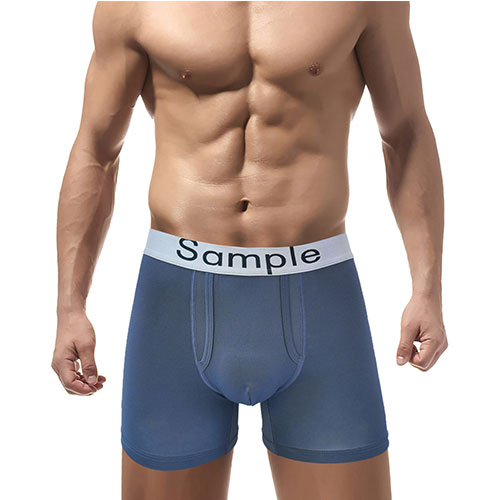
Part of Waistbands, Labels, Printing & Packaging in Finetex Talk — buyer questions answered by the Finetex editorial team.
A brand wants its logo printed on the waistband of its boxer briefs to save the cost of a jacquard elastic. The buyer has seen printed logos crack on other brands and wants to know how to avoid it.
Short answer: A printed logo on a waistband can last, but stretch is the main risk. If the print film cannot stretch as far as the elastic, it cracks; if fastness is low, it fades or rubs off. Choose a print method and ink that suit stretch elastics, and test print adhesion, stretch, washing and rubbing on the real elastic before approving bulk.
Why prints on elastics fail
A waistband stretches far more than the body fabric when the garment is put on. Prints that form a surface film, such as some plastisol or heat-transfer prints, can crack if the film is thicker or less elastic than the substrate. Repeated washing and drying heat add stress. Poor curing, the wrong ink system for the elastic's fibres or too heavy a deposit all increase the risk.
Factors to compare
- Print method: screen print, heat transfer and sublimation behave differently on elastic, and sublimation only works on suitable synthetic yarns.
- Ink and stretch additives: ask what ink system is used and whether it is designed for stretch fabrics.
- Design: large solid areas crack more readily than outlines or broken designs.
- Alternatives: a jacquard elastic weaves the logo into the band and avoids print film, at higher development cost and MOQ.
Tests before bulk
- Stretch the printed waistband to its maximum wearing extension several times and look for cracking.
- Wash to an agreed ISO 6330 procedure for the number of cycles you choose and assess colour change and staining, for example under ISO 105-C06.
- Check rubbing fastness with ISO 105-X12 if the band may rub on outer clothing.
- Inspect after tumble drying if the care label allows it.
Limits
A short test series reduces risk but does not prove long-term durability. If the brand plans heavy tumble-drying care or very high-stretch elastics, a woven-in logo may simply be the better solution.
Facts, recommendations and uncertainty
Established: print film that stretches less than the elastic will crack. Recommendation: test stretch, washing and rubbing on the real band. Uncertain: long-term durability beyond the cycles actually tested.
Sources and further reading
- ISO 105-C06:2010 — Colour fastness to domestic and commercial laundering
- ISO 105-X12:2016 — Colour fastness to rubbing
- ISO 6330:2021 — Domestic washing and drying procedures for textile testing
Standards and regulations are referenced by their published scope. Test parameters, cycles and pass levels should be agreed with your laboratory for the specific product; legal requirements should be confirmed for each destination market.
Three more perspectives
Compare the full cost: printed bands save on elastic MOQ, but a print defect discovered after bulk is expensive to fix. Ask the factory to show previous test results for the same ink and elastic combination.
Simplify artwork for elastic: thinner strokes and broken fills move better with stretch. The main answer applies to waistbands; prints on body fabric face lower stretch and can use different methods.
Check print curing on the production line, not just on samples. Under-cured prints often pass a visual check and fail after a few washes.
Related products
Related articles
- Custom Clothing Labels: Care-Label Compliance and the Woven, Printed or Transfer Choice
- Custom Logo T-Shirts: Choosing a Printing Method for Small Batches
- Custom Printed T-Shirt Manufacturing: Choosing a Print Method That Survives 30 Washes
- Clothing Labels and Tags: Woven, Printed, and Heat-Transfer Options
- Choosing a Custom T-Shirt Manufacturer: Fabric, Print, and Bulk Checks
- Custom Logo T-Shirts at Production Volume: Matching the Method to the Artwork
- Screen Printing at Production Scale: Setting Up Colour, Mesh and Placement for Cost Control
- Blank T-Shirt Manufacturing in China: What Print Shops and Brands Should Specify
- Custom Tank Tops at Production Scale: Beyond the Print-On-Demand Route
- How to personalize a custom boxer briefs waistband: A Manufacturer's Walkthrough
← More in Waistbands, Labels, Printing & Packaging · All Talk topics · Ask us about your programme
More factory-floor notes for brand owners

What should I check on a novelty hoodie such as an eye-mask hood?
What to check on a novelty hoodie such as an eye-mask hood: hood structure and lining, visibility and…
Read more →How should I size a unisex hoodie?
How to size a unisex hoodie: choosing a base block, body measurement ranges, ease, sleeve and body length,…
Read more →What care instructions should a hoodie carry?
What care instructions a hoodie should carry: the elements of a complete washing instruction, warnings for prints and…
Read more →
How do I match colour across hoodie and jogger sets?
How to match colour across hoodie and jogger sets: same fabric lot, rib and trims, dyeing method, shade…
Read more →How many colourways can I order at hoodie MOQ?
How many colourways a hoodie order can include at MOQ: how factories set minimums per style, colour and…
Read more →Why does a dark hoodie stain other clothes?
Why dark hoodies stain other clothes: dye bleeding in washing, rubbing transfer, perspiration, unfixed dye and pigment, and…
Read more →Request a sample & pricing information
Send us your tech pack, target price or a reference sample — we reply with a quotation, a realistic lead time and a fabric recommendation within one working day.
- Free sampling plan & cost breakdown
- MOQ from 300 pcs per style
- Reply within 1 working day