
Why do cotton/polyester T-shirts pill?
Why cotton/polyester T-shirts pill: how polyester holds pills, what yarn and fabric choices reduce pilling, how to test with ISO 12945-2, and care advice.
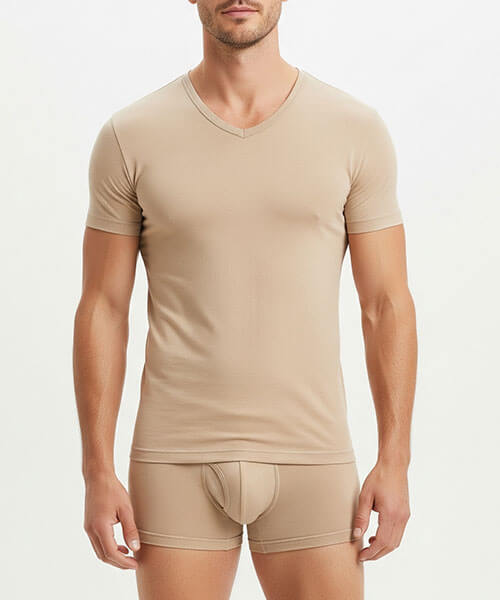
Part of T-Shirts, Undershirts & Tank Tops in Finetex Talk — buyer questions answered by the Finetex editorial team.
A brand switched its basic tee to a 60/40 cotton/polyester blend to reduce shrinkage and cost. After a few washes, customers report small balls of fibre on the sides and under the arms. The cotton tees did not do this as much.
Short answer: All fabrics form fuzz when fibres work loose from the surface during wear and washing. In cotton the loose fibres are relatively weak, so pills often break off. Polyester fibres are much stronger, so the fibre ends tangle into pills and stay anchored to the fabric, making pilling more visible on blends. Short fibres, low yarn twist, open-end spinning, loose knits and abrasion at the sides and underarms make it worse. Ways to reduce it include using a low-pill polyester fibre, more twist or compact spinning, a tighter knit, singeing or anti-pilling finishes, and reviewing the blend ratio. Test pilling with ISO 12945-2 after washing and set a minimum grade in the specification.
Why blends pill more visibly
- Strong polyester fibres anchor pills so they do not fall off.
- Cotton fibres can break and wrap around polyester ends.
- Abrasion at the sides, underarms and where bags rub concentrates pilling.
What reduces pilling
- Low-pill or modified polyester fibre.
- Longer-staple fibres and combed or compact yarns.
- Higher yarn twist and tighter knit, balanced against softness.
- Singeing, shearing or anti-pilling finishes.
- Washing inside out on a gentle cycle.
Testing
- Use ISO 12945-2, the modified Martindale method, on washed fabric.
- Wash specimens first with an ISO 6330 procedure when washing affects the result.
- Compare grades with the approved standard and the specification.
A worked example
The brand tests its 60/40 fabric and a new option using low-pill polyester and compact cotton yarn. After washing, the original fabric grades around 2 to 3 while the new option grades around 4 at the same number of rubs. The new fabric costs a little more, but the brand adopts it and adds a minimum pilling grade to its specification.
Care advice for customers
Washing inside out, using a gentle cycle, avoiding overloading the machine and not washing tees with rough items such as jeans or towels all reduce surface abrasion. Lower tumble drying heat and shorter cycles also help. These tips can go on a hang tag or product page, but they do not replace choosing a fabric that resists pilling.
Limits
Pilling grades are subjective and test conditions affect results. A lab result does not fully reproduce how each customer wears and washes the shirt.
Facts, recommendations and uncertainty
Established: polyester blends hold pills because the stronger fibres anchor them. Recommendation: choose low-pill fibres and tighter yarns, test with ISO 12945-2, and set a minimum grade. Uncertain: the exact grade needed for your customers' wear patterns.
Sources and further reading
- ISO 12945-2:2020 — Pilling, fuzzing or matting, modified Martindale method
- ISO 6330:2021 — Domestic washing and drying procedures for textile testing
Standards and regulations are referenced by their published scope. Test parameters, cycles and pass levels should be agreed with your laboratory for the specific product; legal requirements should be confirmed for each destination market.
Three more perspectives
Ask the mill whether the polyester is a low-pill type and request pilling test results on washed fabric. Put a minimum pilling grade and the test method into the purchase specification. Compare the cost of the improved fabric with the cost of returns and complaints on the current one, which is often higher. Ask whether the mill can share pilling results from earlier lots of the same quality to show consistency.
Develop blends with pilling in mind from the start. Compare fabrics after washing, not only new, and include the sides and underarms in wear tests. Consider whether the blend is needed at all: if the goal was lower shrinkage, compacted cotton may achieve it without the pilling trade-off. Include a bag-strap and seat-belt rub area in wear tests, since these often show pilling first.
Test pilling on each new fabric lot with the agreed method and compare with the approved standard. Wear-test or wash a few garments per lot and inspect the sides and underarms. Record grades by lot and mill so drift can be raised with the supplier early. Photograph pilled areas next to the grade standard so results are easy to compare between inspectors.
Related products
Related articles
- Cotton vs Polyester T-Shirts: Choosing for Comfort, Cost, and Care
- Organic Cotton T-Shirt Manufacturing in China: The Certification and the Cost Premium
- Cotton Fleece vs Polyester Fleece: Which Fabric Is Best — A Technical and Performance Buyer's Guide
- What Is Cotton Polyester Fabric and Why Is It Popular: A Production-Side Explanation
- Is Polyester or Cotton Warmer? The Ultimate Textile Engineering & Performance Guide: What the Evidence Shows
- Cotton Fleece vs Polyester Fleece: Lounge and Activewear Guide — Buyer's Guide
- Sourcing Organic Cotton T-Shirts: Certification and Claim Writing
← More in T-Shirts, Undershirts & Tank Tops · All Talk topics · Ask us about your programme
More factory-floor notes for brand owners

Why did my reorder price go up?
Why an apparel reorder price can go up: fabric and trim costs, smaller quantities, specification changes, labour and…
Read more →
How do I read an underwear quotation line by line?
How to read an underwear quotation line by line: fabric, elastic and trims, labour, packaging, testing, overheads and…
Read more →
How do peak seasons affect apparel factory capacity?
How peak seasons and holidays affect apparel factory capacity and lead times, why fabric and shipping are also…
Read more →
Should I split one style across two factories?
Whether to split one apparel style across two factories: the benefits for capacity and risk, the risks for…
Read more →
What are the biggest risks on a small brand’s first order?
The biggest risks on a small brand's first apparel order, from unclear specifications and sample approval to payment,…
Read more →
What changes should a factory notify before production?
Which changes a factory should notify the buyer about before production, such as fabric, dye, trims, subcontracting or…
Read more →Request a sample & pricing information
Send us your tech pack, target price or a reference sample — we reply with a quotation, a realistic lead time and a fabric recommendation within one working day.
- Free sampling plan & cost breakdown
- MOQ from 300 pcs per style
- Reply within 1 working day