
Which yarns work best for seamless knitted underwear?
Which yarns suit seamless knitted underwear, how nylon, polyester, modal and elastane behave on circular seamless machines, and what to test.
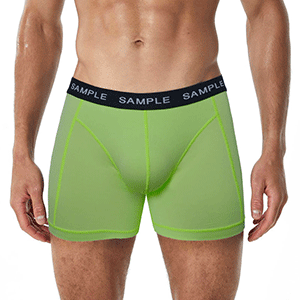
Part of Underwear Fabrics & Comfort in Finetex Talk — buyer questions answered by the Finetex editorial team.
A brand wants a seamless boxer brief and asks the factory to use modal yarn for softness. The factory recommends nylon instead.
Short answer: Seamless garments are knitted on specialised circular machines that place different structures in different zones. Nylon/elastane is common because it runs well, gives clear structure definition and good recovery. Cellulose yarns such as modal can be used, but they may run less efficiently and give less defined zoning. The best yarn depends on the machine, the design and the feel you want.
Why yarn matters more in seamless
In cut-and-sew underwear the fabric is chosen first; in seamless, the garment and fabric are made at once. Yarn determines how well rib, mesh and compression zones are defined, how the garment recovers and how stable the size is after washing.
Options
- Nylon/elastane: smooth, strong, good zoning and recovery.
- Polyester/elastane: often lower cost, good colourfastness when properly dyed.
- Modal or bamboo viscose blends: softer hand, sometimes less defined zoning.
Steps
- Ask which yarns the factory runs regularly on its seamless machines.
- Sample the design in two yarns and compare hand, zoning and recovery.
- Test shrinkage and pilling after washing.
Limits
Seamless designs have machine-specific constraints, so a yarn that works on one factory's machines may not work identically elsewhere.
Cost and minimums
Seamless production has different economics from cut-and-sew. Each design is programmed for a specific machine, and set-up, yarn dyeing and minimum quantities per colour can be higher. Yarn choice affects these too: dope-dyed or stock colours of nylon may be available with lower minimums, while custom-dyed cellulose yarns may require larger quantities. Discuss colour strategy together with yarn choice to avoid surprises in the quotation.
How seamless knitting differs
Seamless garments are knitted as a tube on circular machines with a small diameter, shaping the garment through stitch structure rather than cutting and sewing. The yarn has to run reliably at speed through many feeders and switch between structures such as jersey, rib and mesh in one piece. That is why seamless programmes usually rely on filament nylon or polyester covered or plated with elastane, sometimes with a softer fibre on the face for touch.
What to evaluate in samples
- Size stability after washing, because the tube can shrink or grow differently from cut-and-sew fabric.
- Recovery in high-stretch zones such as the waist and leg openings.
- Surface pilling in friction zones like the inner thigh.
- Visual consistency of mesh and texture zones from piece to piece.
A first sample can look perfect and still drift in bulk, so compare several pieces from the pre-production run.
Facts, recommendations and uncertainty
Established: seamless garments depend heavily on yarn and machine. Recommendation: follow the factory's proven yarns and sample alternatives. Uncertain: performance of unusual yarns until trial knitting.
Sources and further reading
- ISO 12945-2:2020 — Pilling, fuzzing or matting, modified Martindale method
- ASTM D4964 — Tension and elongation of elastic fabrics
- ISO 6330:2021 — Domestic washing and drying procedures for textile testing
Standards and regulations are referenced by their published scope. Test parameters, cycles and pass levels should be agreed with your laboratory for the specific product; legal requirements should be confirmed for each destination market.
Three more perspectives
Ask for the machine type, gauge and yarn proposal together, and request the minimum quantity per colour for each yarn option. Both machine set-up and yarn dyeing influence MOQ and lead time. Ask also whether garments are knitted from dyed yarn or knitted white and garment-dyed, because the route affects shade options, colour consistency and how quickly a new colour can be added.
Use zoning, mesh for ventilation and denser structures for support, to deliver comfort where it matters rather than relying on yarn softness alone. Keep the design within what the machine can knit reliably; very complex zoning increases rejects and cost. Discuss sizing early too, since seamless sizing is set by knitting programmes and tube size, and a range usually covers fewer sizes per programme than cut-and-sew.
Check size stability after washing on the first production pieces, as seamless garments can change size more than cut-and-sew garments. Measure several pieces per size from different machines if the order runs across more than one, since machine-to-machine variation is a known source of inconsistency. Record results against the approved sample and include them in final inspection.
Related products
Related articles
- Best nylon spandex seamless t shirts for running — Buyer's Guide
- Top 15 ODM Seamless Underwear Manufacturers for Professionals in 2026 — Buyer's Guide
- Seamless Men's Underwear: The Machine, the Minimum and the Honest Fit Trade-off
- Seamless Underwear for Online Brands: When It's Worth the Switch
- Which Fabric Is Best for Men's Underwear: Cotton, Modal, Bamboo or Nylon: A Manufacturer's Comparison
- Seamless Apparel Manufacturer China: Innovation, Technical Capabilities, and Global Market Leadership — Buyer's Guide
- What are the best seamless bonding methods and adhesives: How to Read the Lists (and What They Leave Out)
- How do bonded seams create a seamless look in techwear: A Manufacturer's Walkthrough
- Which Is China's Best OEM Seamless Activewear Factory for Women: A Manufacturer's Comparison
- Seamless T-Shirts: A Cost-Benefit Check for Online Sellers
← More in Underwear Fabrics & Comfort · All Talk topics · Ask us about your programme
More factory-floor notes for brand owners
Why did my reorder price go up?
Why an apparel reorder price can go up: fabric and trim costs, smaller quantities, specification changes, labour and…
Read more →
How do I read an underwear quotation line by line?
How to read an underwear quotation line by line: fabric, elastic and trims, labour, packaging, testing, overheads and…
Read more →
How do peak seasons affect apparel factory capacity?
How peak seasons and holidays affect apparel factory capacity and lead times, why fabric and shipping are also…
Read more →
Should I split one style across two factories?
Whether to split one apparel style across two factories: the benefits for capacity and risk, the risks for…
Read more →
What are the biggest risks on a small brand’s first order?
The biggest risks on a small brand's first apparel order, from unclear specifications and sample approval to payment,…
Read more →
What changes should a factory notify before production?
Which changes a factory should notify the buyer about before production, such as fabric, dye, trims, subcontracting or…
Read more →Request a sample & pricing information
Send us your tech pack, target price or a reference sample — we reply with a quotation, a realistic lead time and a fabric recommendation within one working day.
- Free sampling plan & cost breakdown
- MOQ from 300 pcs per style
- Reply within 1 working day