
How much shrinkage should I accept on cotton briefs in bulk production?
How to set and check a shrinkage tolerance for cotton briefs: what drives dimensional change, which test to agree, how to read results and where the…
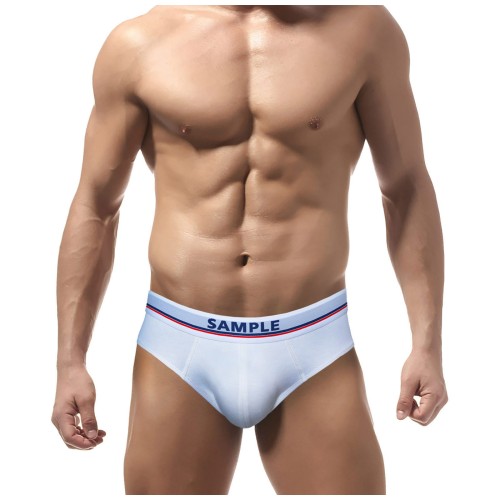
Part of Underwear Fabrics & Comfort in Finetex Talk — buyer questions answered by the Finetex editorial team.
A buyer is placing a first bulk order of combed cotton briefs. The approved sample fitted perfectly, but the buyer has heard that cotton "always shrinks" and wants a number to write into the purchase order.
Short answer: There is no single universal shrinkage figure for cotton briefs. The acceptable limit should be agreed between buyer and factory for the specific fabric, based on a named test method and washing procedure, and written into the purchase specification for length and width separately. What matters is that the limit is defined, tested on bulk fabric and reflected in the size chart.
Why cotton knit changes size
Cotton jersey and rib are stretched during knitting, dyeing and finishing. When the garment is washed and dried, part of that stretch relaxes and the fabric returns toward a more stable state, which shows up as shrinkage, usually more in length than width for a knit. Compaction and pre-shrinking finishes reduce this, but the amount varies by fabric and process.
What to agree
- Method: ISO 5077 describes how to determine dimensional change after washing and drying, with the wash and dry procedure taken from ISO 6330. Results are reported as a percentage for length and width, with a minus sign for shrinkage.
- Procedure: choose the wash temperature and drying method that matches your care label. A tumble-dry result and a line-dry result are not interchangeable.
- Number of cycles: one wash or several — state it.
- Tolerance: agree a figure for length and width for that fabric; your lab or the factory’s historical data for the same quality is the basis, not a number from another product.
How to apply it in bulk
- Test the bulk fabric before cutting, not just the sample fabric.
- Ask whether the pattern already allows for the measured shrinkage. Patterns can be graded to compensate, but only if the result is known before cutting.
- Re-check finished garments after washing at final inspection, measuring key points such as waist, leg opening and rise.
Risk limits
Elastic waistbands and leg bands behave differently from the body fabric, so a body-fabric result does not cover the whole garment. Garment-dyed products follow a different sequence and need measurements after dyeing. If a care-related promise such as "pre-shrunk" is used in marketing, keep the test report that supports it.
Facts, recommendations and uncertainty
Established: knitted cotton relaxes when washed and the change can be measured. Recommendation: agree method, procedure and tolerance per fabric. Uncertain: any figure quoted without the test conditions behind it.
Sources and further reading
- ISO 5077:2007 — Determination of dimensional change in washing and drying
- ISO 6330:2021 — Domestic washing and drying procedures for textile testing
- U.S. FTC — Care Labeling Rule (16 CFR Part 423)
Standards and regulations are referenced by their published scope. Test parameters, cycles and pass levels should be agreed with your laboratory for the specific product; legal requirements should be confirmed for each destination market.
Three more perspectives
Write the method, procedure and tolerance into the purchase order rather than "low shrinkage". Without a written basis, a disagreement after delivery becomes opinion against opinion.
If the brand insists on tumble-dry care, consider a fabric with a more stable finish or a blend with modal or elastane, and adjust the pattern allowance after the first bulk fabric test. The main answer assumes 100% cotton; blends need their own tests.
Measure the same points in the same way every time: relaxed, flat, after conditioning. Inconsistent measuring technique produces "shrinkage" that is really measurement error.
Related products
Related articles
- Cotton Undershirt Supply: Combing, Count and What Actually Stops Shrinkage
- Global Apparel Sourcing Outlook 2026: Cotton, Freight and Supply-Chain Risk
- Organic Cotton T-Shirt Manufacturing in China: The Certification and the Cost Premium
- Organic Cotton Underwear: Building the Chain of Custody Before You Write the Claim
- Cotton Underwear Manufacturing: Choosing the Cotton That Decides Comfort and Reorder Rate
- Which Fabric Is Best for Men's Underwear: Cotton, Modal, Bamboo or Nylon: A Manufacturer's Comparison
- Cotton Fleece vs Polyester Fleece: Which Fabric Is Best — A Technical and Performance Buyer's Guide
- What Is Cotton Polyester Fabric and Why Is It Popular: A Production-Side Explanation
- Who are the top cotton underwear manufacturers: How to Read the Lists (and What They Leave Out)
- Is Polyester or Cotton Warmer? The Ultimate Textile Engineering & Performance Guide: What the Evidence Shows
← More in Underwear Fabrics & Comfort · All Talk topics · Ask us about your programme
More factory-floor notes for brand owners

What should I check on a novelty hoodie such as an eye-mask hood?
What to check on a novelty hoodie such as an eye-mask hood: hood structure and lining, visibility and…
Read more →How should I size a unisex hoodie?
How to size a unisex hoodie: choosing a base block, body measurement ranges, ease, sleeve and body length,…
Read more →What care instructions should a hoodie carry?
What care instructions a hoodie should carry: the elements of a complete washing instruction, warnings for prints and…
Read more →
How do I match colour across hoodie and jogger sets?
How to match colour across hoodie and jogger sets: same fabric lot, rib and trims, dyeing method, shade…
Read more →How many colourways can I order at hoodie MOQ?
How many colourways a hoodie order can include at MOQ: how factories set minimums per style, colour and…
Read more →Why does a dark hoodie stain other clothes?
Why dark hoodies stain other clothes: dye bleeding in washing, rubbing transfer, perspiration, unfixed dye and pigment, and…
Read more →Request a sample & pricing information
Send us your tech pack, target price or a reference sample — we reply with a quotation, a realistic lead time and a fabric recommendation within one working day.
- Free sampling plan & cost breakdown
- MOQ from 300 pcs per style
- Reply within 1 working day